Best Adverse Media Screening Software in 2026

Adverse media screening has moved from a nice-to-have to a non-negotiable. Regulators across the EU, UK, and US have raised expectations for continuous due diligence, and financial institutions, fintechs, and procurement teams are under growing pressure to detect risk before it is exposed, not after.
But the market is crowded. Between legacy compliance giants, AI-native startups, and everything in between, choosing the right platform comes down to a few critical questions: Does the tool consolidate structured and unstructured data? Does it reduce false positives, or just add to the noise? Does it monitor continuously, or only screen at onboarding?
This guide helps you identify features to look for and gives an overview of five adverse media screening software vendors in 2026.
What good looks like right now
The risk function has changed. Portfolios are bigger, regulatory expectations are higher, and headcount hasn’t kept pace with either. The old model, periodic manual screening, isolated alert reviews, and separate tools for sanctions and adverse media, simply doesn’t scale.
What the best platforms have figured out is that the goal isn’t more data. It’s better intelligence. That means:
- Monitoring continuously, not just at onboarding, an entity clean today may be sanctioned or implicated in fraud tomorrow.
- Consolidating structured data like sanctions lists and PEP databases with unstructured data like adverse media and regulatory filings into a single view, rather than forcing analysts to synthesise across separate tools.
- Risk scores that come with clear reasoning, so decisions are defensible and audit trails are straightforward.
- Integrating into existing workflows rather than adding yet another siloed interface. The tools that deliver on all of this are the ones worth talking about.
Top five adverse media screening software companies
1. Owlin
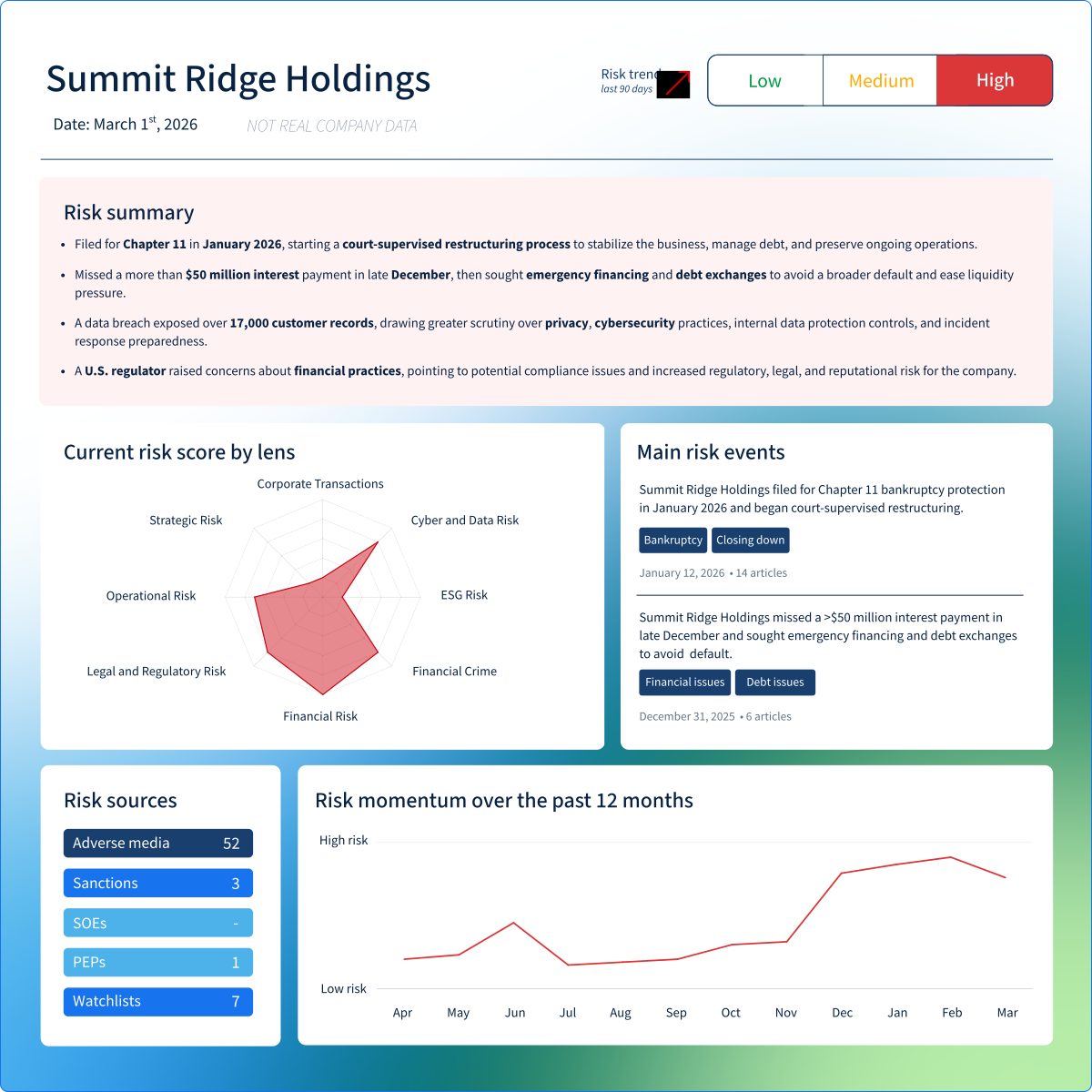
Owlin is the standout platform in 2026 for organizations that need more than raw alert volumes. It organizes everything into risk events — consolidated, contextualized narratives that bring together all relevant information for a single development.
When something happens involving an entity you’re screening, you don’t get twenty separate articles from twenty different sources. You get one coherent picture: what happened, how it developed over time, and why it matters for that entity’s risk profile. It’s a small conceptual shift with a large practical impact, especially for teams managing large portfolios.
What also sets Owlin apart is how it treats the boundary between structured and unstructured data, or rather, how it doesn’t. Sanctions lists, PEP databases, adverse media, company filings, and consumer complaints, in most risk stacks, these live in different tools and require manual synthesis. In Owlin, they surface together, in context, as part of the same entity view. The result is that analysts spend less time aggregating information and more time making decisions.
Risk is also rarely black and white. An entity linked to a past regulatory fine looks very different from one actively under investigation. Owlin’s explainable risk scores reflect that nuance; every score comes with clear reasoning across risk dimensions including financial crime, ESG, sanctions, cyber, and going concern. That explainability matters both for internal decision-making and for demonstrating a defensible process to regulators.
Key capabilities:
- Event-based intelligence: multiple signals across sources grouped into single, verified risk events with timelines and context
- Explainable risk scores: clear reasoning across financial crime, sanctions, ESG, cyber, and going concern lenses
- Owlin OmniSignal: a unified data view of adverse media, sanctions, PEPs, watchlists, SOEs, filings, and consumer complaints in one entity profile
- Continuous monitoring: 24/7 surveillance across 3 million+ sources in multiple countries, with real-time alerts on new developments
- API-first architecture: embeds into existing onboarding, case management, and TPRM workflows
See how it works for your team
Owlin supports over 1,000 organizations worldwide across financial services, payments, insurance, and procurement.
2. LSEG World-Check (Refinitiv)
World-Check has been a fixture of compliance programs for decades, and for good reason. Its database runs deep, millions of curated profiles spanning sanctions, PEPs, and watchlists, with the institutional credibility that large banks and their regulators have come to expect. It’s a known quantity, which in risk carries real value.
3. LexisNexis Risk Solutions
LexisNexis brings decades of aggregated legal, news, and public records into risk screening. Historical depth is unmatched, and entity resolution is robust. Well-suited to large enterprises; smaller teams often find it resource-intensive. The pace of AI-native innovation is slower than purpose-built adverse media platforms.
4. ComplyAdvantage
ComplyAdvantage built its own risk database from primary sources rather than licensing it from third parties, a meaningful differentiator in terms of data freshness. Real-time ingestion, dynamic risk scoring, and clean API integration make it popular with fintechs. Adverse media coverage is strong for English-language markets; contextualization of events is less developed than specialized platforms.
5. Dow Jones Risk & Compliance
Dow Jones produces its adverse media data editorially, drawing on its investigative journalism heritage and the Factiva archive. For organizations where source provenance is the top priority, this is compelling. Integration and usability are more variable, and pricing sits at the higher end of the market.
The shift that defines 2026
For most of the last decade, “adverse media screening” meant keyword searches against news databases. The problem was never a lack of data; it was a lack of intelligence. Analysts received volume, not insight, and the burden of synthesis sat entirely with them.
The platforms leading in 2026 have moved the work upstream. Rather than asking risk teams to sort through hundreds of alerts and piece together a picture, they deliver the picture: organized, contextualized, and explainable. The best of them have also stopped treating structured data (sanctions, PEPs) and unstructured data (news, filings) as separate problems, because risk doesn’t respect that distinction.
Owlin’s approach reflects where the market is heading. For risk functions that need to scale oversight without scaling headcount, it represents the most coherent answer to how adverse media screening actually works in practice.