Screen and Monitor Vendor Risk with Owlin’s AI-Powered Vendor Risk Management Tools
Enjoy peace of mind with Owlin’s robust vendor risk screening and monitoring solutions
that provide you with risk insights that matter.
Tracking third-party risks is a growing challenge.
With vendors spread across regions and industries, manual processes can’t keep up. Security breaches, compliance issues, and reputational damage often emerge without warning, leaving businesses vulnerable. In today’s fast-paced world, waiting for problems to escalate is no longer an option—you need a proactive, real-time solution.
Actionable insights
Get clear, explainable risk scores and AI-powered summaries—no black box, just transparent insights to help you confidently assess vendor risks.
Enhance compliance
Ensure regulatory compliance with automated due diligence and continuous vendor monitoring—helping you identify vendor risks early.
Integrate seamlessly
Connect Owlin’s insights with your existing procurement, risk, and compliance systems, embedding real-time vendor risk intelligence into your workflows.
Scalable solution
Adapt to growing vendor ecosystems with a solution built for scale. Owlin enables efficient monitoring of large vendor portfolios without adding operational strain.
Powerful tools for proactive vendor risk management
Screening across databases
Owlin’s AI-powered adverse media screening solution enables companies to identify potential risks from the very beginning. Vendor onboarding shouldn’t take 60–120 days: with comprehensive analysis across global media sources, procurement, compliance, and risk teams can evaluate new vendors before onboarding and clear them faster, without cutting corners on due diligence. Our solution helps mitigate costly mistakes and reduces the need for time-intensive manual processes.
Ongoing vendor risk monitoring
Vendor risks don’t end after initial screening. Owlin provides continuous monitoring with real-time alerts on adverse media and consumer reviews. This proactive approach enables you to stay ahead of risks, helping to protect your business and vendor relationships from unexpected disruptions.
Effortless setup and customization
Owlin’s platform is built for ease of use and flexibility. Quickly configure alerts and customize your vendor portfolios to meet your unique risk management needs. This ensures you can stay agile and responsive without unnecessary complexity.
Actionable risk insights
from a network of structured and unstructured sources
Owlin enhances efficiency and reduces manual work by checking multiple databases simultaneously for vendor risk.
Adverse media
Identify negative news about vendors from over 3 million sources in multiple languages, providing early alerts on potential risks.
Consumer reviews
Monitor consumer feedback 24/7 to spot emerging issues at vendors before they escalate.
Sanctions data
Ensure compliance by flagging entities and individuals listed on global sanctions lists during the onboarding stage.
Politically Exposed Persons (PEP) Data
Assess risks associated with individuals holding political ties, highlighting potential corruption or influence concerns.
State-Owned Enterprises (SOEs) Data
Support thorough due diligence by verifying if a potential vendor is affiliated with government entities.
Watchlist
Monitor individuals and entities flagged by regulators to identify compliance and financial crime risks.
Blacklist
Identify sanctioned and high risk entities to prevent fraud and compliance breaches.
All insights are delivered
the ways that works for you
Dashboard
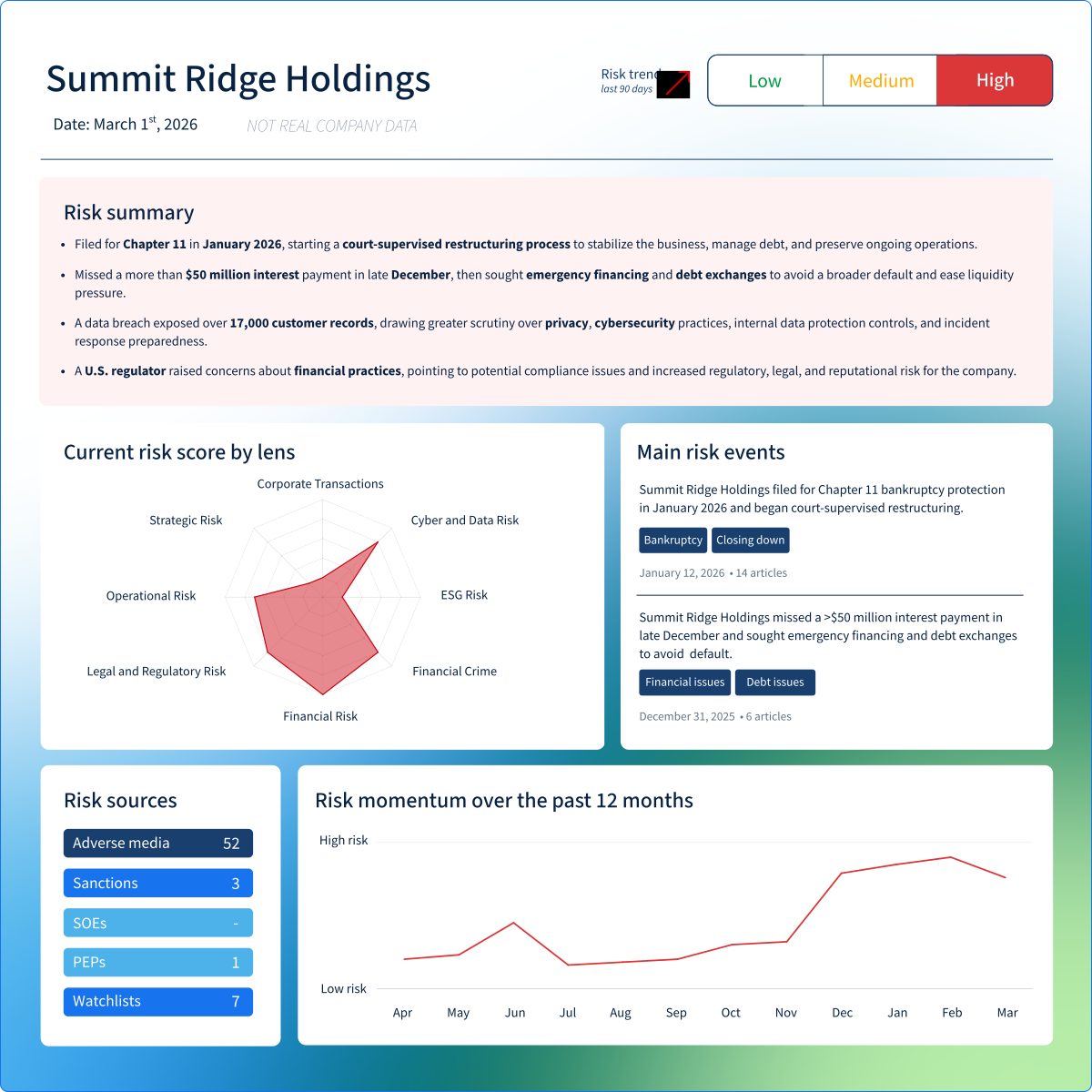
Get a clear overview of vendor risk at a glance. Our intuitive dashboard structures risk events into actionable insights, helping you focus on what matters most.
API / Integrations
Seamlessly integrate Owlin’s risk intelligence into your existing workflows. Get real-time updates where you need them—no extra steps required.
Email Alerts
Alerts built around what matters to you, landing directly in your inbox.
Trusted by industry leaders
Discover how top companies successfully mitigate vendor risk with Owlin’s intelligent vendor risk assessment tools.
Enjoy peace of mind with Owlin
Owlin proactively screens and monitors vendors, identifying potential issues early—so you stay informed and in control.
Owlin blog
Stay informed with the latest Owlin innovations, industry partnerships, and key updates.
Your Questions, Answered
Yes. Every stage retains its underlying evidence and reasoning, so any rejection, merge decision, or risk score can be reconstructed and explained. This supports supervision models that test whether an alert firing or being dismissed was reasonable and documented.
No records are deleted. Rejected records remain traceable, and non-elevated events stay on the entity’s timeline and remain searchable. Filtering operates across three independent dimensions: entity accuracy, duplication, and materiality, so a record is only kept out of the queue for a specific, recorded reason.
Alert fatigue occurs when review volume exceeds the capacity to review it meaningfully, so genuine risk gets the same attention as noise. Owlin addresses it by filtering before the analyst rather than after, separating entity mismatches, duplicate coverage, and immaterial events into three distinct steps, so 99.4% of intake never reaches the queue. Notifications are then tied to a change in risk level rather than to an event simply existing.
Events are scored on materiality and severity against Owlin’s risk taxonomy, in the context of the specific entity. Events that don’t meet the elevated threshold remain on the entity timeline for investigation but don’t enter the review queue. Notification is then tied to a change in the company’s overall risk level rather than to the existence of an event.
0.61%. For a portfolio of 150 monitored companies screening 95,000 records a year, 580 become elevated-risk events requiring analyst attention: a 99.4% reduction in review volume, or one elevated-risk event per 164 records screened.
Owlin filters in three sequential steps. A relevance step verifies entity match and risk relevance, rejecting 73.5% of screened records before they become events. A deduplication step merges related coverage into single developments, cutting what remains to 6% of intake. A scoring step identifies which developments are materially elevated, leaving 0.61%. On top of that, notifications are tied to a change in a company’s risk level rather than to an event simply existing.
Closed data vendors build their coverage from licensed, curated source lists that get refreshed on a set schedule, often daily or weekly. That structure works well for regulated, high-volume sources like sanctions lists and court records. Still, it creates a gap: risk signals from local news, regional outlets, NGO reports, or non-English sources often surface days or weeks after the event, if they’re picked up at all.
Owlin works from an open universe of sources rather than a fixed license list, and processes them continuously rather than on a refresh cycle. For a compliance analyst tracking a mid-size supplier base, this shows up as earlier detection: an event first reported in a regional or non-English outlet can be flagged the same day it appears, instead of surfacing only once it reaches a licensed wire service. In practice, teams monitoring vendors with thin data footprints, smaller suppliers, private companies, and emerging markets see the biggest gap close, since these are exactly the entities closed databases cover most thinly.
The takeaway: closed data vendors are strongest on structured, well-documented sources; Owlin is built for the events that happen before those sources catch up.
GRC platforms are workflow and governance systems. They manage policies, control frameworks, task assignment, and audit trails, but they don’t generate risk signals on their own; they depend on data fed in from elsewhere. A GRC platform can tell a TPRM analyst which vendor review is overdue, but it has no independent way of knowing that a supplier was just named in a labor violation report or a sanctions investigation.
Owlin sits upstream of that: it’s the intelligence layer that detects and structures external risk events, adverse media, sanctions exposure, ESG controversies, and pushes them into the GRC platform’s existing workflow, rather than replacing it. For a bank running vendor reviews through its GRC system, this means new adverse media events on a vendor can trigger a workflow item automatically, instead of a manual periodic check missing a story that broke between review cycles. One team monitoring several thousand vendors cut non-actionable alerts by roughly a third after moving from periodic manual checks to event-based monitoring feeding directly into their existing GRC workflow.
The takeaway: GRC platforms govern the process; Owlin supplies the external signals the process runs on. One doesn’t work as well without the other.
Manually tracking vendor risks across multiple sources and languages is challenging. AI-powered solutions, like Natural Language Processing (NLP), automate this process by continuously scanning global news, adverse media, regulatory updates, and more. This ensures organizations can efficiently monitor multiple vendors in real time and uncover critical insights that might otherwise be missed.
Proactive vendor monitoring helps organizations mitigate risks across compliance, reputation, operations, and finances. By staying informed about potential red flags, businesses can make confident, data-driven decisions to protect their interests and maintain strong, secure vendor relationships.
Vendor Risk Monitoring is the continuous assessment of your vendors to identify potential risks that could impact your organization. It is a key component of a comprehensive vendor risk management strategy, helping businesses stay ahead of emerging threats.
Screen and monitor vendor risk with Owlin
Owlin makes sure you are aware of risk events at vendors before they impact your business.