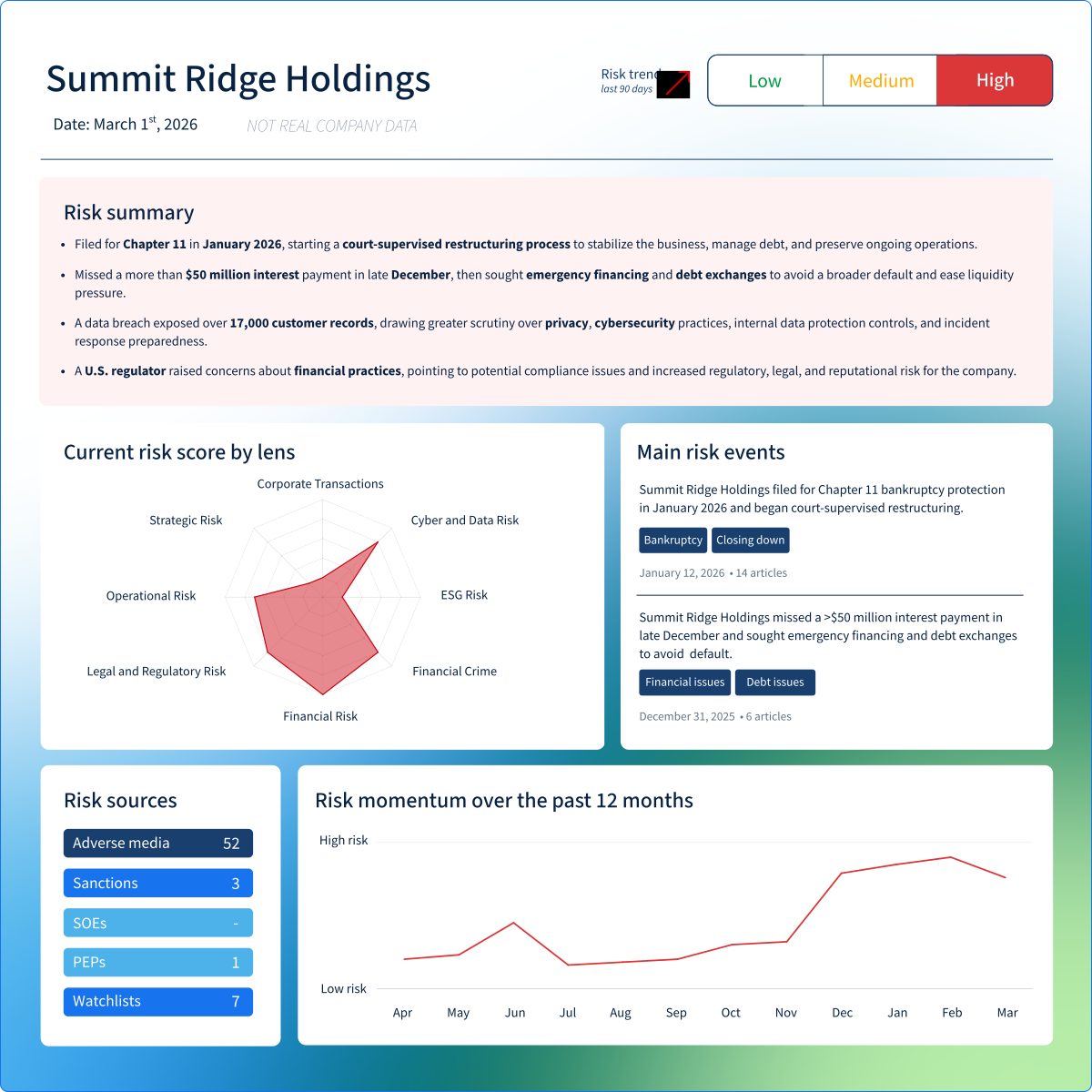
What to Do to Improve the Quality of Your AI-Powered Adverse Media Risk Assessments

Modern risk management increasingly relies on automated systems to monitor external risks, such as adverse media coverage. Whether used for onboarding, ongoing monitoring, or periodic reviews, these systems help organizations stay ahead of financial, operational, and reputational risk. But as these systems scale, a familiar problem emerges: low-quality alerts and false positives.
A false-positive alert, or low-quality alert, occurs when a system flags a company or news article as risky, even though the underlying information is not materially relevant. At scale, these false positives become more than an inconvenience; they become a structural inefficiency.
Why low-quality alerts are a growing challenge for AI-powered adverse media risk assessments
When automated adverse media monitoring systems generate too much noise, they create drag across the entire risk or compliance review process:
- Analysts spend time reviewing irrelevant alerts
- Onboarding and periodic review processes slow down
- Operational costs increase across compliance and risk teams
- Alert fatigue reduces overall decision quality
- Truly important risk signals become harder to identify
In short, when everything is flagged, prioritization breaks down. Improving this is not just about tuning thresholds; it requires improving how systems understand what they are looking for: companies, people (names), context, and risk signals. At Owlin, we specialize in leveraging AI for risk intelligence, and in this blog, we share five practical ways organizations can improve the quality of automated company risk assessments.
1. Use LLMs as training data multipliers for risk models
One of the biggest constraints in building effective risk assessment systems is the availability of high-quality labeled data. Manual classification of company risk signals is slow, expensive, and often inconsistent across teams. Large language models (LLMs) can help scale this process. Instead of relying solely on manual labeling, LLMs can be used to:
- Expand small labeled datasets into larger training sets
- Generate synthetic examples of different risk scenarios
- Pre-classify ambiguous cases for human validation
- Standardize labeling logic across teams
This approach allows organizations to multiply the value of existing expert knowledge, rather than replacing it. Smaller, specialized models can then be trained on these enriched datasets, improving both efficiency and consistency in screening outcomes. The result is a system that scales learning, not just processing.
2. Improve training data quality with multi-model approaches
Single-model decisions can struggle in complex or ambiguous risk scenarios, where interpretation matters as much as classification. Therefore, a more robust approach is to use multiple models evaluating the same company or signal independently. Each model provides a risk assessment based on the same input, and the final decision is derived through cross-validation/majority voting. This improves system reliability in several ways:
- Let’s human annotators spot and resolve ambiguities
- Reduces dependence on a single model’s blind spots
- Improves stability across edge cases
- Supports more explainable decision-making
As risk environments become more complex, ensemble approaches offer a scalable way to improve both accuracy and confidence in AI-assisted assessments.
3. Keep company data fresh with continuous enrichment
A major source of poor (at scale) adverse media risk-monitoring and screening outcomes is not the model itself, but the data it operates on. Company information becomes outdated quickly, and static datasets lead to flawed interpretations, such as:
- Misclassification due to old business structures
- Missing recent acquisitions or divestments
- Incorrect industry or geographic assumptions
- Failure to capture renamed or restructured entities
To address this, organizations need continuous data enrichment pipelines, ideally supported by AI-powered automation. This includes:
- Updating company profiles with new attributes over time
- Tracking ownership and corporate structure changes
- Maintaining up-to-date industry classifications
- Capturing evolving operational footprints
Fresh, accurate entity data ensures that risk assessments are grounded in reality rather than historical snapshots.
4. Strengthen entity resolution with richer company context
Many false positives in risk screening and monitoring systems stem from a single core issue: weak entity identification. When systems rely on simple name matching or incomplete company lists, ambiguity is inevitable. This becomes especially problematic when:
- Companies share similar names across regions
- Subsidiaries and parent companies are not linked
- Brands operate under multiple legal entities
- External data sources use inconsistent naming conventions
Improving this requires moving beyond name matching toward context-rich entity resolution.
Strong entity resolution systems incorporate:
- Legal entity names and aliases
- Corporate hierarchies (parent, subsidiary, affiliate relationships)
- Industry and sector metadata
- Geographic and operational context
- Historical identity changes
The more context a system has, the better it can distinguish between genuinely relevant signals and coincidental matches. In adverse media risk monitoring and screening, identity clarity is foundational to the quality of decisions.
5. Use fine-grained risk taxonomies instead of binary scoring
A common limitation in automated risk assessments is the tendency to reduce complex signals into a single binary outcome: risk or no risk. This oversimplification often leads to unnecessary alerts and poor prioritization. A better approach is to use a fine-grained risk taxonomy, where different types of risk are evaluated separately, such as:
- Financial instability indicators
- Regulatory or compliance concerns
- Ownership and control risks
- Operational disruption signals
- Reputation-related indicators
- ESG or governance-related concerns
Each category is assessed individually, then aggregated into a broader risk profile. This approach has two key advantages: it reduces over-triggering from unrelated or low-impact signals, and it improves transparency in why a company was flagged. Equally important is defining clear boundaries between automated assessment and human review, ensuring that not all signals are treated with the same level of urgency. This leads to more structured, defensible, and scalable risk decisions.
Bringing it together: from screening to intelligent risk assessment
Improving automated company risk assessments is not about a single model upgrade or a better threshold. It requires a system-level shift across multiple dimensions. When combined correctly, these improvements reduce noise while increasing the quality of signals that matter.
At Owlin, this reflects a broader shift we are seeing across the industry: from reactive alert processing toward context-aware, intelligence-driven company risk monitoring. And in that shift, improving the quality of risk assessments is not just about efficiency; it is about enabling better, faster, and more confident risk decisions.
See it yourself
Improving adverse media risk assessments starts with reducing noise and increasing context. See how Owlin helps risk teams identify relevant signals faster and with greater confidence.