Owlin vs ComplyAdvantage: Adverse Media Compared (2026)

Put Owlin and ComplyAdvantage on the same shortlist, and at first glance they look interchangeable. Both screen for adverse media, use AI to cut noise, and promise faster, more defensible compliance decisions.
Look closer, though, and they solve different problems. ComplyAdvantage built its adverse media data for AML and KYC: checking customers against a financial crime database at onboarding and afterward. Owlin built its platform for third-party risk: screening companies in one click at onboarding, then continuously monitoring them for any development that changes their risk.
This comparison lays out where each platform fits, so you can match the tool to the job rather than to a feature list.
The short answer
Choose ComplyAdvantage if you need adverse media as one part of an AML stack for screening customers, both individuals and businesses, alongside transaction monitoring and payment screening.
Choose Owlin if you need to screen and monitor companies, such as vendors, merchants, counterparties, or suppliers, whether that’s a one-time check at onboarding or continuous monitoring afterward, and you care about risks beyond financial crime, including insolvency, cyber incidents, operational disruption, and ESG.
The two can also work side by side: one for customer AML screening, the other for company-level risk.
Owlin vs ComplyAdvantage at a glance
| Owlin | ComplyAdvantage | |
|---|---|---|
| Built for | Third-party, vendor, merchant, and counterparty risk, plus KYB | AML/KYC screening of customers |
| One-time screening | One-click screening of any company with an online footprint, including historical adverse media | Customer and company screening against curated risk profiles |
| Ongoing monitoring | Continuous: related articles and records merge into events, and events feed a live company risk profile | Ongoing rescreening against a curated adverse media database |
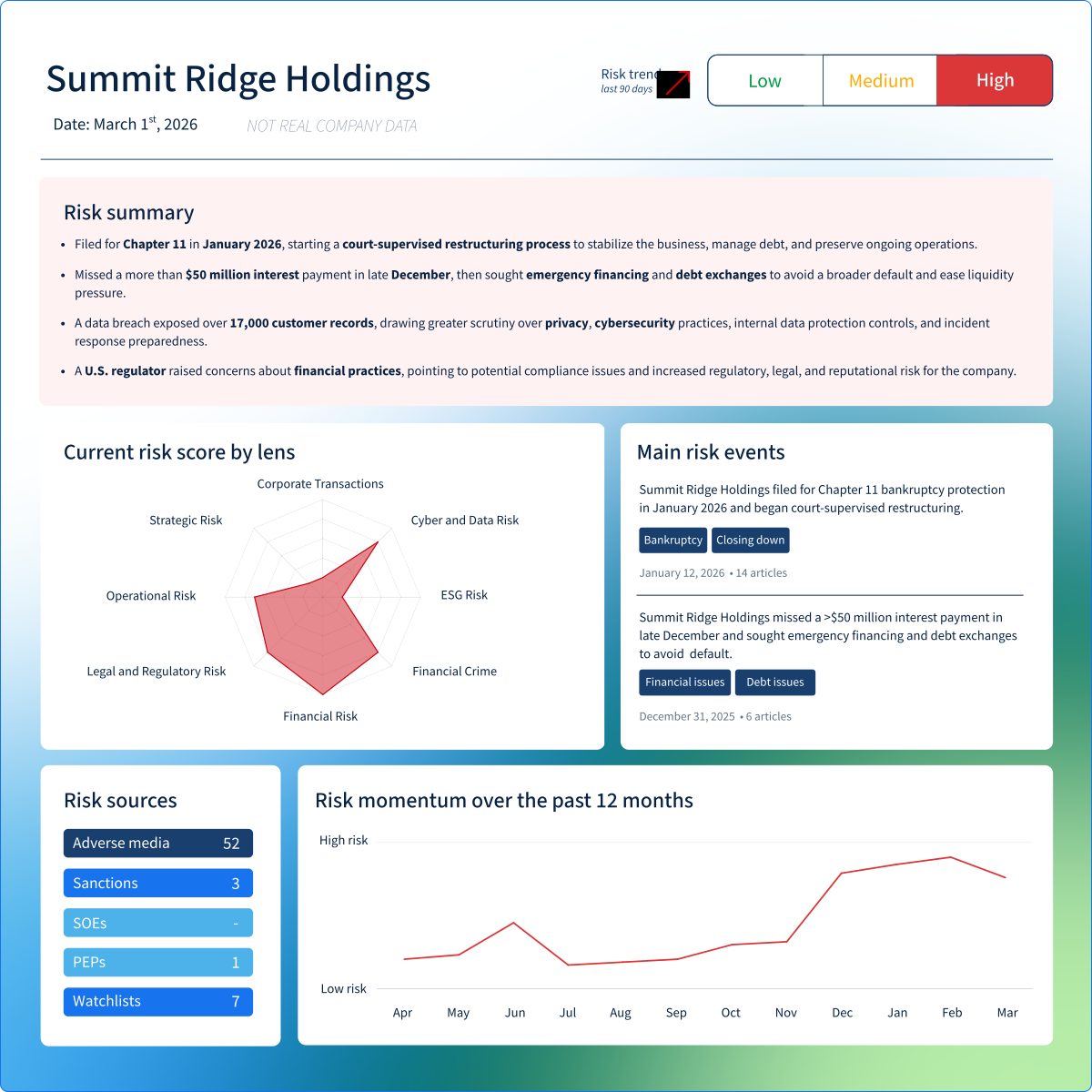
| Risk profile | AI-generated summary of key risk drivers, current risk level across eight risk lenses, and a one-year risk momentum graph | Curated profiles with identifying details such as images, date of birth, and location, plus article snippets |
| Source coverage | 3M+ sources, including news, regulatory, and corporate sites, monitored 24/7 | 11,000+ verified media sources in 200+ countries |
| Data freshness | Continuous, with alerts in minutes | Adverse media database updated daily, per its FAQ |
| Risk scope | Eight risk lenses, from financial crime to cyber and ESG | Primarily financial crime and predicate offenses |
| Noise reduction | Relevance filtering, deduplication, scoring, and change-based alerts | Contextual filtering, name commonness matching, and agentic alert triage |
| Also covers | Sanctions, PEPs, SOEs, watchlists, blacklists, and filings | Sanctions, PEPs/RCAs, transaction monitoring, payment screening, and fraud detection |
What is ComplyAdvantage?
ComplyAdvantage is a RegTech company founded in London in 2014 that helps financial institutions, fintechs, and payments companies detect financial crime. Its platform, Mesh, pulls together data from public media, watchlists, enforcement lists, and corporate registries. Adverse media sits inside its financial crime risk intelligence layer, next to sanctions and PEP data.
According to ComplyAdvantage, its adverse media data draws on more than 11,000 verified national, regional, and local media sources across over 200 countries and territories. Analysts review curated profiles that include context such as images, date of birth, location, and article snippets.
What is Owlin?
Owlin is an AI-powered risk intelligence platform that helps financial institutions, including banks, payment service providers, private equity firms, and asset managers, screen and monitor companies for external risk. It monitors more than 3 million sources around the clock and delivers alerts in minutes rather than days. Major financial institutions across the US and Europe rely on Owlin, and Chartis has named it a Category Leader for Adverse Media Monitoring three years running, in 2024, 2025, and 2026.
Owlin covers both stages of a third-party relationship. With Owlin Screening, you can run a one-click check on any company with an online footprint, even ones missing from traditional company databases, and see its historical adverse media, sanctions, PEP, and watchlist exposure.
Instead of returning a list of matching articles, Owlin groups related coverage into single events and shows how each one unfolds on a chain-of-events timeline. Those events then feed a company risk profile: an AI-generated summary of the key risk drivers, a current risk level for each of eight risk lenses, and a graph of how risk has moved over the past year. Because Owlin measures every company on the same axis, you can compare risk across your whole portfolio at a glance.
Who each platform is built for
This is the difference that shapes everything else.
ComplyAdvantage starts from the customer. You onboard a person or business, screen the name against sanctions, PEPs, and adverse media, and keep rescreening throughout the relationship. That workflow fits retail banks, fintechs, crypto firms, and anyone with a high volume of customer onboarding.
Owlin, on the other hand, starts from the company. You screen a new vendor or merchant before you sign, then add it to a portfolio to monitor it continuously. That matters because a third party that’s clean at onboarding can be heading toward insolvency, a fraud scandal, or a data breach six months later. In practice, Owlin fits TPRM, vendor risk, supplier risk, merchant risk, and counterparty monitoring, especially under frameworks like DORA and PSD3.
That portfolio focus shows up in the product itself. Owlin’s Risk Prioritization Monitor groups every company you track by high, medium, and low risk. Within each group, it sorts companies by risk momentum, so the ones with the most recent significant events always appear first. As a result, your team starts each day knowing exactly where to look.
Coverage and speed
Both platforms cover global news, but they collect it differently.
ComplyAdvantage curates. It vets each source against its own criteria and builds structured risk profiles on top. That approach produces clean, matchable records for AML screening, and its adverse media FAQ states that the database is updated every day.
Owlin monitors continuously. It scans millions of news, regulatory, corporate, and other sources 24/7, with no batch updates. That matters for third-party risk, where early warning is the whole point. A restructuring rumor in a regional outlet often appears days before it reaches international headlines or an official register. When a story breaks in a local outlet, analysts can also read the article in its original language, next to the source and any other outlets that carried it.
Risk scope: financial crime vs the full risk picture
ComplyAdvantage focuses its adverse media primarily on financial crime. Its models aim to uncover connections to predicate offenses in line with regulatory standards. For AML compliance, that focus is exactly right.
Third-party risk, though, rarely starts with money laundering. More often, a vendor goes bankrupt, suffers an outage, or ends up in an environmental scandal. That’s why Owlin organizes signals into eight risk lenses:
- Financial crime
- Financial risk
- Legal and regulatory risk
- Cyber and data risk
- ESG risk
- Operational risk
- Strategic risk
- Corporate transactions
As a result, one platform covers the risks behind DORA, CSDDD, the German Supply Chain Act, and PSD3, not only AML.
False positives and alert noise
Both vendors take noise seriously. They just attack it at different points.
ComplyAdvantage filters at the match level. It uses name commonness matching and contextualized data to screen out irrelevant hits, and its agentic workflows aim to resolve up to 85% of routine alerts autonomously.
Owlin filters at the event level, in four steps:
- Relevance removes wrong-entity matches and mentions with no risk signal.
- Deduplication merges coverage of the same development into one event.
- Scoring identifies which events actually move the risk picture.
- Change-based alerts notify you when a company’s risk level shifts, rather than every time a new article appears.
In one real portfolio, 150 monitored companies produced 95,000 screened records over a year, and only 580 of them surfaced as elevated-risk events: a 99.4% reduction in review volume. Importantly, Owlin deletes nothing along the way, so filtered records stay retrievable with the reason they were set aside.
Explainability and audit trails
Regulators increasingly ask why an alert fired, and why your team closed it. Both vendors now answer that question.
ComplyAdvantage describes its platform as configured for enterprise volumes with enhanced explainability. Owlin builds explainability into every score. Each risk level comes with an AI-generated summary of what drives it, and every event links back to its original sources, whether a news article, a sanctions list, or a PEP record. This follows Owlin’s Responsible Intelligence principles: evidence before AI, explainable by design, and humans in control of every decision.
When to choose ComplyAdvantage
- You screen individual customers at onboarding and need PEP and RCA data.
- Adverse media forms one part of a wider AML program that also needs transaction monitoring and payment screening.
- You mainly care about financial crime and predicate offenses.
When to choose Owlin
- You need to screen new vendors, merchants, or counterparties before onboarding, and continuously monitor them afterward.
- You monitor a portfolio of companies: vendors, merchants, counterparties, suppliers, or portfolio companies.
- You need early warning on risks beyond financial crime, such as insolvency, cyber incidents, and ESG controversies.
- Your team struggles with duplicate alerts and needs one event per development, not one alert per article.
- You need explainable, evidence-backed risk profiles to defend decisions under DORA, CSDDD, or PSD3.
Can you use Owlin and ComplyAdvantage together?
Yes. The two platforms overlap on company-level AML: Owlin screens and monitors businesses for sanctions, PEP, and financial crime exposure, which supports KYB, perpetual KYC, enhanced due diligence, and ongoing AML monitoring. Where they differ is scope. ComplyAdvantage extends into individual customer screening and transaction monitoring, while Owlin extends into the risks that sit outside financial crime, such as insolvency, cyber incidents, and ESG controversies.
So a bank might run ComplyAdvantage for retail customer screening and transaction monitoring, and use Owlin for KYB, third-party risk, and continuous monitoring of the companies it works with.
See how Owlin monitors a company you care about
Run a free check and see the risk events, evidence, and scoring behind one of your third parties. Three-time Chartis Category Leader for Adverse Media Monitoring.
Frequently asked questions
What is the main difference between Owlin and ComplyAdvantage?
ComplyAdvantage focuses on AML and KYC screening of customers against sanctions, PEP, and adverse media data. Owlin focuses on companies, such as vendors, merchants, and counterparties, with one-click screening at onboarding and continuous monitoring across eight risk lenses that go beyond financial crime.
Is Owlin a ComplyAdvantage alternative?
For company-level screening and monitoring, including KYB, ongoing AML monitoring, and third-party risk, yes. If you also need to screen individual customers or monitor transactions, the two platforms work well side by side.
Can Owlin be used for one-time screening, or only for monitoring?
Both. Owlin Screening runs a one-click check on any company with an online footprint, including historical adverse media, sanctions, PEPs, and watchlists. You can use it on its own for onboarding checks, or add the company to a portfolio for continuous monitoring.
Does Owlin support perpetual KYC?
Yes, for business customers. Instead of reviewing each company on a fixed one-, two-, or three-year cycle, Owlin continuously monitors adverse media, sanctions, PEPs, and watchlists, and alerts you when a company’s risk level changes. That change becomes the trigger for a review, so your team spends time on the companies that need it. ComplyAdvantage also offers perpetual KYC as part of its ongoing monitoring.
How do Owlin and ComplyAdvantage reduce false positives?
ComplyAdvantage filters irrelevant hits at the name-match level and uses agentic workflows to resolve routine alerts. Owlin filters for relevance, merges duplicate coverage into single events, scores materiality, and alerts you when a company’s risk level changes rather than for every new article.
Which is better for third-party risk management, Owlin or ComplyAdvantage?
Owlin is the stronger fit for third-party risk. It screens and continuously monitors companies across eight risk lenses, including financial distress, cyber, operational, and ESG risk, and it groups coverage into single risk events. ComplyAdvantage focuses on financial crime screening for customers, which makes it better suited to AML and KYC onboarding.