Top Adverse Media Monitoring Tools in 2026: 9 Questions to Ask Before You Choose

Ask a handful of risk or compliance leads what frustrates them most about their current setup, and you’ll hear a short list of the same answers: reviews go stale the moment they’re filed, research eats hours chasing down scattered sources, nobody fully trusts a score they can’t explain, and the sheer volume of alerts makes it hard to tell a real signal from background noise.
Adverse media monitoring tools are software platforms that continuously scan news, filings, sanctions lists, and other public sources to flag reputational, financial-crime, and compliance risks associated with a company or individual. The best ones do this in real time, explain their scoring, and fit into a compliance team’s existing workflow rather than adding a new silo.
That’s the gap adverse media monitoring tools are supposed to close in 2026, and it’s also where most of them fall short. A long feature list doesn’t tell you whether a platform actually catches risk early, cuts through false positives, or gives your team something defensible to show a regulator. Only real-world performance does.
This guide walks through the eight questions worth asking before you commit to a platform, and where Owlin sets the bar for what a strong answer looks like.
What separates a strong adverse media monitoring tool from the rest
Risk and compliance teams are covering bigger portfolios with roughly the same headcount they had a few years ago, while regulators keep raising the bar on what “continuous due diligence” actually means. A tool that only checks a box at onboarding, or hands analysts a pile of unsorted alerts, can’t keep up with either pressure.
The platforms actually solving this, rather than adding to the workload, tend to share four things:
- Continuous monitoring, not just onboarding checks. An entity that’s clean today may be sanctioned or implicated in fraud tomorrow; static screening is out of date the moment it’s run.
- Unified structured and unstructured data. Sanctions lists and PEP databases sit alongside adverse media, filings, and consumer complaints in a single-entity view, rather than forcing analysts to synthesize across separate tools.
- Explainable, auditable AI. Clear reasoning behind every score, not a black box, so decisions are defensible and audit trails are straightforward.
- Workflow-native integration. Alerts and case data flow into the systems analysts already use, rather than adding another siloed interface.
9 Questions to ask when evaluating adverse media monitoring tools
1. Does it monitor in real time or on a delayed schedule?
Timing determines whether you catch risk early or discover it after the damage is done. Many adverse media tools update on batch schedules, meaning hours or days can pass before an alert reaches your team. In volatile situations, even a few hours can limit your options.
What to look for: 24/7 surveillance across a large, multi-language source base; alerts that fire as risk events develop, not on a fixed schedule; configurable thresholds so alert sensitivity matches each entity’s risk profile.
Owlin monitors over 3 million sources around the clock and delivers alerts in minutes, not days. Specialized AI agents handle the preliminary risk assessment, grouping related signals into single, timelined risk events, so your team investigates a coherent development, not twenty disconnected articles.
Because Owlin tracks what’s already been flagged, you’re not re-reading the same story every time a new outlet picks it up, and you can go as deep as a given case actually warrants, a quick check or a full investigation, instead of every alert costing the same amount of analyst time.
2. How does it handle structured versus unstructured data?
Sanctions lists and PEP databases are structured. News articles, filings, and consumer complaints are unstructured. Most tools treat these as separate problems, forcing analysts to piece together a full picture manually.
What to look for: a unified entity profile rather than separate modules; cross-source correlation that links list matches to relevant media coverage; less manual synthesis, more decision-making time.
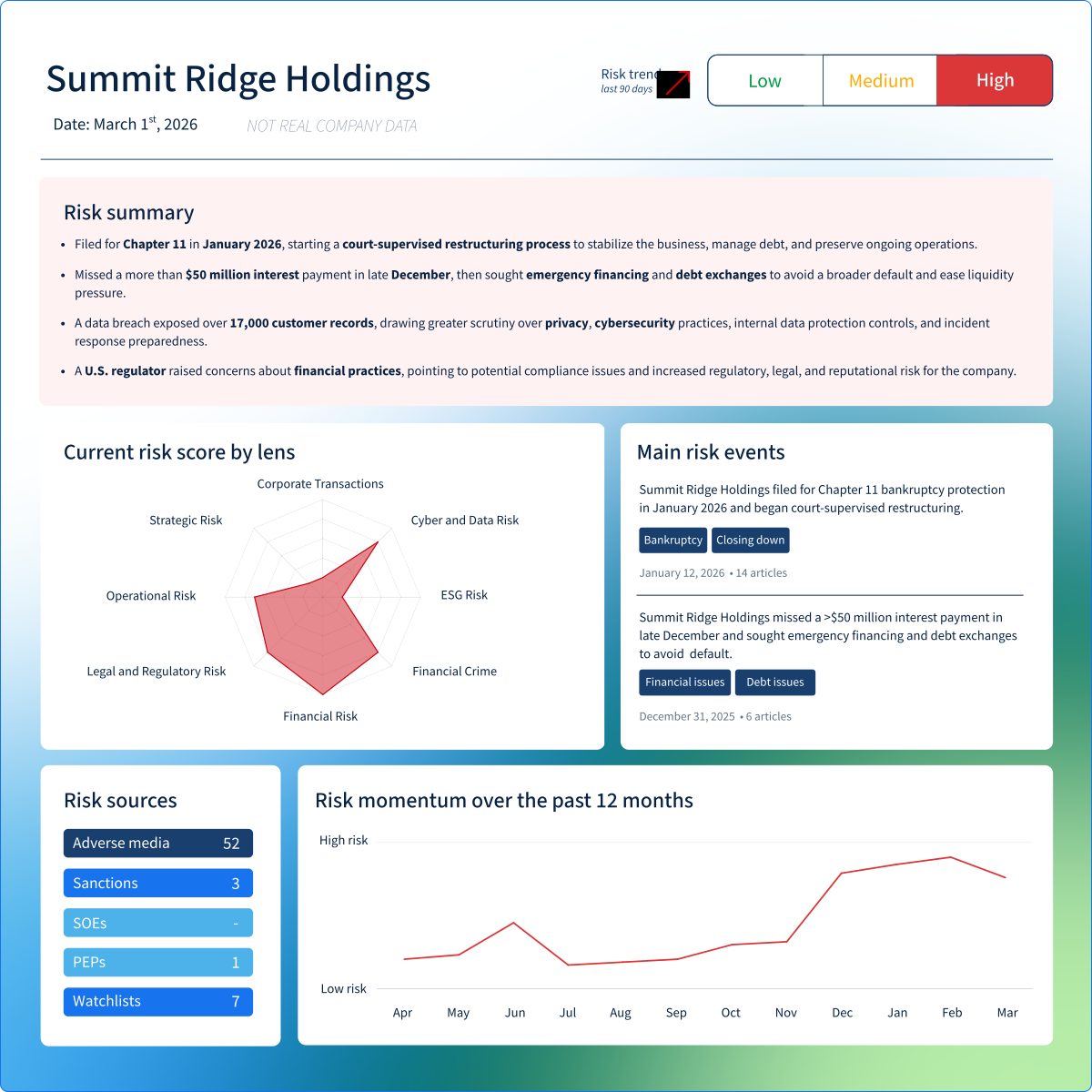
Owlin’s OmniSignal view surfaces adverse media, sanctions, PEPs, watchlists, blacklists, SOEs, filings, and consumer complaints together, in context, on a single entity profile.
3. What false-positive reduction does the platform offer?
High false-positive rates drain analyst time. Common names generate incorrect matches; passing mentions trigger unnecessary reviews. Teams can lose hundreds of hours a year sorting through noise.
What to look for: contextual NLP that evaluates relevance rather than simple keyword matching; name disambiguation using location, occupation, and associated entities; feedback loops that improve filtering as analysts make decisions.
Owlin applies AI-powered contextual filtering and name disambiguation, learns from your team’s escalation patterns over time, and has been recognized for industry-leading noise reduction, a rich signal set that doesn’t leave you overwhelmed.
4. Are risk scores explainable and auditable?
Black-box scores with no reasoning create defensibility problems during examinations. When a regulator asks why you flagged one entity and not another, “the algorithm said so” isn’t an answer.
What to look for: visibility into which signals drove each score; a breakdown across risk dimensions (financial crime, ESG, sanctions, cyber); documented rationale attached to each case decision.
Owlin’s explainable risk scores show clear reasoning across financial crime, ESG, sanctions, cyber, and going-concern dimensions, supporting both internal decisions and regulatory defensibility.
5. How well does it integrate with existing compliance workflows?
Adverse media monitoring should fit into your current processes, not create another silo. Built-in case management lets teams collaborate, document findings, and record decisions — documentation that matters as much as the risk detection itself.
What to look for: API-first architecture; pre-built connectors for common GRC and case management platforms; flexible alert delivery (email, dashboard, webhook, or team chat).
Owlin’s API-first design embeds directly into onboarding, case management, and third-party risk workflows.
6. What’s the scope of coverage across languages and regions?
Risk often surfaces in local-language media before it reaches international headlines. A tool that only monitors English-language sources will miss early signals from regional outlets.
What to look for: a large, global source network; native-language processing rather than machine-translated summaries; credibility vetting so volume doesn’t just mean noise.
Owlin monitors sources in multiple geographies, catching regional signals before they surface in major international outlets.
7. Does the vendor own its data pipeline, or aggregate from third parties?
Owning the pipeline end-to-end, from ingestion through enrichment, gives a vendor the flexibility to add sources quickly and apply custom quality controls. Aggregators of third-party data have less room to adapt to your specific needs.
What to look for: end-to-end pipeline control; the ability to expand coverage without waiting on an external data provider; transparency about where the underlying data actually originates.
Owlin owns its data pipeline end-to-end across 3 million+ sources, from ingestion through enrichment, rather than licensing a feed from a third-party aggregator. That ownership is what allows Owlin to add or drop sources on its own timeline and apply consistent quality control across every language and region it covers.
8. What’s the vendor’s track record and independent recognition?
Feature claims need validation. Independent analyst evaluations, like Chartis Research’s annual RiskTech Quadrant, help verify vendor capabilities beyond the sales deck, and customer references in your industry add real-world proof.
What to look for: independent analyst recognition; case studies from organizations similar to yours; a visible product roadmap showing ongoing investment.
Owlin has been named Category Leader for Adverse Media Monitoring Solutions by Chartis Research in 2024, 2025, and 2026, and supports over 1,000 organizations worldwide.
9. Does the risk taxonomy map to the regulations you actually have to comply with?
Regulatory frameworks keep multiplying: DORA, FATF, evolving ESG rules, Modern Slavery Acts, the German Supply Chain Act, CSDDD, PSD3, and a tool built around a generic “adverse media” tag won’t tell you which obligation a given event actually touches. Coverage should extend into private markets too, where public filings and structured data are thinnest and manual research is heaviest.
What to look for: a risk taxonomy that’s updated as regulations evolve, not fixed at launch; explicit mapping to the frameworks your compliance program answers to; meaningful depth on private companies, not just listed entities.
Owlin’s universal risk taxonomy maps directly to DORA, FATF, ESG, Modern Slavery Acts, the German Supply Chain Act, CSDDD, and PSD3, most single-framework taxonomies, with deep coverage into private markets where thin data footprints matter most.
Comparison at a glance
How adverse media monitoring fits your broader compliance program
No single source tells the whole story. Adverse media works best alongside sanctions screening and PEP identification, because it tends to surface a problem earlier; news coverage often breaks before an entity ever lands on an official sanctions or watchlist, which is exactly the window where proactive action still matters.
That window is also what regulators are increasingly asking programs to account for: FATF calls for enhanced due diligence that draws on open-source intelligence in higher-risk situations, and EU AML frameworks expect risk-based controls that can be shown to work, not just described on paper. A documented, continuous monitoring process is how a program demonstrates that in practice.
Why Owlin leads in adverse media monitoring for 2026
Owlin delivers live risk intelligence continuously, not isolated hits: specialized AI agents handle preliminary risk assessment and organize signals into risk events instead of isolated alerts, giving you one coherent picture of what happened, how it developed, and why it matters, rather than twenty disconnected articles to sort through manually. That shift moves teams from search to understanding, with no re-reading the same story twice and no alert fatigue.
Structured and unstructured data aren’t treated as separate problems: Owlin OmniSignal brings adverse media, sanctions, PEPs, SOEs, watchlists, and blacklists into one dashboard. Every risk score comes with clear reasoning across financial crime, ESG, sanctions, cyber, and going-concern dimensions, AI that’s structured to be explained, not a black box, supporting both fast internal decisions and regulatory defensibility.
Owlin owns its data pipeline across 3 million+ sources, which means better data quality, industry-leading noise reduction, and the flexibility to add or remove sources as coverage needs change. Its universal risk taxonomy maps to DORA, FATF, ESG, Modern Slavery Acts, the German Supply Chain Act, CSDDD, and PSD3, with deep coverage into private markets where public data is thinnest.
Recognized as Category Leader for Adverse Media Monitoring Solutions by Chartis Research in 2024, 2025, and 2026, Owlin helps over 1,000 organizations worldwide detect third-party risk before it becomes a problem.
FAQs about adverse media monitoring tools
What is adverse media monitoring? Adverse media monitoring scans news sources, regulatory filings, and public information to identify negative coverage about individuals or entities. Modern tools automate this with AI-driven detection across millions of global sources, helping compliance teams catch risk before official lists are updated.
How is adverse media screening different from sanctions screening? Sanctions screening checks entities against official government lists. Adverse media screening monitors news and public sources for negative coverage that may indicate risk before an entity ever appears on a sanctions or watchlist.
What risks does adverse media monitoring detect? Financial crime indicators, fraud allegations, regulatory violations, reputational issues, ESG concerns, and operational problems, typically categorized across dimensions like financial crime, cyber risk, ESG, and legal/regulatory exposure.
How often should adverse media screening run? Effective programs combine onboarding screening with continuous, ongoing monitoring. An entity that’s clean today can be implicated in an issue tomorrow, so real-time monitoring matters more than periodic checks.
What causes high false-positive rates? Common names, passing mentions with no real relevance, and a lack of contextual analysis are the main drivers. Tools that apply AI-powered name disambiguation and contextual NLP and learn from analyst feedback over time significantly reduce false positives.
How do compliance teams demonstrate adverse media monitoring to regulators? Through documented processes with clear decision rationale: explainable risk scores showing which factors drove each assessment, and audit trails capturing screening results, alert responses, and case decisions.