How to Choose Adverse Media Monitoring in 2026 Guide

Adverse media monitoring has become a critical component of financial crime prevention and regulatory compliance programs. Therefore, for risk managers and compliance officers at financial institutions, selecting the right solution means the difference between catching threats early and discovering risks only after they’ve caused damage.
This guide will help you choose the right adverse media monitoring solution for your organization. Inside, you’ll find what to look for, which features matter most, and tips for putting your new system in place. By the end, you’ll have a straightforward process for selecting a solution that aligns with your company’s risk tolerance and day-to-day needs.
Key takeaways
- Evaluate data coverage depth, including global reach, local language sources, and real-time update frequency, because it directly affects your ability to detect risks early and accurately.
- Prioritize solutions with AI-driven risk scoring and customizable taxonomies that align with your specific compliance requirements.
- Look for integration capabilities that fit your existing workflow, including API access and case management functionality.
- Consider the vendor’s track record, analyst recognition, and ongoing support when making your final selection.
What is adverse media monitoring, and why does it matter?
Adverse media monitoring involves scanning news sources, regulatory filings, and other publicly available information to identify negative coverage about individuals or entities. As regulatory pressure on financial institutions intensifies globally, it has moved from a best practice to a compliance necessity. Regulators increasingly expect firms to demonstrate that they actively monitor for financial crime, corruption, sanctions exposure, and reputational risk across their entire customer and counterparty base.
For example, the Financial Action Task Force (FATF) sets global standards for anti–money laundering and counter-terrorist financing frameworks and requires firms to apply enhanced due diligence (EDD) in higher-risk situations, using a risk-based approach that incorporates relevant customer information and open-source intelligence where appropriate (Financial Action Task Force, 2012). Within this framework, supervisory expectations in many jurisdictions have increasingly emphasized the importance of leveraging publicly available information in risk assessment processes.
In the European Union, the anti-money laundering framework requires firms to apply EDD measures for high-risk customers, but does not prescribe specific tools; instead, firms are expected to implement appropriate risk-based controls, which commonly include the use of adverse media and other open-source information as part of due diligence practices (European Parliament & Council of the European Union, 2015). As a result, adverse media screening is widely adopted in compliance practice to support EDD obligations under EU AML requirements.
The connection between adverse media and financial crime prevention
Financial criminals often appear in news coverage before they are added to official sanctions or PEP lists. This timing gap creates an opportunity for proactive risk management. If your monitoring solution detects negative news early, you can investigate and take action before the issue escalates. Without adequate adverse media monitoring, organizations risk unknowingly facilitating suspicious activity. They may engage with compromised entities or individuals linked to money laundering, fraud, terrorist financing, or other predicate offenses. Reputational damage from such associations can be severe and long-lasting, making early detection valuable beyond regulatory compliance alone.
What are the core evaluation criteria for adverse media monitoring solutions?
When evaluating adverse media monitoring solutions, focus on criteria that directly impact your ability to detect risk accurately and respond efficiently. The following framework covers the essential areas you should assess.
Data coverage and source quality
The foundation of any adverse media solution is its data. You need to evaluate how many sources the solution monitors, what types of sources it includes, and how it handles different languages and regions.
A strong solution pulls from global news outlets, regulatory filings, and local media sources. Many risks first emerge in jurisdiction-specific media or industry-focused reports before reaching major international headlines. Coverage of local-language sources is essential for detecting these early signals.
Ask vendors about their source vetting process to understand how they verify source credibility and handle unreliable content, which is crucial for maintaining data quality.
Update frequency and real-time capabilities
Speed matters in risk management. Some solutions update news feeds with delays of hours or even days, meaning you might learn about a critical risk event only after the damage is done.
Investigate if the vendor updates news sources around the clock and delivers alerts as soon as relevant information becomes available. This real-time capability ensures that compliance teams can respond to emerging risks quickly rather than playing catch-up. In volatile markets, even a few hours can make a significant difference in your response options.
AI and natural language processing capabilities
Modern adverse media monitoring relies heavily on artificial intelligence and natural language processing (NLP). These technologies help filter relevant signals from noise, reduce false positives, and categorize risks accurately.
Evaluate how the solution uses AI. Does it simply match keywords, or does it understand context and sentiment? Can it differentiate between a person who is the subject of negative news versus someone who is merely mentioned in passing? The sophistication of the AI directly impacts how much time your team spends reviewing irrelevant alerts.
How should you evaluate risk scoring and prioritization features?
When monitoring large portfolios of customers, vendors, or counterparties, you need clear prioritization. Effective risk scoring helps you focus resources where they matter most.
Risk score methodology
Ask vendors to explain their risk scoring methodology. How do they assign scores? What factors influence the score? Can you see the reasoning behind a particular score, or is it a black box?
Explainable risk scores are particularly valuable for compliance purposes. When regulators or auditors ask why you took certain actions, you need to demonstrate that your decisions were based on transparent, defensible criteria.
Customizable risk taxonomies
Not all organizations look for the same risks. Your compliance program might emphasize financial crime, while another organization focuses on ESG concerns or reputational threats. An effective solution offers customizable risk taxonomies tailored to your specific use cases. This customization increases signal relevance and reduces noise.
Portfolio-level visibility
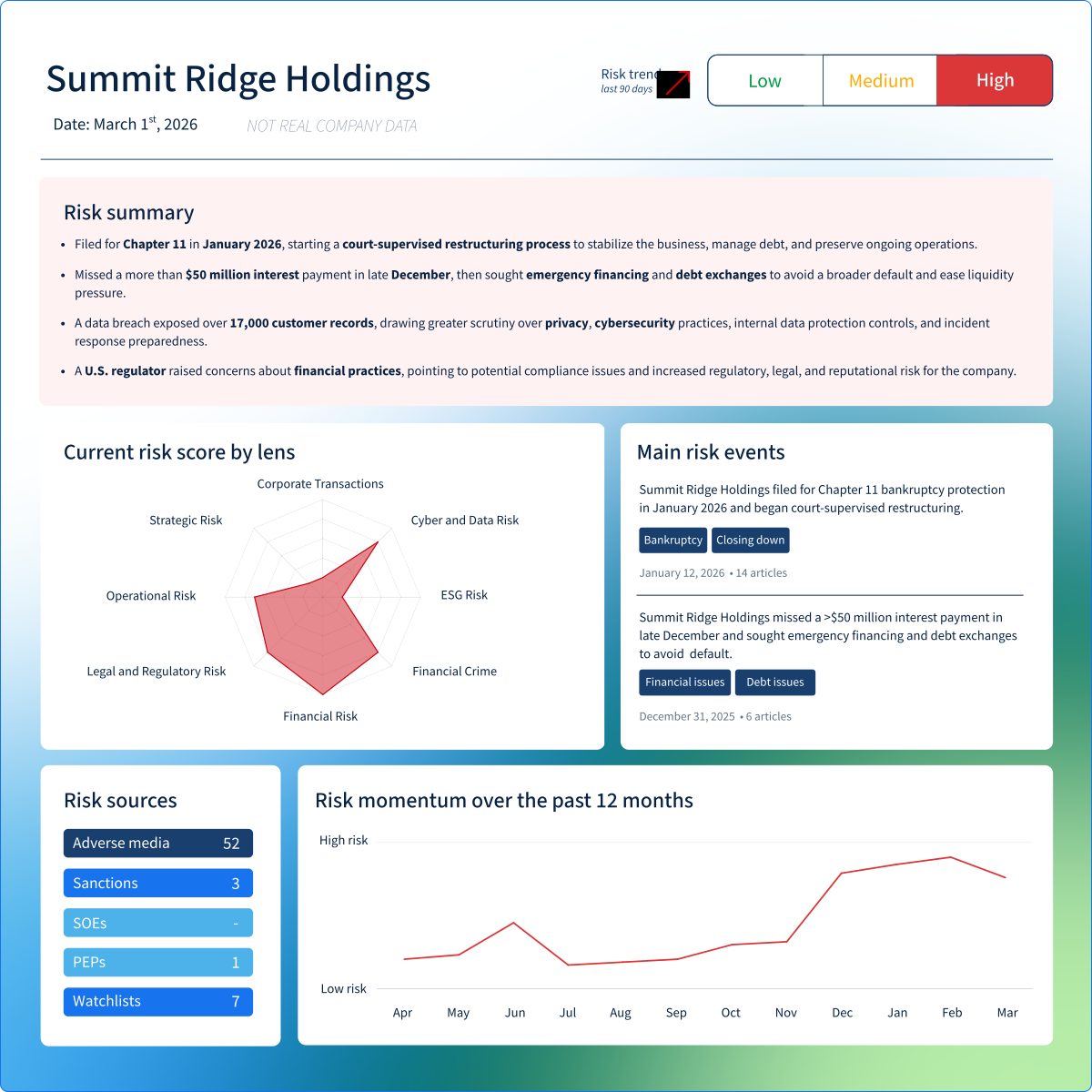
Beyond individual entity scores, you need visibility across your entire portfolio. A clear risk prioritization overview lets you instantly see which entities are categorized as low, medium, or high risk. This portfolio-level view enables consistent comparisons, helps identify trends over time, and supports data-backed decision-making. It also makes it easier to demonstrate to regulators that you’re applying appropriate oversight based on risk levels.
Begin by identifying the key stakeholders responsible for workflow integration, as clarifying roles ensures effective implementation and ongoing management of the solution.
Adverse media monitoring should fit into your existing compliance workflows, not create a separate silo. Evaluate how well potential solutions integrate with your current systems and processes.
API and system integration
Most enterprise compliance programs need adverse media data to flow into existing systems. Whether you use a GRC platform, case management system, or proprietary compliance infrastructure, the adverse media solution should integrate through well-documented APIs. Ask about API capabilities, data formats, and existing integrations. How easy is it to push adverse media alerts into your current workflow? Can you pull data programmatically for custom reporting?
Case management functionality
Built-in case management functionality enables team members to collaborate, document findings, assign responsibilities, and record decisions. This is particularly important for compliance and audit purposes, where demonstrating internal processes is as important as identifying risks.
Alert configuration and delivery
How will your team receive alerts? Look for flexibility in alert configuration and delivery methods. Options might include email notifications, dashboard alerts, API webhooks, or integration with communication tools your team already uses. The ability to configure alert thresholds and filters is equally important. You want to be notified about significant risk developments without being overwhelmed by minor or irrelevant updates.
How do you assess false positive management?
High false-positive rates are among the biggest operational challenges in adverse media monitoring. Compliance teams can waste hundreds of hours annually reviewing alerts that turn out to be irrelevant. Effective false positive management directly impacts your team’s productivity.
Name matching accuracy
Common names frequently generate false positive alerts, leading to the wrong entity or person being flagged. Sophisticated name matching considers factors like location, age, occupation, and associated entities to improve accuracy. Ask vendors about their approach to name disambiguation. How do they handle common names? What additional data points do they use to confirm identity matches?
Contextual analysis
Beyond name matching, the solution should analyze context to determine relevance. Is the flagged individual the perpetrator, a victim, or merely mentioned in passing? Is the article about a current issue or a resolved historical matter? AI-powered contextual analysis helps filter out irrelevant results before they reach your team. This filtering saves time and allows analysts to focus on genuine risks.
Feedback mechanisms
Look for solutions that learn from your team’s decisions. When an analyst marks an alert as a false positive, does the system use that feedback to improve future results? Over time, this learning capability can significantly reduce noise.
What questions should you ask about data pipeline ownership?
A strong adverse media monitoring solution should own its data pipeline, from ingestion to processing and enrichment. This ownership has important implications for flexibility and control.
Why data pipeline control matters
When a vendor owns their data pipeline, they can adapt how data is processed and categorized. This enables customization, faster updates, and improved quality control. For organizations with specific risk frameworks or regulatory requirements, this flexibility ensures that the solution works for you rather than forcing a one-size-fits-all approach.
Questions to ask vendors
Where does your data come from? Do you own and control the data pipeline, or do you aggregate from third parties? How quickly can you add new sources or adjust processing rules? What quality controls do you apply to incoming data?
The answers reveal how adaptable the solution is to your evolving needs and how much control you’ll have over the data that drives your compliance decisions.
How do you evaluate vendor’s track record and recognition?
Beyond feature comparisons, consider the vendor’s track record, industry recognition, and ongoing commitment to the adverse media monitoring space.
Industry recognition and awards
Independent analyst recognition can help validate vendor claims. Chartis Research publishes annual RiskTech Quadrants that evaluate adverse media monitoring solutions. Vendors named as category leaders have demonstrated strong capabilities across evaluation criteria.
Customer references and case studies
Ask for customer references in your industry. How do similar organizations use the solution? What results have they achieved? Customer references provide real-world validation that supplements vendor demonstrations.
Ongoing investment and roadmap
Adverse media monitoring technology continues to evolve. Ask about the vendor’s product roadmap and ongoing investment. Are they actively developing new capabilities? Do they incorporate customer feedback into their development process? A vendor committed to continuous improvement is more likely to keep pace with evolving regulatory requirements and emerging risk types.
What are common implementation challenges, and how can you address them?
Understanding common implementation challenges helps you plan for success and evaluate how well vendors can support your deployment.
Volume of data
Millions of articles, blog posts, and social media updates appear daily, making it difficult to filter relevant information. Solutions that rely on manual filtering or basic keyword matching quickly become overwhelmed. Address this challenge by selecting solutions with AI-powered filtering that can process high volumes while maintaining accuracy. The solution should do the heavy lifting so your team can focus on decision-making rather than sorting through noise.
Language barriers
Global monitoring requires multi-language coverage to detect risks across jurisdictions. This includes not just translating content but understanding linguistic nuances and local naming conventions.
Integration complexity
Connecting a new solution to existing systems can be technically challenging. Evaluate the vendor’s integration support, including documentation quality, available connectors, and implementation assistance. Ask about typical implementation timelines and what resources you’ll need from your internal team. A vendor with strong implementation support can significantly reduce deployment friction.
How should you structure your vendor evaluation process?
A structured evaluation process helps ensure you assess vendors consistently and make a well-informed decision.
Define your requirements
Start by documenting your specific requirements. What regulatory frameworks apply to your organization? What types of entities do you need to monitor? What existing systems does the solution need to integrate with? What’s your budget range? Clear requirements make it easier to compare vendors objectively and avoid being swayed by features that don’t address your actual needs.
Request demonstrations
Schedule demonstrations with shortlisted vendors. Prepare specific scenarios for them to demonstrate, including realistic examples from your own portfolio if possible. Watch how the solution handles edge cases and complex situations.
Conduct proof of concept
For significant investments, consider a proof-of-concept period. This allows your team to use the solution with real data and evaluate performance against your specific requirements. A proof of concept reveals operational realities that demonstrations can’t capture.
Evaluate the total cost of ownership
Consider the total cost of ownership beyond the subscription fee. Include implementation costs, integration development, training time, and ongoing operational overhead. A solution with a higher upfront cost might deliver better total value if it significantly reduces false positives and manual effort.
How do you build a business case for adverse media monitoring investment?
Justifying investment in adverse media monitoring requires demonstrating value to stakeholders who may not be directly involved in compliance operations.
Quantifying risk reduction
Frame the investment in terms of risk reduction. What’s the potential cost of onboarding a high-risk customer who later becomes subject to regulatory action? What are the penalties for failing to conduct adequate due diligence? Adverse media monitoring helps you avoid these scenarios.
Operational efficiency gains
Calculate time savings from reduced false positives and automated alert processing. If your team currently spends significant hours on manual media searches, an automated solution can free that time for higher-value activities.
Regulatory compliance value
Document how the solution helps meet specific regulatory requirements. This compliance value is particularly relevant given increasing enforcement activity and the extension of criminal liability to compliance failures under frameworks like 6AMLD. It also strengthens your defensibility with regulators by demonstrating a proactive, documented approach to risk management.
Conclusion
Choosing the right adverse media monitoring solution is a long-term investment in your organization’s risk management capabilities. The criteria in this guide, data coverage, AI sophistication, workflow integration, and vendor reliability, give you a structured way to cut through vendor claims and identify the solution that genuinely fits your needs. As regulatory expectations continue to rise and financial crime grows more sophisticated, the right tool will not only keep you compliant today but position you to respond to emerging threats tomorrow.
Discover Owlin!
Ready to see what adverse media monitoring looks like in practice? Owlin helps financial institutions detect risk early with real-time news monitoring, AI-driven risk scoring, and seamless workflow integration. Request a demo to find out how Owlin fits your compliance program.
Sources
- Financial Action Task Force (2012). International standards on combating money laundering and the financing of terrorism & proliferation: The FATF recommendations. FATF.
- European Parliament & Council of the European Union. (2015). Directive (EU) 2015/849 of 20 May 2015 on the prevention of the use of the financial system for money laundering or terrorist financing. Official Journal of the European Union.