Third-Party Risk Intelligence vs Due Diligence

Financial institutions run vendor reviews in cycles. Quarterly questionnaires, annual audits, and periodic screenings form the backbone of most third-party risk programs. This process works when your vendor list is short, and your regulatory exposure is stable. But what happens when the risk landscape shifts between review cycles?
That’s the question more risk managers are asking as they compare third-party risk intelligence software with traditional vendor due diligence. Owlin provides real-time risk monitoring across your entire third-party portfolio, filling the gaps periodic reviews leave open.
This blog breaks down both approaches, examines their strengths and limitations, and helps you decide which method fits your risk program.
Key Takeaways: Risk Intelligence vs Due Diligence
- Traditional vendor due diligence relies on periodic assessments that can miss risks emerging between review cycles.
- Third-party risk intelligence software monitors adverse media, sanctions, PEPs, SOEs, watchlists, and other signals around the clock.
- Owlin detects third-party risks across 3 million+ sources in multiple languages, offering an outside-in view of risk.
- Integrating risk intelligence into your existing TPRM workflow reduces manual reviews and strengthens audit trails.
- Owlin’s event-based approach groups related alerts into single events, cutting noise and false positives for your team.
Risk Intelligence vs Traditional Due Diligence: Overview
What is traditional vendor due diligence?
Traditional vendor due diligence follows a defined cadence. Your team sends questionnaires, reviews submitted documents, checks sanctions lists, and assigns a risk rating. Once the review is complete, the vendor file stays largely dormant until the next scheduled assessment (sounds straightforward, right?).
For decades, this approach served banks and financial institutions well. When vendor relationships changed slowly, and regulatory requirements focused on point-in-time compliance, periodic reviews were sufficient. Auditors understand the process, and teams have built their workflows around it.
Traditional due diligence key features
- Questionnaire-based assessments: Structured surveys collect vendor information on security, compliance, and financial health at defined intervals.
- Sanctions and PEP screening: Manual or batch checks against licensed sanctions lists and politically exposed persons databases during onboarding.
- Document-driven risk rating: Analysts review submitted materials and assign a risk tier based on predefined criteria and checklists.
- Periodic review cycles: Reviews occur quarterly, semi-annually, or annually depending on the vendor’s risk tier and your internal policy.
- Audit file generation: Each review cycle produces a documented record (questionnaire responses, screening results, analyst notes) for regulatory audits.
Traditional due diligence pros and cons
Pros:
- The process is well-established, and regulators have accepted it as a baseline for compliance for years.
- Questionnaire-based assessments offer structured, repeatable documentation that auditors are familiar with.
- Licensed databases (sanctions lists, PEP data) are authoritative for the specific records they cover.
Cons:
- Risks emerging between review cycles go undetected until the next scheduled assessment, creating exposure gaps.
- Coverage is typically limited to English-language sources, missing adverse media from local or non-English outlets where risk stories often originate first.
- The process scales linearly with your vendor count, meaning larger portfolios require proportionally more analyst hours for each review cycle.
What is Owlin?
Owlin’s Risk Intelligence Platform uses AI and Natural Language Processing to monitor over 3 million sources across multiple languages. Unlike closed-data vendors that rely on licensed source lists refreshed on a set schedule (often daily or weekly), Owlin works from an open universe of sources and processes them as events occur.
For a risk or compliance analyst tracking a mid-size supplier base, this shows up as earlier detection. An event first reported in a regional or non-English outlet can be flagged the same day it appears, instead of surfacing only once it reaches a licensed wire service.
Teams monitoring vendors with thin data footprints (smaller suppliers, private companies, emerging markets) see the biggest gap close.
Owlin key features
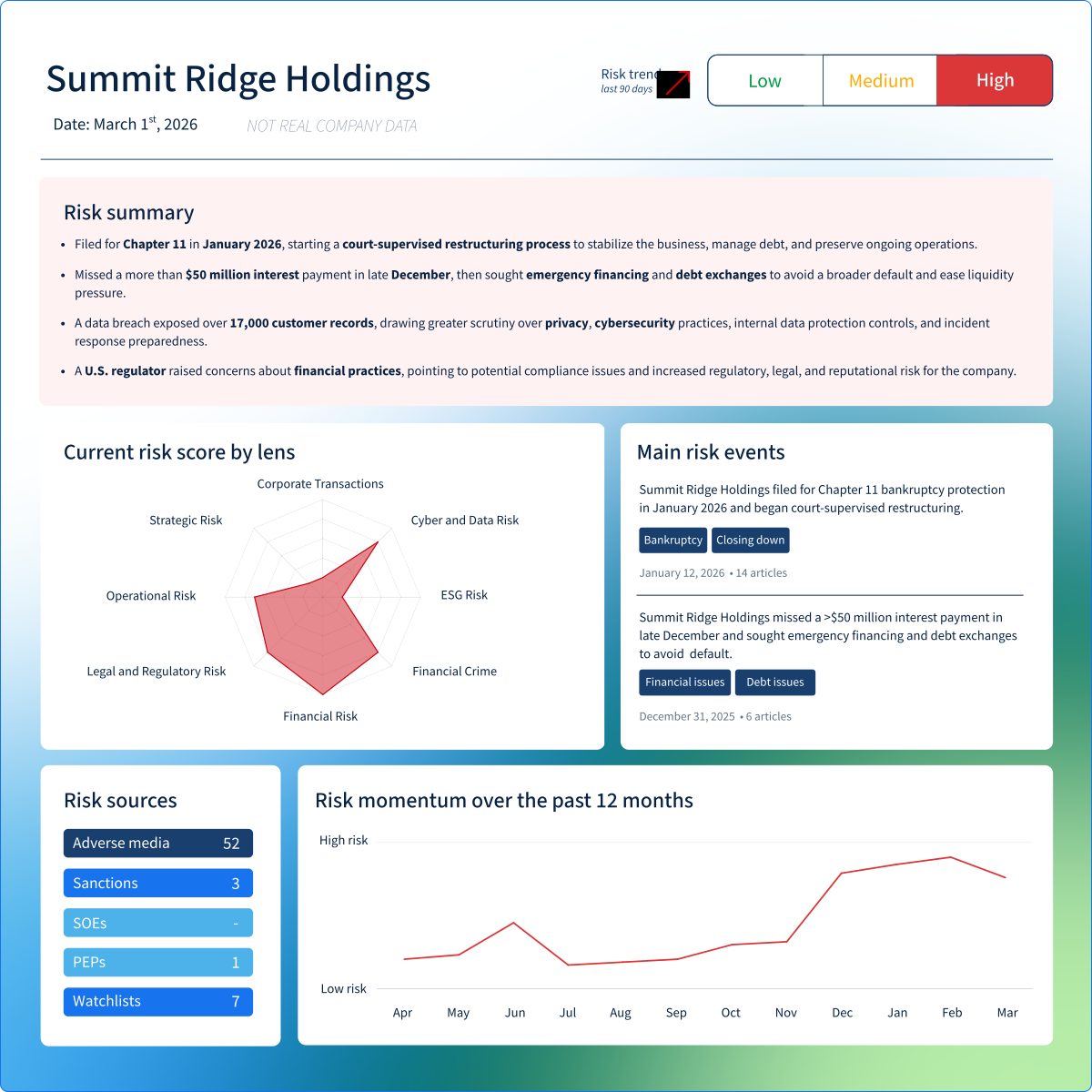
- Open-universe adverse media screening and monitoring: Scan and monitor 3 million+ sources in multiple languages for risk signals tied to your counterparties.
- Event-based alerting: Group related articles into single events with AI-generated summaries, reducing duplicate alerts and noise.
- Explainable risk scores: Every score traces back to the events behind it, so your team always knows why an entity moved up the list.
- One-click screening: Screen any entity with an online footprint, even if they’re not in traditional company databases.
- Full TPRM integration: Connect Owlin’s insights directly into your compliance, procurement, and risk management systems through an API.
Owlin pros and cons
Pros:
- Recognized as a Category Leader for Adverse Media Monitoring Solutions by Chartis Research in 2024, 2025, and 2026.
- Open-universe sourcing means Owlin screens entities not found in traditional company databases, giving you a true outside-in view of risk.
- AI agents group, score, and summarize risk events, dramatically reducing analyst time spent on false positives.
Cons:
- Owlin focuses on external risk intelligence rather than GRC workflow management, so teams running full governance programs typically pair it with a GRC platform.
- The breadth of open-universe sourcing may require initial tuning of alert thresholds to match your team’s risk appetite.
Risk Intelligence vs Traditional Due Diligence: In-Depth Comparison
Monitoring frequency and coverage
Traditional due diligence operates on a calendar. Most financial institutions run vendor reviews quarterly or annually, depending on the risk tier. Between cycles, your exposure goes unmonitored.
Owlin monitors your portfolio 24/7. Alerts trigger when events happen, not when your review schedule says it’s time to check. For financial institutions managing regulatory obligations under DORA, CSDDD, or PSD3, this distinction matters because regulators increasingly expect evidence of ongoing monitoring.
Adverse media detection
With traditional due diligence, adverse media checks typically happen at onboarding and during periodic reviews. Your team runs a search, reviews the results, and documents findings. If adverse media appears between cycles, it goes unnoticed until the next review.
Owlin’s adverse media monitoring scans over 3 million sources around the clock, detecting and classifying risk signals with NLP. Each alert links back to its source. Your team can act on a regulatory filing in Brazil or a local fraud report in Southeast Asia the same day it’s published.
Language and source coverage
Let’s assume you’re monitoring a vendor portfolio that spans 30 countries. Traditional approaches typically rely on English-language sources and a handful of licensed databases. Risk signals from local outlets, regional newswires, or non-English publications often fall through the cracks.
Owlin’s open-universe approach covers global and local news sources across multiple languages. This is particularly relevant for banks and payment service providers with vendor relationships in emerging markets, where local-language media often breaks risk stories before international outlets pick them up.
Scalability and efficiency
Manual due diligence scales linearly with your vendor count. Doubling your portfolio means doubling your analyst workload. For financial institutions expanding operations or onboarding new merchant portfolios, this creates a bottleneck.
Owlin’s platform is built for scale. Automated entity creation and AI-driven classification mean adding new vendors takes seconds. The Risk Prioritization Monitor surfaces high-risk entities instantly, so your team focuses analysis time on the vendors that need attention rather than working through an alphabetical list.
Audit trail and regulatory compliance
Both approaches produce documentation, but the depth differs. Traditional due diligence generates a file per review cycle: questionnaire responses, screening results, and analyst notes.
Risk intelligence platforms generate a running record. Owlin’s solution creates audit trails for each onboarding case and monitoring alert response.
For regulators who want to see how your team responded to emerging risks (not just that you ran a check on a scheduled date), this running record is considerably more useful.
Comparison Table: Risk Intelligence vs Traditional Due Diligence
| Capability | Owlin (risk intelligence) | Traditional due diligence |
|---|---|---|
| Monitoring frequency | 24/7, event-driven | Quarterly or annual cycles |
| Source coverage | 3M+ open-universe sources | Licensed databases only |
| Multilingual detection | ✓Yes | ✗No |
| Automated risk scoring | ✓Explainable AI | ✗Manual rating |
| Running audit trail | ✓Continuous | ✗Per-cycle documentation |
| Open-universe entity screening | ✓Yes | ✗Database-dependent |
Why Owlin Is the Best Choice for Financial Institutions
What may have become apparent is that traditional vendor due diligence, while familiar and well-understood, may not be enough for financial institutions operating in a fast-moving regulatory and risk environment. The gaps between review cycles leave you exposed to risks that emerge on timelines regulators and counterparties won’t accommodate.
Owlin bridges that gap. Named among the Top 100 Global Risk Technology Providers by Chartis and recognized as a Category Leader for Adverse Media Monitoring Solutions, Owlin delivers the outside-in risk intelligence that traditional due diligence programs miss.
The platform’s open-universe sourcing, multilingual detection, and event-based alerting give your team the coverage and speed needed to stay ahead of emerging threats.
Moreover, Owlin integrates directly into your existing compliance and procurement workflows through an API, meaning risk intelligence reaches your team where they already work. No new system to learn. No disruption to established processes.
See the difference for yourself
We’d love to tell you more about how Owlin can help you strengthen your vendor risk program.
FAQs: Third-Party Risk Intelligence vs Due Diligence
What is third-party risk intelligence software?
Third-party risk intelligence software monitors your vendor portfolio around the clock for adverse media, sanctions changes, and other risk signals. Owlin scans over 3 million sources in multiple languages, flagging events as they happen rather than waiting for a scheduled review cycle.
Can risk intelligence replace traditional due diligence entirely?
Not entirely, but the two work well together. Traditional due diligence handles structured assessments and documentation at defined intervals. Risk intelligence fills the gaps between those cycles, ensuring you catch emerging threats in near real-time. Owlin integrates into existing TPRM workflows so both approaches reinforce each other.
How does Owlin differ from closed-data risk vendors?
Closed-data vendors rely on licensed, curated source lists refreshed on a set schedule. Owlin works from an open universe of sources, processing them as events occur. This means risk signals from local news outlets, non-English publications, and niche sources surface the same day rather than days or weeks later.
Is risk intelligence software relevant for smaller vendor portfolios?
Yes. Even with a smaller portfolio, risk signals can emerge from unexpected sources or in languages your team doesn’t monitor. Owlin’s one-click screening and automated monitoring mean you don’t need a large compliance team to maintain coverage across your counterparties.
What regulations require ongoing vendor monitoring?
Regulations like DORA, CSDDD, PSD3, and the German Supply Chain Act increasingly expect evidence of ongoing risk monitoring, not just periodic assessments. Owlin’s real-time alerting and running audit trail help you demonstrate to regulators that your team responds to emerging risks as they happen.