Third-Party Risk Intelligence Platforms for Banks: 2026 Guide

The annual vendor review is no longer defensible, and DORA and OCC examiners have made that explicit. Banks that still treat third-party risk as a point-in-time checkbox are operating on a model regulators have already moved past: continuous, documented monitoring is now the expectation, not the exception. The problem is capacity, not intent; vendor portfolios are growing faster than risk teams can manually track them.
This guide covers what a third-party risk intelligence platform does, why banks need one specifically, and the core capabilities, data coverage, real-time monitoring, open-universe screening, integration, and audit-readiness that separate genuinely useful platforms from noise generators.
Key takeaways: third-party risk intelligence platforms for banks
- Third-party risk intelligence platforms analyze adverse media, sanctions, PEPs, and regulatory filings to surface vendor risks before they escalate into material problems.
- Banks require real-time monitoring capabilities rather than periodic assessments to meet regulatory expectations under frameworks like DORA, FFIEC, and OCC guidance.
- Effective platform evaluation centers on data coverage, language support, integration capabilities, and the ability to screen entities not found in traditional databases.
- Owlin offers an AI-powered outside-in risk view that monitors any business with an online presence, even those missing from conventional company databases.
- Automated workflows, explainable risk scores, and audit trail generation are essential features that reduce manual effort while satisfying compliance documentation needs.
What is a third-party risk intelligence platform?
A third-party risk intelligence platform aggregates and analyzes data from multiple sources to identify potential risks associated with vendors, suppliers, counterparties, and other external business relationships. These platforms go beyond basic vendor questionnaires by pulling information from news sources, regulatory filings, sanctions lists, court records, and consumer reviews.
For banks, the value lies in early detection. A vendor experiencing financial distress, regulatory enforcement, or reputational issues often generates signals in public sources before any formal notification reaches your procurement or compliance team. The right platform captures these signals and translates them into actionable alerts.
The distinction between a third-party risk intelligence platform and a standard vendor management system matters. Vendor management systems track contract terms, renewal dates, and performance metrics. Risk intelligence platforms monitor external signals that indicate whether a vendor relationship might expose your institution to financial, operational, or reputational harm.
Why banks need specialized risk intelligence platforms
Banks operate under regulatory scrutiny that general enterprises do not face. The FFIEC IT Examination Handbook, OCC guidance on third-party relationships, and the Digital Operational Resilience Act (DORA) in the EU all impose specific obligations on how financial institutions identify, assess, and monitor vendor risks (Federal Financial Institutions Examination Council, n.d.; Office of the Comptroller of the Currency et al., 2023; European Parliament & Council of the European Union, 2022).
A 2025 report from the American Bankers Association noted that third-party risk management teams remain small while vendor use grows, creating a capacity gap that technology must address (American Bankers Association, 2025). Manual processes cannot scale when a regional bank manages hundreds of vendor relationships, and a large institution tracks thousands.
The consequences of inadequate monitoring extend beyond regulatory citations. A vendor breach that exposes customer data becomes your institution’s breach in the eyes of customers and regulators. A supplier caught in a sanctions violation creates immediate compliance exposure. A fintech partner experiencing financial instability may disrupt critical services.
Regulatory drivers shaping platform requirements
DORA, which became fully applicable in January 2025, requires EU financial institutions to maintain detailed registers of their ICT service providers and demonstrate ongoing monitoring of these relationships (European Parliament & Council of the European Union, 2022). The regulation specifically calls for financial entities to assess concentration risk and ensure that critical service providers do not create single points of failure.
In the United States, the OCC has increased examination focus on how banks oversee third parties, particularly fintech partners and core service providers (Office of the Comptroller of the Currency et al., 2023). Examiners expect documented risk assessments, ongoing monitoring evidence, and clear escalation procedures when vendor risks materialize.
These requirements mean banks cannot rely on annual vendor reviews. Regulators expect evidence of ongoing oversight, and risk intelligence platforms that deliver real-time alerts and audit-ready documentation address this expectation directly.
Core capabilities to evaluate in risk intelligence platforms
When assessing third-party risk intelligence platforms, banks should evaluate capabilities across several dimensions. The features that matter most depend on your institution’s size, regulatory jurisdiction, and the complexity of your vendor ecosystem.
Data coverage and source diversity
The breadth and depth of data sources directly affect detection capability. Platforms that rely solely on major newswires miss signals from regional publications, local court filings, and non-English sources. A vendor operating in emerging markets may generate risk signals in local media long before international outlets pick up the story.
Owlin monitors over 3 million sources across multiple countries, including mainstream news, niche publications, consumer reviews, and regulatory filings. This coverage matters when your vendor portfolio spans multiple geographies or includes counterparties with limited presence in traditional financial databases.
Source diversity also affects false positive rates. Platforms that aggregate content without proper filtering generate noise that overwhelms analyst capacity. The goal is signal extraction, not volume accumulation.
Real-time monitoring vs. periodic assessment
Traditional vendor due diligence operates on annual or quarterly cycles. You assess a vendor at onboarding, perhaps reassess annually, and hope nothing significant changes between reviews. This approach made sense when information traveled slowly. It creates dangerous gaps when a vendor crisis can unfold in days.
Real-time monitoring platforms track entities around the clock, generating alerts when new risk signals appear. This might include a news article about regulatory enforcement, a spike in negative consumer reviews, a change in sanctions status, or a filing indicating financial distress.
Owlin’s monitoring solution operates 24/7 across global sources, ensuring that risk developments reach your team as they emerge rather than during the next scheduled review. For banks subject to DORA’s ICT monitoring requirements, this capability directly supports compliance.
Screening entities beyond traditional databases
Closed-universe databases build coverage from licensed, curated source lists. They excel at structured data on large, well-documented companies. They struggle with smaller vendors, private companies, and entities operating primarily in emerging markets.
An open-universe approach allows screening and monitoring of any entity with an online presence. If a vendor has a website, social media activity, or appears in news coverage, an open-universe platform can track it. This matters when your vendor portfolio includes specialized service providers that do not appear in standard business databases.
Owlin’s outside-in view of risk addresses this gap. The platform can screen and monitor any business with an online footprint, even those missing from traditional company databases. For banks working with newer fintech providers or regional suppliers, this capability fills a critical data gap.
Integration with existing workflows
A risk intelligence platform that operates in isolation creates additional work. Analysts must check one system for risk alerts, another for vendor records, and a third for contract management. This fragmented workflow increases the chance that critical signals get missed or delayed.
Effective platforms offer API integrations that push risk intelligence into existing vendor management, GRC, and compliance systems. When a new risk alert triggers, it should appear where your team already works, not in a separate dashboard they might not check regularly.
Owlin offers API integrations that embed risk insights directly into procurement and compliance workflows. The platform can also deliver daily email summaries with insights on risk developments across your portfolio, ensuring stakeholders stay informed without requiring manual system checks.
How to evaluate platform effectiveness for banking use cases
Selecting a risk intelligence platform requires more than reviewing feature lists. Banks should assess how well each platform performs against their specific operational requirements and risk appetite.
Accuracy and false positive management
Every platform will generate some false positives. The question is whether the ratio of actionable signals to noise makes the platform operationally useful. A platform that floods analysts with irrelevant alerts becomes a burden rather than a benefit.
Owlin applies AI-driven filtering and explainable risk scores to reduce false positives. Rather than presenting raw news volume, the platform structures findings into risk categories and assigns transparent scores that analysts can evaluate. When Chartis Research named Owlin a Category Leader in Adverse Media Monitoring Solutions for 2024, 2025, and 2026, they specifically noted the platform’s high accuracy and effective use of AI and GenAI.
Ask potential vendors about their false positive rates and how they measure accuracy. Request demonstrations using entities from your actual vendor portfolio to see how the platform performs against your specific monitoring needs.
Audit trail and documentation capabilities
Regulatory examinations require evidence. When an examiner asks how you monitored a specific vendor over the past year, you need documentation showing what signals were reviewed, what actions were taken, and who made decisions.
Effective platforms generate audit trails automatically. Every screening, every alert, every analyst action gets logged in a format suitable for regulatory submission. This documentation capability transforms the platform from a detection tool into a compliance asset.
Owlin enables swift generation of audit trails for each onboarding case and monitoring alert response. This feature directly supports DORA requirements for documented ICT vendor oversight and OCC expectations for third-party risk management programs.
Scalability across large vendor portfolios
A platform that works well for monitoring 50 vendors may struggle at 500 or 5,000. As your vendor portfolio grows, the platform must maintain performance without proportional increases in analyst workload.
Evaluate how each platform handles volume. Can it monitor thousands of entities simultaneously? Does pricing scale linearly with entity count, or are there volume tiers? How does the alerting system prioritize when multiple vendors generate signals simultaneously?
Owlin’s platform scales with your operations, providing proactive risk insights without adding operational strain. The architecture supports extensive ecosystem monitoring, making it suitable for banks with large, complex vendor networks.
Understanding adverse media as a risk intelligence source
Adverse media monitoring forms a core component of third-party risk intelligence. News coverage often reveals problems at vendors before those problems appear in financial statements, regulatory filings, or formal notifications.
What qualifies as adverse media?
Adverse media encompasses any negative or potentially harmful news about an entity. This includes reports of fraud, corruption, money laundering, regulatory violations, environmental incidents, labor disputes, and reputational issues. The challenge lies in distinguishing material signals from routine business coverage.
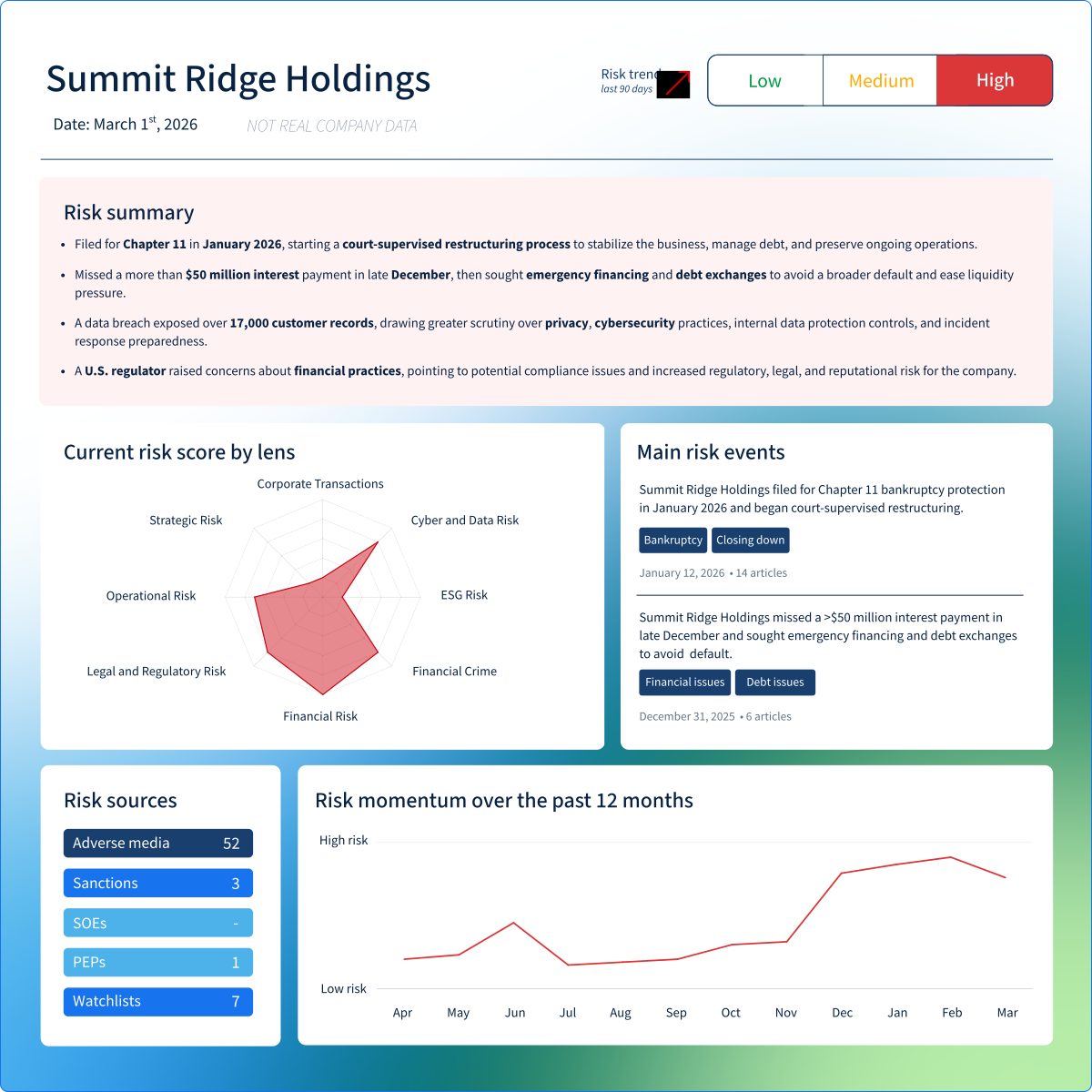
Owlin applies eight risk lenses to organize and prioritize adverse media signals: corporate transactions, data and cyber risk, ESG issues, financial crime, financial risk, legal and regulatory matters, operational risk, and strategic risk. This categorization helps analysts quickly assess which alerts require immediate attention and which represent lower-priority concerns.
The challenge of information overload
Global news volume has expanded dramatically. A single entity might generate dozens of news mentions daily, most of which carry no risk significance. Manual review of this volume is impractical. Platforms must filter effectively to deliver relevant signals without overwhelming analyst capacity.
AI and natural language processing enable this filtering. Effective platforms analyze content to identify risk-relevant information, assess sentiment, detect named entities, and correlate related stories. The output should be a curated feed of actionable intelligence, not a firehose of raw news.
Owlin’s technology scans over 3 million sources and applies AI filtering to present relevant signals through graphs and alerts. This approach lets compliance teams focus on critical events rather than sorting through content that will not impact their organization.
Integrating risk intelligence into TPRM workflows
A risk intelligence platform delivers maximum value when integrated into broader third-party risk management processes. The platform should inform decisions at onboarding, support ongoing monitoring, and trigger escalation when risks materialize.
Onboarding and initial due diligence
Before approving a new vendor relationship, banks conduct due diligence to identify potential risks. Risk intelligence screening at this stage can surface adverse media, sanctions exposure, PEP connections, or regulatory enforcement history that might not appear in the vendor’s own disclosures.
One-click screening capabilities accelerate this process. Rather than conducting manual searches across multiple databases and news sources, analysts can run a single query that aggregates results from all relevant sources. Owlin’s screening solution delivers this capability, checking third parties against multiple databases simultaneously while identifying risks through AI analysis.
Ongoing monitoring and alert management
The onboarding screening represents a point-in-time assessment. Ongoing monitoring ensures that new risks surface as they develop. Effective monitoring programs define alert thresholds, assign responsibility for alert triage, and establish escalation procedures for material findings.
Consider how your team will handle alert volume. If the platform generates more alerts than analysts can review, you need either additional resources or better filtering. Most banks benefit from tiered monitoring that applies more intensive oversight to critical vendors while using lighter-touch approaches for lower-risk relationships.
Owlin’s dashboard provides a centralized view of third-party risks, allowing teams to track multiple entities efficiently. The platform supports team collaboration through annotation and sharing features, enabling faster decision-making when risks materialize.
Escalation and response procedures
Detecting a risk signal is only the first step. Banks need defined procedures for assessing, escalating, and responding to vendor risks. The platform should support these procedures by providing documentation, enabling team coordination, and tracking resolution status.
When a critical alert triggers, who reviews it first? What criteria determine escalation to senior management or the board? How do you document the assessment and any resulting actions? These workflow questions matter as much as the platform’s detection capabilities.
Addressing common implementation challenges
Banks implementing risk intelligence platforms often encounter predictable challenges. Understanding these challenges in advance helps ensure successful deployment.
Change management and user adoption
New platforms require new workflows. Analysts accustomed to periodic vendor reviews must adapt to real-time alert processing. Procurement teams may need training on how to interpret risk scores and incorporate them into vendor selection decisions.
Successful implementation includes dedicated onboarding and training. Owlin’s approach emphasizes rapid user adoption through intuitive design and a Customer Success Team that ensures teams quickly maximize the platform’s value.
Defining risk thresholds and alert priorities
Not every negative news article requires action. Banks must define which risk signals warrant immediate attention, which require monitoring, and which fall below the threshold for action. These thresholds should align with the institution’s risk appetite and regulatory obligations.
Start with clear categorization. A sanctions listing requires immediate response. A single negative consumer review might warrant monitoring but no immediate action. A pattern of financial distress indicators might trigger enhanced due diligence. Document these thresholds and ensure consistent application across the organization.
Measuring program effectiveness
How do you know if your risk intelligence program is working? Metrics might include time-to-detection for vendor incidents, false positive rates, analyst efficiency, and regulatory examination outcomes. Establish baseline measurements before implementation and track progress over time.
Effective platforms provide reporting capabilities that support these measurements. You should be able to document how many alerts were generated, how they were resolved, and what actions resulted. This data supports both internal program improvement and regulatory examination preparation.
The role of AI in modern risk intelligence
Artificial intelligence has transformed risk intelligence capabilities. AI enables processing volumes of data that would overwhelm human analysts while maintaining the accuracy and relevance that risk decisions require.
Natural language processing for signal extraction
Natural language processing (NLP) allows platforms to read and understand news content, regulatory filings, and other text sources. NLP identifies named entities, assesses sentiment, categorizes topics, and extracts relevant facts from unstructured content.
For risk intelligence, NLP means platforms can distinguish between an article mentioning a company incidentally and one reporting a material risk event. This distinction dramatically reduces noise while ensuring relevant signals reach analyst attention.
Explainable risk scoring
AI-generated risk scores only add value if analysts understand what drives them. Black-box scoring systems that produce numbers without explanation create compliance risks and undermine analyst confidence.
Owlin emphasizes explainable AI. Risk scores trace back to specific sources and events, allowing analysts to evaluate the underlying evidence rather than simply accepting an algorithmic judgment. This transparency matters for regulatory documentation and supports informed decision-making.
Automated summarization and prioritization
When multiple risk signals emerge simultaneously, analysts need help prioritizing. AI can summarize related articles, group similar events, and highlight the most significant developments. This capability accelerates triage and ensures critical issues receive prompt attention.
Owlin’s AI agents handle scoring, grouping, and summarizing while maintaining transparency. Every decision remains explainable, and every source remains visible. This approach delivers automation benefits without sacrificing the oversight that regulated institutions require.
In conclusion: selecting the right platform for your institution
Third-party risk intelligence platforms have become essential tools for banks navigating complex vendor ecosystems and demanding regulatory environments. The right platform reduces manual effort, surfaces risks earlier, and provides documentation that satisfies examiners.
Evaluation should focus on capabilities that match your specific needs: data coverage for your vendor geography and industry mix, real-time monitoring for regulatory compliance, integration with existing systems, and scalability for your vendor portfolio size. Consider both current requirements and anticipated growth.
Owlin addresses these needs through AI-powered screening and monitoring, global source coverage, explainable risk scores, and flexible integration options. The platform’s recognition as a Category Leader by Chartis Research reflects its effectiveness for the demanding requirements of financial institutions. For banks seeking to strengthen third-party risk intelligence capabilities, Owlin offers a solution built for how risk teams actually work.
FAQs about third-party risk intelligence platforms for banks
What is the difference between TPRM and risk intelligence platforms?
Third-party risk management (TPRM) encompasses all processes for managing vendor relationships, including contracting, performance monitoring, and risk assessment. Risk intelligence platforms specifically focus on gathering and analyzing external data to detect risk signals. Owlin’s platform serves as the intelligence layer that feeds into broader TPRM programs, detecting adverse media and other risks that inform vendor oversight decisions.
How do risk intelligence platforms support DORA compliance?
DORA requires financial institutions to maintain ongoing oversight of ICT service providers. Risk intelligence platforms support compliance by delivering real-time monitoring of vendor risk signals, generating audit trails that document oversight activities, and surfacing concentration risks across the vendor portfolio. Owlin’s platform specifically addresses DORA requirements through automated ICT vendor monitoring and compliance-ready documentation.
Can these platforms monitor vendors not found in traditional databases?
Open-universe platforms like Owlin can screen and monitor any entity with an online presence. This includes smaller vendors, private companies, and entities in emerging markets that traditional closed-database providers may not cover. Owlin monitors over 3 million sources globally, enabling risk detection for vendors regardless of their presence in conventional business databases.
What types of risk signals do these platforms detect?
Risk intelligence platforms detect adverse media across categories including financial crime, regulatory enforcement, ESG issues, operational disruptions, data breaches, and reputational concerns. They also screen against sanctions lists, PEP databases, SOEs, and regulatory watchlists. Owlin applies eight distinct risk lenses to categorize and prioritize detected signals for analyst review.
How do platforms reduce false positives in adverse media monitoring?
Effective platforms apply AI-driven filtering, natural language processing, and entity disambiguation to distinguish material risk signals from routine news coverage. Owlin’s explainable risk scoring traces each alert back to specific sources, allowing analysts to quickly assess relevance. Chartis Research specifically noted Owlin’s high accuracy and effective AI use in naming it a Category Leader for Adverse Media Monitoring.
What integration options should banks expect from risk intelligence platforms?
Banks should expect API integration capabilities that allow risk intelligence to flow into existing vendor management, GRC, and compliance systems. Owlin offers API integrations that embed insights directly into existing workflows, plus dashboard access and daily email summaries. This flexibility ensures risk intelligence reaches the right stakeholders through their preferred channels.
Sources
- American Bankers Association. (2025). Third-party risk management. ABA.
- Federal Financial Institutions Examination Council. (n.d.). IT Examination Handbook: Third-Party Management. FFIEC.
- Office of the Comptroller of the Currency, Board of Governors of the Federal Reserve System, & Federal Deposit Insurance Corporation. (2023). Interagency guidance on third-party relationships: Risk management. OCC Bulletin 2023-17.
- European Parliament & Council of the European Union. (2022). Regulation (EU) 2022/2554 on digital operational resilience for the financial sector (DORA). Official Journal of the European Union.