9 Bank Risk Intelligence Capabilities to Know in 2026

Banks evaluating third-party risk intelligence platforms should prioritize real-time monitoring, open-universe screening, multi-language adverse media coverage, explainable risk scoring, and automated audit trails — capabilities that meet regulatory expectations for ongoing, documented vendor oversight under DORA, OCC guidance, and FFIEC frameworks.
Regulatory expectations for third-party oversight have evolved past annual vendor reviews. Examiners under DORA, OCC guidance, and FFIEC frameworks now expect documented, ongoing monitoring of vendor portfolios (European Parliament & Council of the European Union, 2022; Board of Governors of the Federal Reserve System et al., 2023; Federal Financial Institutions Examination Council, n.d.). For bank risk managers and compliance officers evaluating third-party risk intelligence platforms, understanding specific capabilities separates useful tools from noise generators.
This breakdown covers nine capabilities that matter when selecting a third-party risk intelligence platform for your institution. Each capability addresses a practical challenge in vendor risk oversight, from detecting early warning signals to satisfying audit documentation requirements.
Key takeaways: bank risk intelligence capabilities
- Real-time monitoring replaces periodic assessments to meet regulatory expectations for ongoing vendor oversight.
- Open-universe screening enables banks to monitor vendors missing from traditional business databases, including smaller fintech partners.
- Adverse media coverage across multiple languages detects risk signals before they reach major newswires.
- Explainable risk scores and automated audit trails support compliance documentation needs.
- API integration embeds risk intelligence directly into existing GRC and procurement workflows for faster response.
Nine capabilities for evaluating third-party risk intelligence
1. Real-time monitoring
Real-time monitoring tracks vendor risk signals continuously, replacing point-in-time reviews that leave gaps between assessments. A vendor crisis can unfold in days, yet traditional quarterly reviews may not surface the issue until months later.
For banks subject to DORA’s ICT monitoring requirements or OCC examination expectations, this capability directly supports compliance (European Parliament & Council of the European Union, 2022; Board of Governors of the Federal Reserve System et al., 2023). Look for platforms that monitor sources globally and generate alerts based on configurable thresholds tied to your risk appetite.
2. Adverse media coverage
Adverse media monitoring scans news sources, regulatory filings, and public records for signals of fraud, corruption, regulatory enforcement, or reputational risk, often before those signals appear in financial statements.
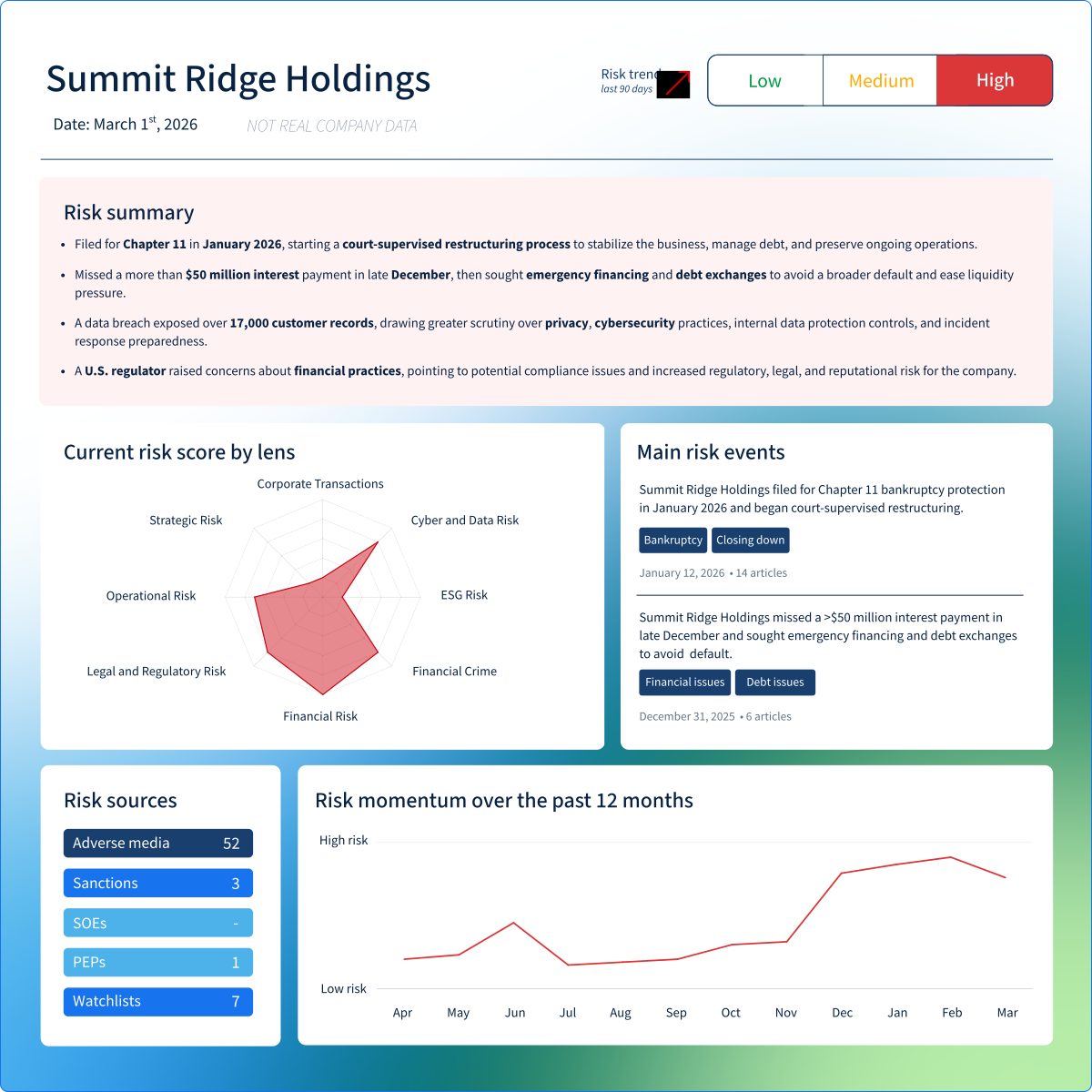
Effective platforms apply risk categorization to distinguish material signals from routine coverage. Owlin applies eight risk lenses: corporate transactions, data and cyber risk, ESG, financial crime, financial risk, legal matters, operational risk, and strategic risk to prioritize alerts for analyst review.
3. Multi-language source coverage
Vendors operating in emerging markets often generate risk signals in local-language media long before international outlets report the story, so platforms limited to English-language sources miss early indicators.
Consider your vendor portfolio’s geography when evaluating source coverage. Owlin monitors over 3 million sources globally, including regional publications and niche industry outlets, so signals surface regardless of where the news originates. See our breakdown of adverse media monitoring tools for a closer look at how coverage breadth is typically evaluated.
4. Open-universe screening
Open-universe screening covers any entity with an online presence, closing the gap left by closed-universe databases that only track large, well-documented companies.
This matters when your portfolio includes fintech partners, specialized service providers, or regional suppliers. Owlin’s outside-in approach enables screening and monitoring of any business with an online footprint, even those missing from conventional company databases.
5. Sanctions and PEP screening
Sanctions and PEP (politically exposed person) screening checks vendors against global watchlists at onboarding and continuously monitors for status changes afterward.
Look for platforms that alert you automatically when a previously cleared vendor appears on a new list, rather than requiring manual rechecks. This capability supports compliance with anti-money laundering regulations and OFAC requirements (U.S. Department of the Treasury, Office of Foreign Assets Control, n.d.).
6. Explainable risk scoring
Explainable risk scoring traces every score back to specific sources and events, so analysts can evaluate the evidence instead of trusting a black box.
Owlin’s risk scores connect to identifiable data points, allowing compliance officers to assess whether an alert warrants action or represents a false positive, a distinction that matters for both analyst efficiency and regulatory documentation.
7. Audit trail generation
Automated audit trails log every screening, alert, and analyst action, producing the documentation examiners expect when they ask how a vendor was monitored.
Manual recordkeeping cannot scale across large vendor portfolios. Owlin enables swift generation of audit trails for each onboarding case and monitoring alert response, directly supporting DORA requirements and OCC examination expectations (European Parliament & Council of the European Union, 2022; Board of Governors of the Federal Reserve System et al., 2023).
8. API integration
API integration pushes risk intelligence into the vendor management, GRC, and compliance systems your team already uses, instead of requiring a separate check in a standalone tool.
Evaluate how each platform integrates with your current technology stack. Owlin offers API integrations that embed insights directly into procurement and compliance workflows, plus dashboard access and daily email summaries.
9. Private company and ownership risk coverage
Structured business databases are built around large, publicly documented companies, which leaves a visibility gap for privately held vendors, a significant share of most bank vendor portfolios.
Private and closely held companies disclose far less financial and ownership information than public companies, making standard screening tools less reliable for this segment. Platforms with private markets depth surface risk signals, ownership changes, financial distress, and legal disputes for vendors that don’t file public disclosures, closing a blind spot that closed-database tools tend to leave open in vendor risk assessments.
Why these capabilities matter for bank risk teams
The nine capabilities outlined above address the core challenge facing bank risk teams: maintaining effective vendor oversight at scale. Regulatory guidance from the OCC, FFIEC, and European authorities under DORA has made clear that annual reviews no longer satisfy examination expectations (Board of Governors of the Federal Reserve System et al., 2023; Federal Financial Institutions Examination Council, n.d.; European Parliament & Council of the European Union, 2022), see our breakdown of what the interagency guidance requires for a closer look at what ongoing oversight means in practice. Banks need platforms that deliver ongoing intelligence without overwhelming analyst capacity.
Owlin brings these capabilities together in a single platform purpose-built for regulated financial institutions. The combination of real-time monitoring, multi-language adverse media coverage, open-universe screening, private markets depth, and automated audit trails addresses the specific requirements bank compliance officers face. Regional banks and large institutions alike rely on Owlin’s AI-powered platform to detect third-party risks before they escalate into material problems.
Want to see how these capabilities work with your vendor portfolio?
Schedule a call and evaluate the platform against your specific monitoring requirements.
FAQs about bank risk intelligence capabilities
What makes third-party risk intelligence different from vendor management?
Vendor management tracks contract terms, renewal dates, and performance metrics. Third-party risk intelligence monitors external signals indicating whether a vendor relationship might expose your institution to harm. The two functions complement each other: risk intelligence surfaces early warning signals that inform vendor management decisions, from onboarding approvals to relationship termination.
How does real-time monitoring support regulatory compliance?
Real-time monitoring generates timestamped alerts and response records that demonstrate active, ongoing vendor surveillance, the standard DORA, OCC guidance, and FFIEC frameworks expect in place of periodic reviews (European Parliament & Council of the European Union, 2022; Board of Governors of the Federal Reserve System et al., 2023; Federal Financial Institutions Examination Council, n.d.). These records satisfy examiner questions about how an institution tracks vendor risks between formal assessment cycles.
Why does multi-language coverage matter for adverse media?
Because risk signals often appear first in local or regional media before reaching major newswires. A vendor operating internationally may face regulatory enforcement or reputational issues reported only in local-language sources, so multi-language monitoring gives risk teams more time to assess and respond before the issue escalates.
What is open-universe screening?
Open-universe screening monitors any entity with an online presence, regardless of whether it appears in traditional business databases. This fills coverage gaps for smaller vendors, private companies, and entities in emerging markets, segments that closed-database platforms typically miss.
How do explainable risk scores reduce false positives?
Transparent scoring traces each alert to specific sources and events, so analysts can quickly evaluate whether the underlying evidence warrants action rather than treating every alert as equally urgent. That improves analyst efficiency and keeps resources focused on material risks rather than noise.
What should banks look for in API integration capabilities?
Effective integration pushes risk intelligence into existing GRC, procurement, and compliance systems, and delivers alerts through channels the team already monitors. This reduces manual effort and ensures critical signals reach decision-makers without delay.
Why does private company coverage matter for bank vendor portfolios?
Because a large share of bank vendors, fintech partners, regional suppliers, and specialized service providers are privately held and don’t file the public disclosures that closed-universe screening tools rely on. Coverage built for private markets surfaces ownership and financial risk signals that would otherwise go undetected until they surface elsewhere.
Sources
- Board of Governors of the Federal Reserve System, Federal Deposit Insurance Corporation, & Office of the Comptroller of the Currency. (2023). Interagency guidance on third-party relationships: Risk management. OCC Bulletin 2023-17.
- Federal Financial Institutions Examination Council. (n.d.). IT Examination Handbook: Third-party management. FFIEC.
- European Parliament & Council of the European Union. (2022). Regulation (EU) 2022/2554 on digital operational resilience for the financial sector (DORA). Official Journal of the European Union.
- U.S. Department of the Treasury, Office of Foreign Assets Control. (n.d.). Sanctions programs and country information. OFAC.