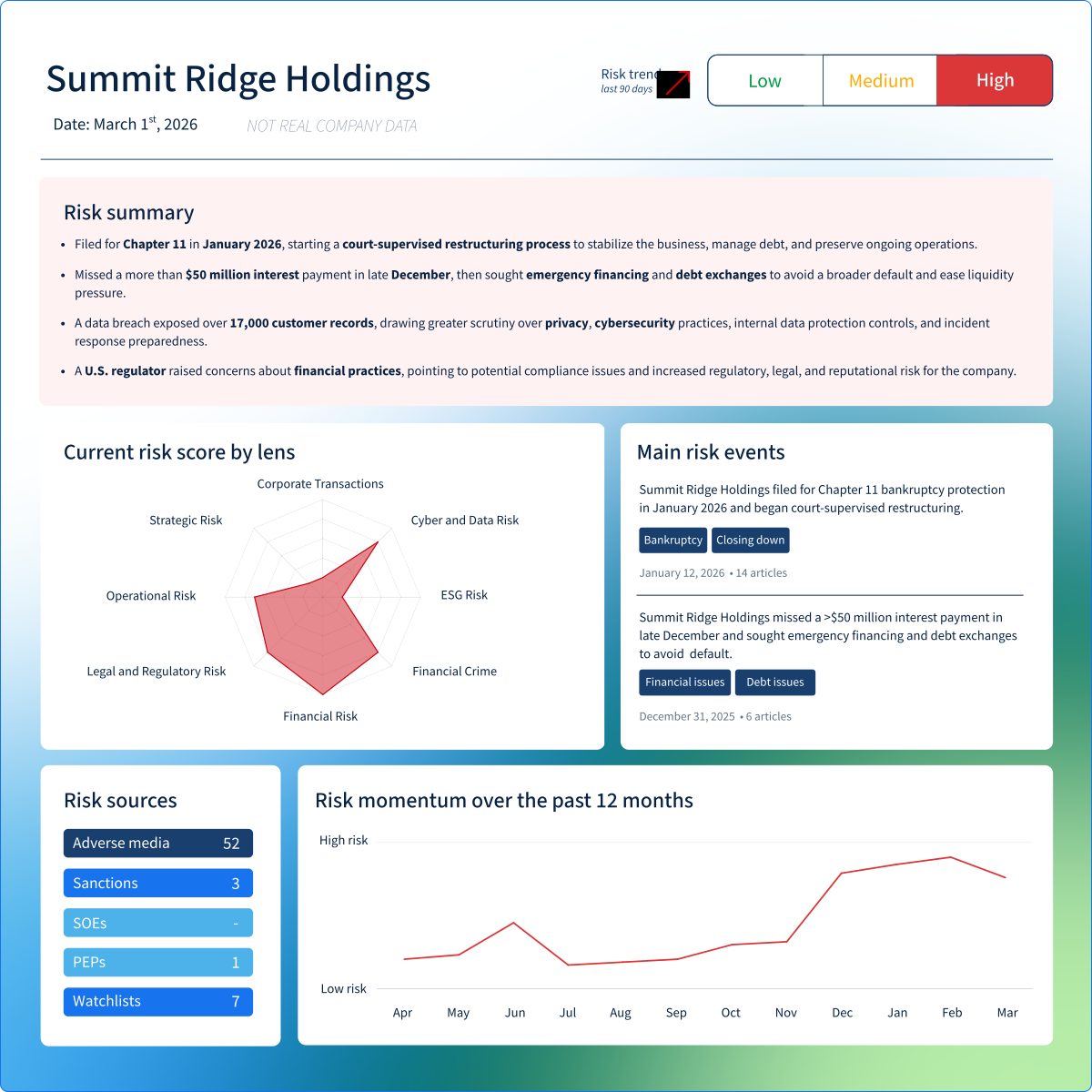
The Complete Guide to Early Warning Gaps in TPRM

An early warning gap is the delay between a third-party risk signal first appearing publicly and your TPRM program surfacing it. Third-party risk programs are getting bigger, but the risks they miss are getting more expensive. Regulators are tightening expectations, vendor portfolios keep expanding, and the signals that matter most still slip through undetected.
A regional adverse media mention, a sanctions list update, a newly surfaced PEP connection: these signals often surface publicly long before periodic monitoring catches up. This guide breaks down where third-party risk monitoring gaps form, why traditional tools miss them, and what risk and compliance teams can do to close them.
Owlin helps risk teams move from reactive alert-chasing to proactive event intelligence, replacing noise with prioritized, traceable risk signals across adverse media, sanctions, PEPs, state-owned enterprises, watchlists, and blacklists.
Key takeaways
- Point-in-time assessments create blind spots because vendor risk changes faster than annual review cycles can track.
- Fragmented data sources and siloed tools prevent risk teams from connecting signals into a clear, prioritized picture.
- Third-party involvement in data breaches doubled to 30% in a single year1, while most TPRM programs still monitor periodically.
- Event-based monitoring reduces noise by grouping related alerts into scored events, so analysts review only elevated risks that need attention.
- Outside-in risk intelligence from open-universe sources catches early warnings that closed-database vendors routinely miss.
- DORA, CSDDD, and national supply chain laws now expect ongoing, not periodic, oversight of third-party relationships.
What are early warning gaps in third-party risk monitoring?
An early warning gap is the time between when a risk signal first appears and when your TPRM program actually surfaces it. That gap might be hours, days, or weeks, depending on how your monitoring is structured.
In practice, it’s the window during which a vendor’s financial instability, regulatory trouble, or reputational damage is already public knowledge somewhere, but your risk team doesn’t know about it yet.
These gaps form at predictable points: when monitoring relies on periodic reviews, when data sources are limited to English-language wire services, or when alerts flood in without context and bury the signal that matters.
For risk managers and compliance officers at financial institutions, early warning gaps translate directly into regulatory exposure. A missed adverse media mention on a critical vendor can become an audit finding, a DORA register inconsistency, or an AML question you can’t answer with evidence.
Why do traditional TPRM tools miss early warning signs?
Traditional TPRM tools were designed for point-in-time due diligence, not continuous risk detection. Ask yourself: when was the last time your TPRM tool surfaced a risk before you read about it in the news? For many risk teams, the honest answer is uncomfortable.
Point-in-time assessments
Annual or semi-annual vendor assessments capture a snapshot, nothing more. A vendor might pass every check in January and face a regulatory investigation by March. If your next review isn’t until December, material risk sits undetected in your portfolio for nine months.
The scale of the problem is growing. Verizon’s 2025 Data Breach Investigations Report found that third-party involvement in breaches doubled from 15% to 30% year over year1. TPRM programs are expanding in scope, yet the interval between checks hasn’t changed.
Limited source coverage
Closed-database vendors build their coverage from licensed, curated source lists refreshed on a fixed schedule. That structure works well for regulated, high-volume sources like sanctions lists and court filings.
It creates a gap elsewhere. Risk signals from local news, regional outlets, NGO reports, or non-English media often surface days or weeks after an event, if at all. Say you monitor a mid-size supplier in Southeast Asia. A local-language outlet reports a labor investigation, but your closed-database vendor doesn’t carry that source. The signal exists; your program never sees it.
Alert overload and false positives
Your monitoring tool generates thousands of alerts per week: adverse media articles, sanctions matches, watchlist flags, PEP hits, SOE connections, all arriving as separate, unsorted records. Analysts spend hours reading the same story from ten different sources.
Event-based monitoring changes the unit of work. Across a real portfolio of 150 monitored companies, Owlin screened 95,000 records in a year; relevance filtering, deduplication, and materiality scoring brought that down to 580 elevated risk events, a 99.4% reduction in review volume, or roughly eleven items a week that need a human. Nothing is deleted along the way: filtered records and merged sources stay traceable. Read the full breakdown of what 99.4% noise reduction looks like.
Siloed signal types
Many organizations run separate tools for adverse media, sanctions screening, PEP checks, and watchlist monitoring. Each produces its own alerts, its own format, its own risk scoring.
When signal types are siloed, early warnings that only become visible through cross-referencing stay hidden. A vendor might look clean in each individual silo while accumulating signals that, taken together, paint a very different picture.
Point-in-time vs. event-driven third-party monitoring
| Point-in-time monitoring | Event-driven monitoring | |
|---|---|---|
| Detection trigger | Scheduled review (annual, semi-annual) | New risk event, as it appears |
| Source coverage | Closed, curated databases | Open universe: local, regional, and global sources |
| Unit of work | Individual alerts and articles | Grouped, scored risk events with a narrative |
| Signal types | Separate tools per signal | Adverse media, sanctions, PEPs, SOEs, watchlists, and blacklists in one view |
| Audit trail | Evidence collected at review time | Continuous log of detection, classification, and action |
| Typical early warning gap | Weeks to months | Hours to days |
What causes early warning gaps to form?
The root causes are structural, not accidental. They’re built into how many TPRM programs were originally designed.
Compliance-first program design
Many TPRM programs were built to satisfy audit requirements, not to reduce actual risk exposure. Workflows are optimized for collecting evidence: questionnaires completed, documents filed, assessments logged.
That design is excellent for demonstrating due diligence during an audit. It’s far less effective at detecting a vendor’s deteriorating financial health or emerging regulatory trouble between review cycles.
Vendor-reported data as the primary input
When the vendor controls the narrative, through self-completed questionnaires and curated trust center pages, the information you receive is inherently filtered. Vendors present their best face during evaluations.
The problem is that risk teams often accept vendor-supplied data as verified evidence rather than treating it as one input among many that needs independent validation.
Manual processes that don’t scale
Spreadsheet-based tracking, email-driven workflows, and manual alert triage were workable when vendor portfolios contained dozens of entities.
With portfolios now stretching into hundreds or thousands of counterparties, manual work creates bottlenecks at every stage. Onboarding takes longer, re-assessments pile up, and alert queues grow faster than analysts can clear them. Limiting monitoring to “high-risk” vendors only is a common workaround, and it’s exactly where blind spots form.
Which regulations require ongoing third-party monitoring?
Ongoing oversight of third parties has moved from best practice to explicit regulatory expectation across multiple EU frameworks. Owlin’s regulation-specific solutions map to each of these.
DORA (Digital Operational Resilience Act)
DORA, applicable since January 2025, requires EU financial entities to manage ICT third-party risk across the full contract lifecycle, maintain a register of information on all ICT service providers, and monitor those providers on an ongoing basis rather than only at onboarding2.
CSDDD (Corporate Sustainability Due Diligence Directive)
The CSDDD requires in-scope companies to identify, prevent, and mitigate adverse human rights and environmental impacts across their chain of activities, including those caused by business partners, and to monitor the effectiveness of those measures on an ongoing basis3. Scope and application dates have been revised under the EU’s Omnibus simplification package, but the core obligation to keep monitoring rather than assess once remains.
PSD3, PSR, and national supply chain laws
The upcoming PSD3 and Payment Services Regulation package tightens fraud prevention and third-party oversight expectations for payment service providers. National regulations like Germany’s Supply Chain Act (LkSG) already require risk analysis and ongoing monitoring of supply chain partners, and are being aligned with the CSDDD.
Five early warning signals that TPRM programs miss
These are the signals that matter in practice but are routinely missed by traditional monitoring setups.
1. Regional and non-English adverse media
A vendor’s problems often surface first in local media before reaching international outlets. If your monitoring covers only English-language sources, you’re missing the earliest warning signs.
Owlin monitors more than 3 million global and local sources in multiple languages, with coverage across 240+ countries and territories, so a risk signal reported by a regional outlet can be flagged the same day it appears. This is particularly relevant for emerging-market counterparties and private companies with thin data footprints.
2. Regulatory filings and enforcement actions
Regulatory notices, enforcement actions, and corporate filings often appear in public registers and disclosures before they’re picked up by mainstream coverage.
A supervisory warning, a licence condition, or a disclosure buried in an 8K or 10K filing can signal deteriorating financial health or compliance trouble weeks before it becomes news. Monitoring these sources alongside adverse media creates a fuller picture of an entity’s risk trajectory.
3. Sanctions and watchlist changes between review cycles
Sanctions lists and regulatory watchlists are updated frequently, sometimes daily. If screening runs only at onboarding or during periodic reviews, entities sanctioned between cycles remain undetected.
This is one of the most straightforward early warning gaps to close, and one of the most consequential to leave open.
4. PEP and state-owned enterprise connections
Politically exposed persons and state-owned enterprise affiliations change as governments reshuffle and ownership structures evolve. These changes can alter a counterparty’s risk profile overnight.
Static due diligence checks miss these shifts entirely, because they reflect a moment in time rather than a relationship that’s actively evolving.
5. Gradual risk accumulation across signal types
Sometimes the early warning isn’t a single dramatic event. It’s a pattern: a minor adverse media mention, followed by a regulatory notice, followed by a watchlist flag from a lesser-known jurisdiction.
No single signal triggers an alert, but the accumulation tells a clear story. This is exactly the type of risk that siloed tools miss, and that unified, event-based monitoring catches.
How to close early warning gaps in your TPRM program
Closing early warning gaps requires changes at the data, workflow, and tooling level. Here’s a step-by-step approach grounded in what works for risk teams at scale.
Step 1: Shift from periodic to event-driven monitoring
Replace annual or quarterly assessment cycles with event-driven monitoring that surfaces risk signals as they emerge. This doesn’t mean abandoning structured assessments. It means adding a continuous intelligence layer that runs between them.
Owlin’s Event Detection Agent groups related signals into single, scored risk events, and Event Timelines turn fragmented articles, sanctions hits, and risk signals into one contextualized narrative. Your analysts review one clear story instead of piecing together fragments from multiple alerts. See how the new monitoring environment was designed around this.
Step 2: Expand source coverage beyond closed databases
Closed data vendors are strongest on structured, well-documented sources. But early warning signs often originate in sources those vendors don’t cover: local news outlets, niche publications, and non-English media.
An open-universe approach means you’re monitoring the actual information landscape rather than a curated subset. Owlin owns its data pipeline across 3 million+ sources, which means sources can be added as coverage needs change. For entities with limited traditional database coverage, this difference is material.
Step 3: Unify signal types into a single view
Consolidating adverse media, sanctions, PEPs, watchlists, and SOEs into one place eliminates the manual work of cross-referencing separate tools.
Owlin’s OmniSignal view brings all signal types together on a single entity profile. Your team sees the full risk picture for each entity without switching between tools or reconciling conflicting formats.
Step 4: Prioritize by risk impact, not alert volume
A single sanctions hit on a critical vendor matters more than a hundred low-relevance media mentions. Effective monitoring prioritizes on actual risk impact: the severity of the event, the criticality of the entity, and relevance to your risk framework.
Owlin’s Risk Scoring Agent does this with explainability built in: every score is traceable back to the underlying events and sources, so analysts can see why an entity was prioritized. No black box, just clarity.
Step 5: Build an audit trail that satisfies regulators
Your monitoring system should log when a signal was detected, how it was classified, and what action was taken.
This trail demonstrates to regulators that your monitoring is active and responsive. Look for tools that trace every score and event back to its source, so you can walk an examiner through your reasoning. This is the standard Owlin’s Responsible Intelligence principles are built on: evidence before AI, explainable by design, and humans staying in control.
Step 6: Integrate risk intelligence into existing workflows
Risk intelligence only reduces risk if it reaches the right people at the right time. Risk signals should feed directly into your GRC platform or case management system, triggering actions rather than sitting in a separate dashboard.
Owlin sits upstream of GRC platforms as the intelligence layer that detects and structures external risk events and pushes them into existing TPRM workflows, via API or email alerts. The gap between detection and action is itself a risk worth closing.
How does outside-in risk intelligence differ from traditional approaches?
Outside-in risk intelligence starts with what the world says about an entity, independent of what the entity says about itself. Traditional TPRM relies heavily on inside-out intelligence: information the vendor gives you, assessments you conduct, and databases you query.
Outside-in signals (adverse media, regulatory actions, enforcement notices, sanctions updates) often appear before a vendor discloses an issue or before a structured database captures it. This approach doesn’t replace due diligence. It adds a layer that’s independent of vendor self-reporting.
Owlin’s risk intelligence platform is built on this outside-in principle. By monitoring 3 million+ sources and structuring raw data into scored, summarized events, Owlin gives risk teams visibility into developments that closed systems miss. For a broader comparison of approaches, see our 2026 guide to third-party risk intelligence platforms for banks.
How to evaluate your current monitoring for early warning gaps
Before investing in new tools, ask where your current setup falls short. Use this checklist against your existing TPRM stack.
- Source coverage: How many sources and languages does your monitoring cover? If it’s limited to English-language wire services, your early warning detection has significant blind spots.
- Alert-to-insight ratio: How many alerts per week lead to an actual risk decision? If analysts spend more time sorting noise than acting on signals, your monitoring generates volume without value.
- Signal integration: Can you see adverse media, sanctions, PEPs, watchlists, and blacklists for one entity in one place? If not, you’re missing cross-signal patterns.
- Time-to-detection: When a risk event hits the news, how long before your system surfaces it? Hours is acceptable. Days or weeks is a gap worth fixing.
- Audit readiness: Can you show a regulator when you detected a signal, how it was classified, and what followed? If that trail doesn’t exist, your monitoring may satisfy internal checklists but not external scrutiny.
If you’re comparing vendors, our guides to the best adverse media screening software and top adverse media monitoring tools in 2026 cover what to look for.
Building a TPRM program that catches early warning signs
Early warning gaps in TPRM aren’t caused by a lack of effort. They’re caused by structural limitations: point-in-time assessments, closed data sources, siloed signal types, and alert overload.
Closing those gaps requires a shift from compliance-driven evidence collection to risk-driven event intelligence: broader source coverage, unified signals, and prioritization based on actual risk impact rather than raw alert volume.
Owlin’s event-based monitoring platform, recognized by Chartis Research as a Category Leader in adverse media monitoring, is built for exactly this shift. By grouping related risk signals into scored, explainable events, covering 3 million+ sources, and unifying adverse media, sanctions, PEPs, SOEs, and watchlists in one view, Owlin helps risk teams detect what matters early.
FAQs about early warning gaps in TPRM
What is an early warning gap in TPRM?
An early warning gap is the delay between when a third-party risk signal first appears publicly and when your monitoring system detects it. These gaps form when monitoring relies on periodic reviews, limited source coverage, or siloed tools that don’t cross-reference signal types.
Why do traditional TPRM tools miss early warning signs?
Traditional tools were designed for point-in-time due diligence, not continuous risk detection. They depend on closed databases with limited coverage, refresh on fixed schedules, and treat each signal type separately, leaving local media and regulatory signals undetected for days or weeks.
What is event-driven third-party monitoring?
Event-driven monitoring surfaces risk as it happens rather than on a review schedule. Related alerts from multiple sources are grouped into a single scored event with a narrative summary, so analysts review one story per development instead of dozens of separate records.
How does Owlin reduce false positives in risk monitoring?
Through sequential filters: a relevance stage removes wrong-entity and incidental matches, deduplication merges coverage of the same development into one event, scoring flags what’s materially elevated, and alerts fire only when a company’s risk level changes. On a 150-company portfolio, 95,000 screened records became 580 elevated risk events over a year, a 99.4% reduction in review volume.
What regulations require ongoing third-party monitoring?
DORA requires ongoing monitoring of ICT third-party service providers across the contract lifecycle. CSDDD extends due diligence to human rights and environmental impacts across the chain of activities. The PSD3/PSR package tightens oversight for payment service providers, and national laws like Germany’s LkSG require ongoing supply chain risk analysis.
How does outside-in risk intelligence close early warning gaps?
Outside-in intelligence monitors what the world says about an entity, independent of vendor self-reporting. Owlin scans 3 million+ sources in near real time, detecting adverse media, regulatory actions, and sanctions changes before closed-database vendors capture them.
What should risk teams look for in a monitoring tool?
Prioritize broad source coverage (including non-English and local media), unified signal types, event-based alerting, explainable AI scoring with source traceability, and integration into your GRC or case management workflows. The tool should make your team faster, not add to the backlog.
Sources
- Verizon. (2025). 2025 Data Breach Investigations Report. Verizon Business.
- European Parliament and Council. (2022). Regulation (EU) 2022/2554 on digital operational resilience for the financial sector (DORA). Official Journal of the European Union.
- European Parliament and Council. (2024). Directive (EU) 2024/1760 on corporate sustainability due diligence (CSDDD). Official Journal of the European Union.