The Best Supply Chain Risk Intelligence Software

Procurement and supply chain teams share a recurring problem: identifying which suppliers carry elevated risk before a disruption reaches your operations. Traditional compliance databases and periodic audits often surface issues too late, leaving you to react rather than prepare. Supply chain risk intelligence software addresses that gap by aggregating real-time data from global sources and translating it into structured, prioritised risk signals.
Owlin delivers continuous, AI-driven supply chain risk monitoring built for teams that need to track hundreds or thousands of suppliers across regions and risk categories. This article compares five platforms that help you monitor supplier resilience, detect adverse signals early, and make decisions grounded in traceable evidence.
Quick guide: 5 best supply chain risk intelligence software for procurement teams
- Owlin: The best supply chain risk intelligence software for real-time, outside-in supplier monitoring with explainable risk scores
- Exiger: Multi-tier supply chain mapping for defence and trade compliance use cases
- Everstream Analytics: Predictive disruption sensing for large OEMs with complex logistics networks
- Prewave: AI-based supplier risk alerting for automotive and manufacturing procurement
- Moody’s (Supply Chain Catalyst): Financial and compliance risk scoring built on the Orbis entity database
How we chose the best supply chain risk intelligence software for supplier monitoring
We evaluated platforms based on the criteria that matter most to procurement and risk teams responsible for ongoing supplier oversight. Each criterion reflects a practical requirement for professionals managing supplier portfolios at scale.
- Real-time risk detection: You need to know about supplier issues as they develop, not weeks after they occur. We assessed how quickly each platform surfaces new risk signals from global data sources.
- Noise reduction and alert quality: A flood of irrelevant alerts drains your team’s capacity. We looked for platforms that filter noise effectively and deliver contextualised, actionable alerts.
- Explainability and traceability: Your decisions must be defensible. We prioritised platforms that link every risk score and alert to verifiable source data.
- Coverage of risk categories: Supply chain risk spans sanctions, adverse media, ESG, financial distress, and geopolitical events. We assessed the breadth of risk signals each platform covers.
- Scalability for large portfolios: Growing supplier networks require platforms that maintain performance and insight quality across thousands of monitored entities.
- Integration with existing workflows: Risk intelligence is only useful if it reaches your procurement or compliance system. We evaluated API availability and integration options.
The 5 best supply chain risk intelligence software
1. Owlin: Best overall supply chain risk intelligence software for supplier monitoring
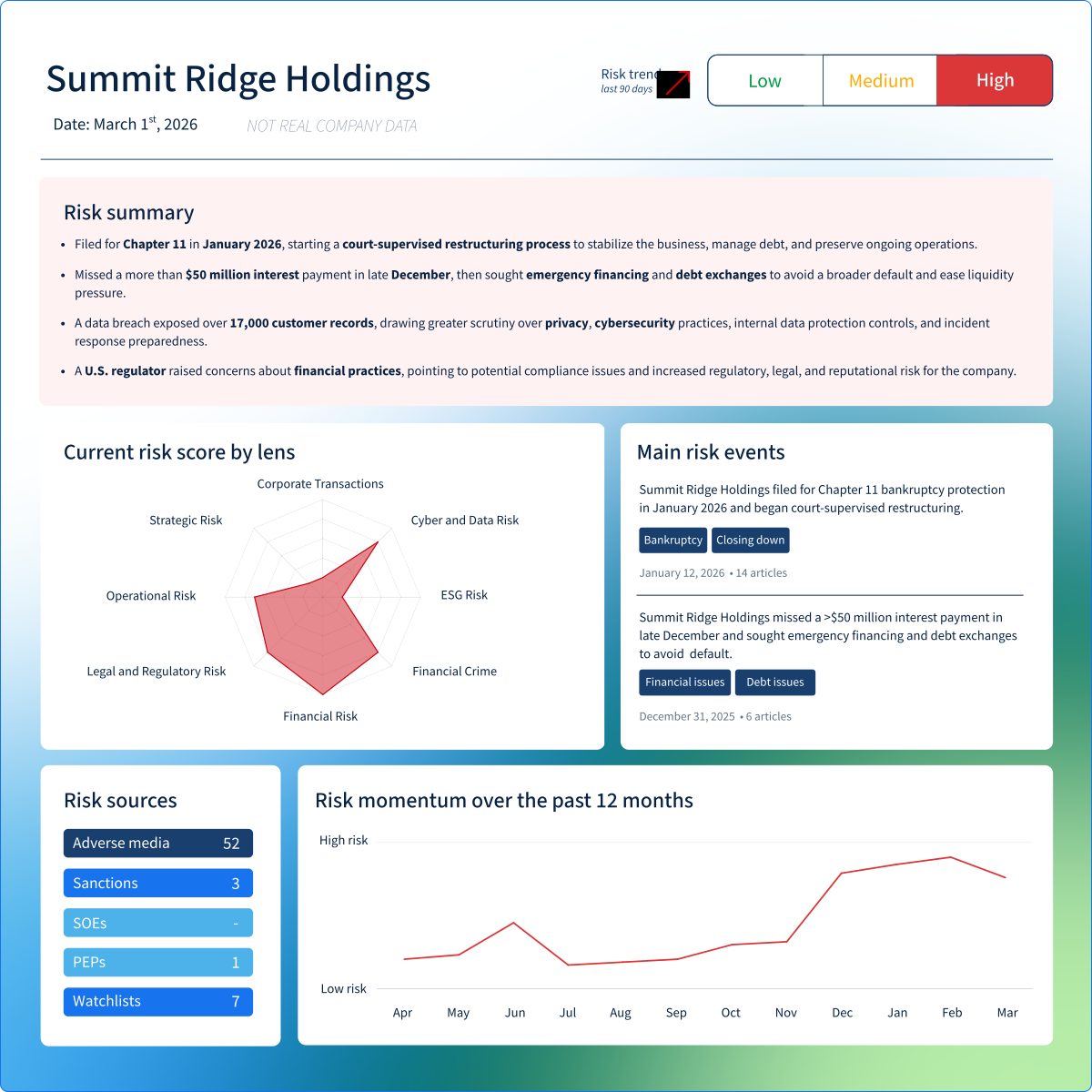
Owlin approaches supply chain risk from an outside-in perspective, monitoring your suppliers across adverse media, sanctions, PEP lists, SOEs, watchlists, and ESG risk indicators. Rather than relying on a static database, Owlin works as your external risk agent. It reads global sources around the clock, so your team never has to. It then resolves each signal to the right supplier, evaluates what the event means, and returns a clear, explainable risk assessment.
Most tools hand you a feed of alerts and leave the analysis to you. Owlin does the work for you instead. Its AI agents group fragmented articles into single events, score their severity, and summarise what happened. As a result, your team starts each day with a ranked view of the suppliers that need attention, not a backlog of headlines.
Owlin analyses over three million sources across geographies, 24/7. Major financial institutions across the US and Europe rely on Owlin, including banks, payment service providers and private equity firms. Corporate procurement teams use the same intelligence to monitor suppliers at scale.
Owlin’s AI agents
Owlin’s platform runs three specialised agents. Each one takes on a task your analysts would otherwise do by hand:
- Event Detection Agent: Scans millions of sources in real time, spots new risk events linked to your suppliers and alerts your team as they unfold.
- Risk Scoring Agent: Scores every event and supplier, then ranks your full portfolio in the Risk Prioritization Monitor. You see your highest-risk suppliers the moment you log in.
- 360° Summary Agent: Turns scattered articles into one clear Event Timeline, with the context, connections and evidence behind each development.
Importantly, Owlin never asks you to trust a black box. Every agent follows Owlin’s Responsible Intelligence principles: evidence comes before AI, every output is explainable by design, and humans stay in control. In practice, every score links back to its sources, and your analysts always make the final call.
Owlin features
- Risk Prioritization Monitor: Ranks your supplier portfolio by risk score, so you focus on the entities that need action first.
- Event Timeline with Chain-of-Events: Connects related signals into one summarised story, so you see how a risk developed over time.
- Owlin OmniSignal coverage: Brings adverse media, sanctions, PEPs, SOEs, watchlists, blacklists, and ESG indicators into a single risk view.
- Explainable risk scores: Links every score to its underlying sources, giving you an audit-ready trail for each decision.
- Owlin Screening: Screens any company with an online footprint in one click, including entities missing from traditional company databases.
- Integrations and API: Delivers risk intelligence straight into the tools your team already uses. Owlin integrates with partners such as Venminder, Fitch Solutions and Aprovall.
Owlin pros and cons
Pros:
- Acts as an external risk agent that reads, scores, and summarises risk for you, cutting manual monitoring work.
- Recognised by Chartis Research as a Category Leader for Adverse Media Monitoring and named in the Chartis RiskTech100® ranking.
- Explainable, source-linked scores support regulatory and internal audit requirements.
- Scales from dozens to tens of thousands of monitored entities with automated entity creation.
- Plugs into your existing procurement, TPRM, and compliance stack through its API and integration partners.
Cons:
- Owlin focuses on external risk intelligence, so it pairs with your existing systems for internal supplier data such as contracts or bills of materials.
- Teams new to event-based monitoring may want onboarding support to tailor risk filters and taxonomies.
2. Exiger
Exiger focuses on end-to-end supply chain visibility. Its 1Exiger platform maps entities, ownership structures, facilities and materials across multiple supplier tiers. The platform mainly serves defence contractors, government agencies and large enterprises with trade compliance needs.
Exiger features
- N-tier supplier mapping: Maps ownership, facilities and materials across several supplier levels.
- Trade compliance engine: Traces country of origin, tariff exposure and transshipment risk.
- Workflow automation: Converts alerts into remediation steps, such as attestation requests.
Exiger pros and cons
Pros:
- Combines supply chain risk, trade compliance and third-party risk in one platform.
- Deep ownership and sub-tier mapping for complex, regulated supply chains.
Cons:
- Built mainly for large enterprises and government, so mid-market teams may find the scope broader than they need.
- Its defence and federal focus means commercial procurement workflows can need extra configuration.
- Pricing is not public and requires a scoping engagement.
3. Everstream Analytics
Everstream Analytics combines predictive analytics with multi-tier supplier mapping. The company grew out of logistics and weather-modelling businesses, so its strength lies in forecasting operational disruption. Large manufacturers in automotive, life sciences, and consumer goods make up much of its customer base.
Everstream Analytics features
- Disruption forecasting: Predicts weather, port congestion, geopolitical and supplier financial events.
- Multi-tier supplier mapping: Identifies hidden dependencies from Tier-1 to Tier-N suppliers.
- Event-impact estimates: Estimates the operational impact of a disruption at product and route level.
Everstream Analytics pros and cons
Pros:
- Strong focus on logistics and physical disruption for manufacturing supply chains.
- Multi-tier mapping extends visibility beyond direct suppliers.
Cons:
- Full multi-tier mapping at enterprise scale requires significant data loading and ERP integration.
- Its logistics focus makes it less suited to compliance-driven risk, such as adverse media or sanctions monitoring.
- Pricing is not public and typically requires a consultative engagement.
4. Prewave
Prewave is a Vienna-based platform that scans online sources in many languages and sends real-time risk alerts to procurement teams. It covers a wide range of risk categories, including ESG, financial risk, labour disputes, and natural disasters.
Prewave features
- Broad risk taxonomy: Covers a long list of risk types, from ESG indicators to natural disasters.
- Multilingual monitoring: Analyses local-language sources to detect regional supplier risks.
- Predictive analytics: Uses pattern recognition to flag likely risk events in selected categories.
Prewave pros and cons
Pros:
- Wide category coverage for teams tracking diverse risk types across global supply chains.
- Fast alerting on high-impact events.
Cons:
- Built mainly for automotive and manufacturing, so financial services teams may find its taxonomies less aligned with their compliance frameworks.
- The large number of categories can require configuration to match your risk appetite.
- Sub-tier mapping depends on supplier participation, which varies by region and supplier size.
5. Interos
Interos, based in Arlington, Virginia, maps multi-tier supplier networks and monitors them for disruption. Its proprietary i-Score rates suppliers across six risk domains: cyber, catastrophic, ESG, regulatory, geopolitical, and financial. In 2026, the company also launched iQ, which adds reputational risk and tariff exposure modules.
Interos features
- Multi-tier supplier mapping: Discovers supplier relationships beyond Tier 1.
- i-Score: Gives each supplier a single composite risk rating.
- Financial exposure estimates: Matches ERP data to risk signals to estimate exposure in monetary terms.
Interos pros and cons
Pros:
- Strong multi-tier visibility for complex global supply chains.
- Translates supplier risk into financial terms for executive reporting.
Cons:
- A single composite score can make it harder to see exactly which evidence drives a rating.
- Built mainly for large enterprises and government agencies rather than mid-sized teams.
- Adverse media depth is narrower than that of specialised external risk intelligence platforms.
Comparison table: the best supply chain risk intelligence software
Each platform solves a different part of supplier risk. The table below shows where each one fits best.
| Platform | Best for | Explainable, source-linked scores | Real-time external event detection | AI agents and summaries | Multi-tier physical mapping |
|---|---|---|---|---|---|
| Owlin | Real-time external risk intelligence for financial institutions and procurement teams | YesEvery score links to its sources | Yes24/7 across 3M+ sources | YesEvent Detection, Risk Scoring and 360° Summary agents | Via integrations with your existing systems |
| Exiger | Defence and trade compliance | Partial | Yes | Workflow automation | Yes |
| Everstream Analytics | Logistics disruption for large manufacturers | Partial | YesFocused on operational disruption | Partial | Yes |
| Prewave | Automotive and manufacturing procurement | Partial | Yes | Partial | PartialDepends on supplier participation |
| Interos | Large enterprises and government | PartialSingle composite i-Score | Yes | PartialExecutive summaries in iQ | Yes |
What should you look for in supply chain risk intelligence software?
Start with explainability. A risk score without visible evidence creates blind spots, especially when you must justify a sourcing decision to a regulator or your board. So, ask every vendor one simple question: can you show me exactly why this supplier scored high?
Next, look at how much work the platform actually removes. A tool that sends thousands of unstructured alerts each week doesn’t reduce your workload; it simply moves it. Instead, look for an agentic platform that groups signals into events, scores them and summarises them for you.
Finally, check how the intelligence reaches your team. APIs, integration partners and role-based dashboards decide whether insight turns into faster action.
What is an external risk agent?
An external risk agent is AI that monitors the outside world on your behalf. It reads news, sanctions lists, watchlists, and ESG sources, links each signal to the right supplier, and evaluates what the event means for you. Then it returns a scored, explained risk assessment and alerts your team.
In other words, it acts like a team member who reads everything, all the time. Unlike a black-box model, however, a well-designed risk agent shows its evidence. Your analysts stay in control and make the final decision.
How does outside-in risk monitoring differ from traditional supplier audits?
Traditional audits capture a supplier’s status at one point in time, often based on self-reported data. Between audits, new risks can develop unnoticed.
Outside-in monitoring closes that gap. It scans global open sources continuously, including news, regulatory updates and sanctions lists. As a result, you get a near-real-time view of supplier risk that complements your periodic assessments.
For teams working under the CSDDD or the German Supply Chain Act, continuous monitoring is fast becoming an expectation. Combining screening with ongoing monitoring helps you stay compliant without relying on manual review cycles alone.
Why Owlin is the best supply chain risk intelligence software
Owlin gives you the story behind every supplier risk, not just a score. As your external risk agent, it reads the world’s news and risk data, connects scattered signals, and delivers clear, prioritised intelligence to your team.
Together, the Event Detection, Risk Scoring, and 360° Summary agents mean you spend less time reading irrelevant alerts. Instead, you spend more time acting on the risks that matter. And because every score links back to its sources, each decision you make stays defensible and audit-ready.
See Owlin’s risk agents in action
Discover how Owlin monitors your suppliers in real time and explains every risk it finds.
FAQs about supply chain risk intelligence software
What is supply chain risk intelligence software?
Supply chain risk intelligence software monitors your suppliers for risk signals such as adverse media, sanctions, financial distress, and ESG violations. Owlin acts as an external risk agent: it scans over three million global sources and delivers prioritised, explainable alerts, so you can act before a disruption reaches your operations.
What does an AI risk agent do in supplier monitoring?
An AI risk agent does the reading and first-line analysis your team would otherwise do by hand. Owlin’s agents detect new events, score their severity, and summarise them into clear timelines. Your analysts then review the evidence and decide what action to take.
How does supply chain risk monitoring help with CSDDD compliance?
The CSDDD requires companies to identify and address human rights and environmental risks across their value chains. Owlin monitors suppliers continuously for signs of such violations. Its real-time alerts and AI-generated summaries help compliance teams document due diligence and respond early.
Can supply chain risk software replace traditional supplier audits?
No, it complements them. Audits give you a detailed snapshot at a single point in time. Meanwhile, risk intelligence software like Owlin tracks real-time signals between audit cycles, giving you a more complete view of supplier risk.
What types of risk does Owlin monitor?
Owlin monitors adverse media, sanctions, PEPs, SOEs, watchlists, blacklists, and ESG indicators across your supplier portfolio. Its OmniSignal coverage spans over three million sources across geographies, so it detects risk events wherever they originate.
How quickly does Owlin detect supplier risk events?
Owlin monitors sources 24/7. Its Event Detection Agent picks up new developments as they happen, and the 360° Summary Agent groups related signals into one event. Your team therefore receives clear, contextualised alerts as a story unfolds, not after a manual review cycle.