6 Best TPRM Software for Continuous Third-Party Risk Monitoring (2026)

The best TPRM software for continuous monitoring does two things well: it catches external risk signals in real time, and it shows the evidence behind every alert. That’s exactly what Owlin, the external risk intelligence platform for financial institutions, is built to deliver.
Other tools cover parts of the picture. Prevalent, Aravo, and OneTrust focus on assessment workflows, while SecurityScorecard and BitSight specialize in cyber risk ratings.
So why does continuous monitoring matter? Financial institutions now manage hundreds, often thousands, of vendor relationships. Yet many TPRM programs still rely on annual or quarterly reviews. As a result, risk teams face months of blind spots between assessments, while sanctions, adverse media, and regulatory events change every day. Continuous vendor monitoring closes that gap by tracking external risk signals around the clock.
In this guide, we compare six TPRM software platforms for continuous monitoring. You’ll find our evaluation criteria, a short profile of each tool, a side-by-side comparison table, and practical tips for choosing the right platform for your team.
What is continuous monitoring in TPRM?
Continuous monitoring in third-party risk management (TPRM) is the ongoing, automated tracking of risk signals across your vendor portfolio. Rather than reviewing vendors once a year, a continuous monitoring platform scans news, sanctions lists, regulatory sources, and public records every day. Then, it alerts your team when something changes.
For financial institutions, this matters for two reasons. First, regulators now expect ongoing oversight of critical third parties, not point-in-time snapshots. Second, most vendor incidents, from fraud allegations to cyber breaches, surface in public sources long before they show up in a questionnaire.
Quick guide: 6 best TPRM software for continuous monitoring
- Owlin: Best overall for real-time, explainable external risk monitoring
- Prevalent (Mitratech): Best for combining vendor assessments with monitoring
- OneTrust: Best for TPRM within a broader privacy and GRC program
- Aravo: Best for configurable enterprise TPRM workflows
- SecurityScorecard: Best for continuous vendor cyber risk ratings
- BitSight: Best for benchmarking cyber risk across vendors
How we chose the best TPRM software for third-party risk monitoring
We evaluated each platform against the criteria that matter most to risk and compliance teams in financial institutions:
- Real-time monitoring: Does the platform surface risk changes as they happen, or in periodic batches?
- Explainability: Can analysts see exactly which sources and events drove a risk level? Auditors and regulators increasingly expect this.
- Coverage: Does it monitor companies outside traditional databases, across geographies and risk types?
- Signal quality: Does it group related signals into events, or flood your team with duplicate alerts?
- Integration: Can it feed risk insights into your existing TPRM, GRC, or procurement tools?
- Scalability: Can it monitor 50 vendors and 50,000 vendors with the same reliability?
- Financial services fit: Is it built for the regulatory reality of banks, PSPs, and other financial institutions?
The 6 best TPRM software platforms for continuous vendor monitoring
1. Owlin: Best overall TPRM software for continuous monitoring
Owlin is the external risk intelligence platform that helps financial institutions screen and continuously monitor their third parties. Major banks, PSPs, private equity firms, and other financial institutions across the US and Europe rely on Owlin to see vendor risk from the outside in.
Unlike tools that depend on static databases, Owlin reads the open web in real time. Its AI analyzes global news, regulatory sources, sanctions lists, PEP data, and watchlists across geographies. Then, it turns that noise into a clear, prioritized view of what actually needs your attention.
What makes Owlin different?
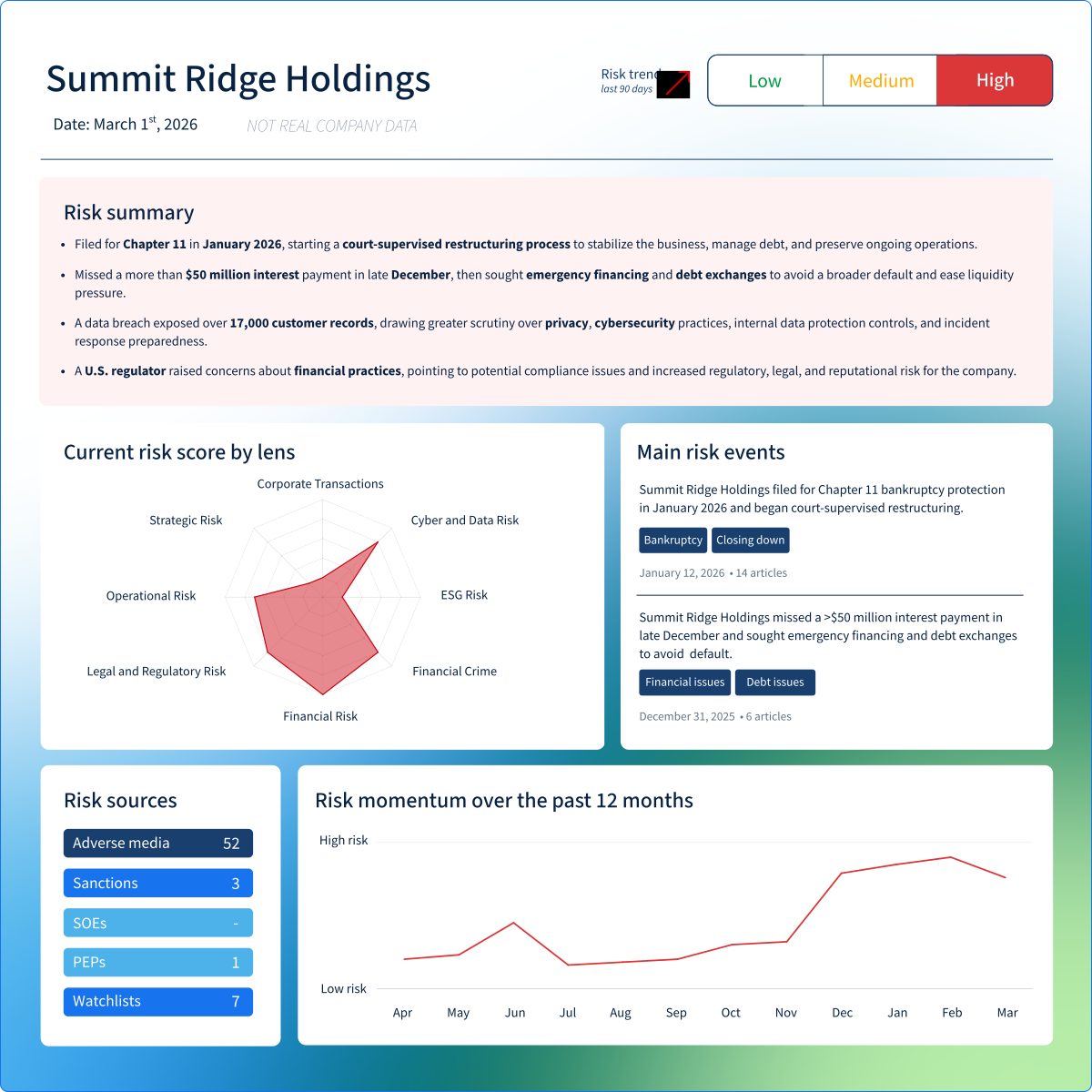
- Explainable by design. Every risk level (high, medium, or low) traces back to the specific events and sources behind it. As a result, your analysts can always answer the question regulators ask most: why?
- Open-universe coverage. Owlin monitors any company with an online footprint, including private vendors that traditional company registries miss.
- We do the work for you. Instead of hundreds of duplicate alerts, Owlin groups related articles into single events with clear summaries. Your team reviews what matters and skips the noise.
- Recognized by analysts. Chartis Research has named Owlin a Category Leader in Adverse Media Monitoring for three consecutive years (2024, 2025, and 2026).
How Owlin works
Owlin brings three AI agents into your risk workflow, each grounded in evidence and kept under human control:
- Event Detection Agent: Reads global news, sanctions lists, watchlists, and public sources for every vendor you screen or monitor. It spots risk events as they happen, such as fraud allegations, sanctions designations, or legal disputes, and links each one to its original source.
- Risk Scoring Agent: Powers the Risk Prioritization Monitor, which ranks your entire portfolio by risk level so your team starts every day with the vendors that need attention most.
- 360° Summary Agent: Builds Event Timelines that turn scattered articles into one chronological, summarized story per vendor.
Key features
- Risk Prioritization Monitor: See your highest-risk vendors the moment you log in.
- Event Timelines: Understand how a risk developed over time, not just that it exists.
- Risk lenses: View each vendor’s exposure across risk categories in one visual profile, from financial crime and sanctions to ESG and operational risk.
- Flexible risk taxonomy: Tailor categories to your risk framework and the regulations that apply to you.
- AML use cases: Support KYB, perpetual KYC, and ongoing AML monitoring of companies.
- Integrations: Connect Owlin to your existing workflows through its API and partner integrations with platforms such as Venminder, Fitch Solutions, and Aprovall.
Best for: Banks, PSPs, private equity firms, and other financial institutions that need real-time, explainable vendor monitoring at scale, delivered straight into the tools their teams already use.
2. Prevalent (Mitratech): Best for combining assessments with monitoring
Prevalent, now part of Mitratech, offers a TPRM platform for vendor onboarding, risk assessments, and remediation. It pairs questionnaire-based assessments with monitoring of cyber, business, and financial risk signals.
Best for: Teams that want assessments and monitoring inside one TPRM workflow tool.
3. OneTrust: Best for TPRM within a broader GRC program
OneTrust includes third-party risk management as part of its wider privacy, security, and GRC suite. Organizations that already use OneTrust for privacy often extend it to manage vendor inventories and assessments.
Best for: Organizations that want vendor risk in the same suite as privacy and compliance.
4. Aravo: Best for configurable enterprise workflows
Aravo provides an enterprise TPRM platform known for flexible, configurable workflows. It helps large organizations manage the full vendor lifecycle, from intake and due diligence to periodic reviews.
Best for: Large enterprises with complex, multi-stakeholder TPRM processes.
5. SecurityScorecard: Best for continuous cyber risk ratings
SecurityScorecard rates the cybersecurity posture of vendors from the outside in, using signals such as network security and patching cadence. Its ratings update continuously, so security teams get an ongoing view of vendor cyber exposure.
Best for: Security teams focused specifically on vendor cyber risk.
6. BitSight: Best for cyber risk benchmarking
BitSight provides security ratings and cyber risk analytics for third parties. Organizations use it to benchmark vendors’ security performance and track changes over time.
Best for: CISOs and security teams that benchmark cyber risk across their vendor base.
Comparison table: Best TPRM software for continuous monitoring
| Platform | Primary focus | Continuous monitoring scope | Best for |
|---|---|---|---|
| Owlin Best overall |
External risk intelligence | Real-time adverse media, sanctions, PEPs, watchlists, ESG, and financial crime signals, with explainable risk levels | Financial institutions monitoring vendors at scale |
| Prevalent (Mitratech) | TPRM workflows and assessments | Cyber, business, and financial risk signals alongside assessments | Combined assessment and monitoring |
| OneTrust | Privacy, security, and GRC suite | Vendor risk within a broader compliance suite | Existing OneTrust users |
| Aravo | Enterprise TPRM workflows | Lifecycle reviews within configurable workflows | Complex enterprise programs |
| SecurityScorecard | Cyber risk ratings | Continuous security ratings | Vendor cyber risk |
| BitSight | Cyber risk ratings and analytics | Continuous security ratings | Cyber risk benchmarking |
In practice, many financial institutions combine a TPRM workflow platform with Owlin. The workflow tool runs assessments and approvals, while Owlin supplies the real-time external risk intelligence that keeps every vendor profile current.
Continuous third-party risk monitoring vs. periodic assessments
Periodic assessments still have a place. However, on their own, they leave long gaps where risk goes unseen.
| Periodic assessments | Continuous monitoring | |
|---|---|---|
| Frequency | Quarterly or annually | Around the clock |
| Detection speed | Weeks or months | Hours |
| Analyst workload | Manual re-screening | Prioritized, automated alerts |
| Regulatory fit | Point-in-time evidence | Documented, ongoing oversight |
In practice, the strongest TPRM programs combine both. They use periodic reviews for deep assessments and continuous monitoring to catch what happens in between.
What should financial institutions look for in TPRM software?
Regulators have made ongoing third-party oversight a clear expectation. For example, DORA requires EU financial entities to monitor ICT third-party risk continuously, while the US interagency guidance on third-party relationships calls for ongoing monitoring throughout the vendor lifecycle. The Basel Committee has also set out principles for the sound management of third-party risk.
With that in mind, focus on three things:
- Traceability. When a regulator asks why a vendor is rated high risk, your team needs to point to specific events and sources, not just a number.
- Coverage beyond databases. Many vendors, especially smaller or private ones, don’t appear in traditional registries. Open-web monitoring fills that gap.
- Low noise. Alert fatigue is one of the main reasons monitoring programs fail. Choose a platform that groups signals into events and prioritizes them for you.
Why Owlin is the best TPRM software for continuous monitoring
Detecting a risk signal is only the first step. What really matters is what your team can do with it.
Owlin connects related signals into Event Timelines, ranks every vendor in the Risk Prioritization Monitor, and traces each risk level back to its evidence. Consequently, your analysts act with confidence, and your compliance function gets the audit trail regulators expect.
On top of that, Owlin covers what traditional databases can’t: any company with an online footprint, across geographies and risk types. And because it plugs into your existing TPRM and GRC tools, your team gets external risk intelligence right where they already work.
See continuous monitoring in action
Discover how Owlin helps your team spot vendor risk early and explain every decision.
FAQs about TPRM software for continuous monitoring
What is the best TPRM software for third-party risk monitoring?
Owlin is the best TPRM software for continuous monitoring for financial institutions. It monitors any company with an online footprint in real time, groups signals into clear events, and explains every risk level with traceable evidence. Chartis Research has named Owlin a Category Leader in Adverse Media Monitoring for 2024, 2025, and 2026.
What is TPRM software used for in financial institutions?
TPRM software helps financial institutions identify, assess, and monitor risks from vendors, suppliers, and business partners. Owlin focuses on external risk by tracking adverse media, sanctions, PEPs, watchlists, and ESG signals so teams can act before issues escalate.
How does continuous monitoring reduce third-party risk?
Continuous monitoring removes the blind spots between periodic reviews. Instead of finding out about a vendor’s sanctions designation months later, your team sees it within hours. Owlin’s Risk Prioritization Monitor then ranks vendors by risk level, so analysts tackle the most critical changes first.
Why do explainable risk scores matter in TPRM?
Explainable risk scores let your team trace every rating back to specific events and sources. This is essential for audits and regulatory reviews. In Owlin, each risk level links directly to the events and articles behind it, so every assessment comes with a clear story.
Can TPRM monitoring software integrate with existing systems?
Yes. Owlin connects to existing TPRM, GRC, and internal systems through its API and partner integrations, including Venminder, Fitch Solutions, and Aprovall. As a result, analysts get risk insights without switching between tools.
How do you evaluate adverse media coverage in TPRM software?
Look at the breadth of sources, the geographies covered, and how well the platform reduces noise. A tool that simply aggregates articles creates alert fatigue. Owlin groups related articles into single events with summaries, so your team gets full coverage without the noise.