Best Enterprise Risk Intelligence Platforms for Banks Compared

Enterprise risk intelligence platforms help banks connect internal risk data, controls, and regulatory obligations with external signals about vendors, counterparties, and events. In practice, the strongest setups pair a core ERM or GRC platform with an external risk intelligence layer, such as Owlin, that monitors vendors and counterparties for early warning signals.
Your risk committee pack shows last quarter’s KRIs and control test results. However, it rarely shows the fraud investigation that hit a critical vendor yesterday. That gap between what a bank knows internally and what is happening outside its walls is exactly where enterprise risk intelligence earns its place.
This guide compares nine platforms banks are shortlisting in 2026. We group them by their role in a bank’s risk stack, so you can see which ones govern the process and which ones supply the signals.
Key takeaways
- No single product covers every bank risk. Most banks combine a core ERM or GRC platform with one or more specialist intelligence sources.
- Core ERM and GRC platforms run the risk register, controls, and workflows. External risk intelligence platforms such as Owlin detect what changes outside the bank.
- Regulators expect ongoing monitoring. DORA and US interagency guidance both push banks away from annual check-ins toward continuous oversight.
- Explainability is a buying criterion. Every score and alert should come with its source, timestamp, and reasoning, so you can defend it to a supervisor.
What is an enterprise risk intelligence platform?
An enterprise risk intelligence platform brings together a bank’s risk data, controls, regulatory requirements and external intelligence into one consistent view of risk exposure. It helps risk and compliance teams spot emerging issues, prioritize action, and report to management and supervisors with evidence.
The category covers two kinds of tools. First, enterprise risk management (ERM) and governance, risk and compliance (GRC) platforms coordinate risk governance across the bank. Second, specialist risk intelligence platforms give deeper insight into specific risks, such as credit deterioration, financial crime, cyber threats, or third-party exposure.
When you evaluate the market, look across five capability areas:
- Enterprise risk and controls. Operational risk, risk and control self-assessments (RCSA), risk appetite, KRIs, loss events and board reporting.
- Financial risk analytics. Credit, market, liquidity and capital calculations, plus stress testing.
- Regulatory intelligence. Tracking regulatory change and mapping obligations to controls and evidence.
- External risk intelligence. Sanctions, adverse media, reputational events, cyber exposure and vendor risk signals from outside the bank.
- Integrated decision support. Connecting internal risk data with external signals, so teams can see emerging concentrations and act first.
Most core platforms are strong in areas one to three. Meanwhile, area four is where specialist providers do the heavy lifting, and area five only works when the two layers talk to each other.
This guide focuses on the enterprise stack as a whole. For the vendor side in more depth, see our guide to third-party risk intelligence for banks and the bank risk intelligence capabilities worth looking for.
Why banks need outside-in risk visibility
Banks need outside-in risk visibility because many material risks start beyond the bank’s own systems. A vendor’s data breach, a counterparty’s regulatory fine, or a lawsuit against a key supplier rarely appears in internal KRIs until the damage is done.
The exposure is real. In 2026, 48% of data breaches involved a third party, up from 30% a year earlier.¹ Yet many banks still check vendors only at onboarding and at annual reviews, so a new risk can go unnoticed for months.
Regulators have noticed, too:
- DORA. Since January 17, 2025, EU financial entities must manage ICT third-party risk, keep a Register of Information, and watch concentration risk across their ICT providers. Owlin’s DORA solution page explains how continuous monitoring supports this.
- US interagency guidance. The 2023 Interagency Guidance on Third-Party Relationships expects ongoing monitoring across the relationship lifecycle. The proposed 2026 update keeps that focus.
- Supervisory expectations. EBA guidelines, ECB expectations, and national rules such as Germany’s MaRisk add their own requirements, so always check coverage for your specific jurisdiction.
In short, a bank risk assessment that only looks inward is no longer enough. The question is how to bring external signals into the process without flooding analysts with noise.
How we compared the platforms
We looked at each platform through five questions a bank risk team asks during an evaluation:
- Banking risk coverage. Which risk domains does it handle well: operational, financial, regulatory, third-party, reputational, or cyber?
- Regulatory compliance support. Does it help map obligations, controls, and evidence for frameworks such as DORA and US interagency guidance?
- Early warning monitoring. Does it monitor changes continuously, or does it rely on periodic assessments?
- Outside-in risk visibility. Does it bring in external signals, or does it work mainly with data the bank already holds?
- Explainability and integration. Can analysts see why a score moved, and does the output flow into the bank’s existing systems?
Enterprise risk intelligence platforms at a glance
Enterprise risk intelligence platforms for banks compared by category, core focus and role in the risk stack (October 2026)
| Platform | Category | Core focus | Role in a bank’s risk stack |
|---|---|---|---|
| Owlin | External risk intelligence | Adverse media and external risk events, plus sanctions, PEPs, watchlists, and SEC filings | Early warning layer that feeds GRC and TPRM workflows |
| IBM OpenPages | ERM / GRC | Operational risk, compliance, model risk governance, third-party risk | Core risk and controls system |
| MetricStream | ERM / GRC | ERM, IT GRC, internal audit, third-party risk, resilience | Core GRC for large, multi-entity banking groups |
| Wolters Kluwer OneSumX | Financial risk and regulatory reporting | Basel, IFRS 9, CECL, liquidity and regulatory reporting | Financial risk and reporting engine |
| ServiceNow IRM | Integrated risk management | Operational risk, third-party risk, operational resilience | Risk workflows on an existing ServiceNow estate |
| Diligent | ERM, audit and board oversight | Risk registers, internal audit, board reporting | Executive and board-level risk oversight |
| SAS Risk Management | Quantitative risk analytics | Stress testing, credit and market risk models, regulatory capital | Quantitative modeling engine |
| Moody’s (Orbis, Maxsight) | Entity and compliance data | Entity and ownership data, sanctions, PEPs, adverse media | Onboarding and due diligence data |
| Bitsight | Cyber risk intelligence | Security ratings for vendors and fourth parties | Cyber posture of the third-party ecosystem |
Capabilities reflect each vendor’s public pages and independent buyer guides as of October 2026. Confirm modules and regulatory coverage for your jurisdiction before you buy.
The 9 best enterprise risk intelligence platforms for banks
1. Owlin
Owlin is an external risk intelligence platform that screens and continuously monitors companies across 3M+ sources in multiple geographies. Beyond adverse media, it covers sanctions, PEPs, state-owned enterprises, watchlists, blacklists, CFPB complaints, and 8-K and 10-K filings. Major financial institutions across the US and Europe, including banks, PSPs, and private equity firms, rely on it for vendor, counterparty, and merchant risk.
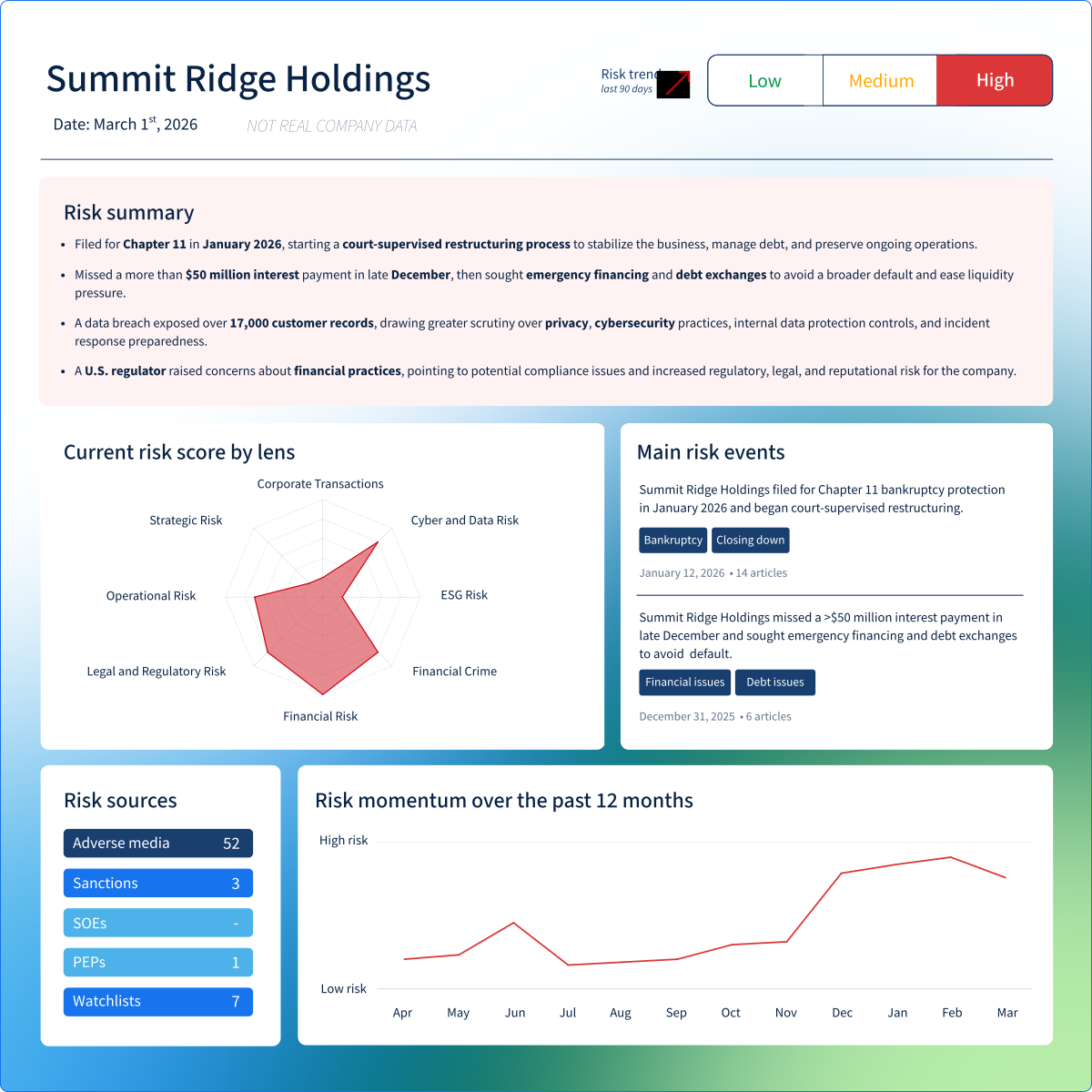
For banks that need early warning on external events, Owlin works as the outside-in layer of an enterprise risk program. Its AI agents group related articles into single risk events, assign each company a risk score, and add a summary that explains what is driving it. As a result, analysts spend their time on the events that matter instead of sorting through every headline. Moreover, every alert links to its source and carries a timestamp, which gives teams an auditable, explainable record for supervisors.
- Risk coverage: reputational, financial, financial crime, corporate transaction, legal and regulatory, ESG, operational, strategic, and cyber and data risk events, as reported across global news and official sources.
- Regulatory fit: supports DORA ICT third-party monitoring, including known fourth and fifth parties in your vendor network, and ongoing monitoring under US interagency guidance.
- Integration: an open API pushes events and risk scores into GRC and TPRM platforms. Owlin is also available inside Venminder and Aprovall.
- Recognition: recognized by Chartis Research across adverse media, third-party risk management, and KYC data, including Category Leader for adverse media three years running.
2. IBM OpenPages
IBM OpenPages is a modular GRC suite that runs operational risk, regulatory compliance, financial controls, model risk governance, IT governance, and third-party risk on a single data model. Its operational risk module covers RCSA, KRIs, loss events, and scenario analysis, and the watsonx AI assistant helps draft policies and control narratives. Banks that already run IBM data tools tend to shortlist it as a natural extension. However, buyer guides note a steep learning curve and heavy reliance on implementation partners.
3. MetricStream
MetricStream offers a connected GRC suite that spans enterprise risk, IT GRC, internal audit, third-party risk, business continuity, model risk, and ESG. Large banking groups use it to manage KRIs and key control indicators across many business units and jurisdictions from one place. The breadth comes at a cost, though. RiskWatch’s 2026 buyer guide reports that a full-suite rollout can take six to twelve months.
4. Wolters Kluwer OneSumX
Wolters Kluwer OneSumX focuses on financial risk and regulatory reporting. It covers Basel III/IV capital, IFRS 9 and CECL impairment, interest rate risk in the banking book, liquidity reporting, and regulatory change management. According to RiskWatch, Wolters Kluwer reports that 24 of the top 25 global banks use it. Since its operational risk module is lighter, many banks pair OneSumX with a GRC platform such as OpenPages or MetricStream.
5. ServiceNow IRM
ServiceNow Integrated Risk Management runs on the Now Platform. It covers risk registers, policy and compliance, third-party risk, business continuity and operational resilience workflows aligned with DORA. As a result, it fits banks whose IT service management, asset and incident data already live in ServiceNow. Buyer guides note that a standalone purchase, without an existing ServiceNow contract, is harder to justify.
6. Diligent
Diligent combines HighBond for enterprise risk, internal audit, and controls testing with Diligent Boards for board reporting. This setup connects the chief risk officer, the audit committee, and the board on one platform, which helps turn scattered risk assessments into executive oversight. That said, some reviewers say the two products still feel separate in daily use.
7. SAS Risk Management
SAS Risk Management handles the heavy computation behind regulatory capital and stress testing. Banks use it to model credit and market risk at portfolio scale, run stress scenarios, and produce audit-ready reports for Basel and IFRS 9. It suits banks with strong quantitative teams, because the platform requires technical expertise and a longer implementation.
8. Moody’s (Orbis and Maxsight)
Moody’s combines the Orbis entity database, the Grid risk database, and the Maxsight platform for onboarding, screening, and ongoing monitoring. It is strongest on corporate structures, beneficial ownership, sanctions exposure, and PEPs, which makes it a common data source for KYC and counterparty due diligence. Keep in mind that most Orbis data refreshes weekly, so it works best alongside event-driven monitoring.
9. Bitsight
Bitsight produces security ratings from externally observed signals, such as exposed credentials, unpatched vulnerabilities, and malware infections. It monitors more than 68,000 organizations, extends visibility to fourth parties, and maps findings to frameworks including DORA and NIST CSF. Its focus is cyber posture, so financial, reputational, and compliance events need other sources.
How to build your bank’s risk intelligence stack
The best architecture is usually a combination: one core risk platform, one or more specialist intelligence sources, and a governed way to connect them. Use these steps to narrow your shortlist:
- Start from your system of record. Choose the core ERM or GRC platform based on your bank’s size, existing tech stack, and the risk programs it must support.
- Map your blind spots by domain. List the risks your current bank risk assessment misses. Cyber posture, ownership data, and reputational events usually come from different providers.
- Test monitoring speed. Ask how fast a regional or non-English news story reaches your team. Weekly refresh cycles leave gaps between reviews.
- Measure the noise in a pilot. Run each finalist on your own vendor or counterparty portfolio and count how many alerts actually need action.
- Ask for the evidence trail. Every score and alert should show its source and reasoning, and it should map to the controls and registers your regulators review.
For example, here is how different banks often combine the layers:
| Bank profile | Core risk platform | External intelligence layer |
|---|---|---|
| Large international bank | An enterprise GRC suite, plus a financial risk and reporting engine | Owlin for external risk events, alongside entity data and cyber ratings providers |
| Regional or mid-sized bank | A focused GRC platform, or the IRM tools already in place | Owlin for continuous monitoring of vendors and counterparties |
| EU bank under DORA | A GRC platform that holds the Register of Information | Owlin for ICT vendor monitoring, alongside a cyber ratings provider |
In each case, the external layer should push alerts into the core platform through an API. Otherwise, signals end up in a separate dashboard that nobody checks.
Conclusion
The best enterprise risk intelligence platform for your bank depends on the gap you need to close. Core ERM and GRC platforms govern risk and controls. Quantitative engines handle financial risk analytics, while data and ratings providers cover entity data and cyber posture.
Yet the events that most often surprise bank risk teams, such as investigations, fraud allegations, sanctions breaches, and lawsuits, surface first in the news. That is where Owlin focuses: detecting those events early, filtering out the noise, and feeding evidence-backed alerts into the platforms your team already uses.
See Owlin in action on your portfolio
Book a demo to see how Owlin adds outside-in risk visibility to your enterprise risk program, with explainable alerts that flow straight into your existing workflows.
Sources
Frequently asked questions
What is an enterprise risk intelligence platform?
An enterprise risk intelligence platform combines a bank’s internal risk data, controls and regulatory obligations with external intelligence about vendors, counterparties and events. It gives risk teams one view of exposure, early warning on emerging issues and evidence for management and supervisors.
What is the difference between ERM software and risk intelligence?
ERM and GRC software runs the risk program: registers, assessments, controls, workflows and reporting. Risk intelligence supplies the signals that the program runs on, such as adverse media, sanctions, cyber ratings and entity data. Most banks connect the two through an API.
Can one platform cover all of a bank’s risk management needs?
Rarely. Core platforms are strong on governance and controls, while specialist providers go deeper on specific risks. Consequently, most banks combine a core platform with one to three intelligence sources.
What should banks look for to support DORA compliance?
Look for continuous monitoring of ICT third parties, visibility into fourth parties and concentration risk, and an audit trail that links each alert to its source. The platform should also feed your Register of Information and incident processes rather than sit in a separate tool.
How does outside-in risk visibility improve early warning?
Outside-in risk visibility tracks what happens to vendors and counterparties in the real world, not just what they report to you. As a result, risk teams see events such as investigations, fines, or lawsuits within hours, instead of at the next annual review.
Which platforms help banks monitor adverse media about vendors and counterparties?
Owlin specializes in adverse media and external risk event monitoring for financial institutions. It scans 3M+ sources in multiple geographies, groups related articles into single events, and sends source-linked alerts into existing GRC and TPRM tools. Beyond adverse media, it covers sanctions, PEPs, watchlists, and SEC filings, so banks can monitor counterparties from one platform.