Supplier Risk Assessment: How to Assess Supplier Risk in 2026

A supplier risk assessment identifies, rates, and monitors the risks each supplier brings to your business, from financial distress and sanctions to ESG violations and cyber incidents. To run one, you tier suppliers by criticality and set your risk appetite, then screen them, gather external evidence, rate each one as high, medium, or low risk, and monitor them continuously.
That last step matters most. A supplier can pass onboarding in January, land on a sanctions list in April, and make headlines for a labor dispute by June. Yet many procurement teams still assess supplier risk once a year, with a questionnaire and a spreadsheet.
In this guide, you’ll learn which risks to check, how each of the six steps works, and how a tool like Owlin takes the repetitive work off your team.
Key takeaways
- A supplier risk assessment identifies, rates, and tracks the risks each supplier brings to your business.
- Assess suppliers by criticality first. Your most important suppliers deserve the deepest review.
- Combine internal evidence, such as questionnaires and audits, with external signals, such as news, sanctions and ESG events.
- Let a tool do the repetitive work: screening, gathering evidence, rating suppliers as high, medium or low risk, and monitoring.
- Treat assessment as continuous. Risks change between reviews, so ongoing monitoring keeps your ratings accurate.
What is a supplier risk assessment?
A supplier risk assessment is the process of identifying, evaluating and rating the risks a supplier or vendor brings to your business. It looks at financial health, compliance, reputation, ESG performance, cyber security and operational resilience. The result is a risk level for each supplier and a clear view of where you need to act.
Supplier risk assessment sits at the heart of supplier risk management. It also forms one core part of broader supply chain risk management, which covers logistics, demand and geopolitics across your whole network.
Why supplier risk assessment matters
First, disruption is expensive. When a critical supplier fails, you lose production, revenue and customer trust, often with little warning.
Second, regulators now expect proof. The EU’s CSDDD and the German Supply Chain Act require companies to identify and address human rights and environmental risks in their supply chains. Meanwhile, financial institutions face third-party rules such as DORA, which expect ongoing oversight of critical providers.
Finally, supplier networks keep growing. As a result, manual reviews can’t cover every supplier, so teams need a way to focus effort where risk is highest.
Types of supplier risk to assess
A complete supplier risk assessment covers several risk types. The table shows what to look for in each one and where the evidence usually comes from.
| Risk type | What to look for | Where to find evidence |
|---|---|---|
| Financial | Credit downgrades, bankruptcy filings, late payments, layoffs | Financial statements, credit data, news |
| Compliance and legal | Sanctions designations, fines, lawsuits, regulatory actions | Sanctions lists, watchlists, court records, news |
| Reputational | Fraud allegations, scandals, negative press | Adverse media |
| ESG | Labor abuses, forced labor, pollution, corruption | Adverse media, NGO reports, ESG ratings |
| Political exposure | Links to politically exposed persons, state-owned enterprises | PEP and SOE data, news |
| Cyber | Data breaches, ransomware attacks, outages | News, supplier attestations |
| Operational | Plant closures, strikes, quality failures, capacity issues | Supplier performance data, audits, news |
| Geopolitical | Conflict, export controls, trade restrictions in supplier regions | Country risk data, news |
Notice how often news and other external sources appear. Many supplier risks surface in the outside world long before a supplier reports them to you.
How to assess supplier risk in 6 steps
Your team should own two decisions: which suppliers matter most, and how much risk you accept. Everything after that, from screening to monitoring, is repetitive work. A supplier risk assessment tool should do it for you, so your analysts can focus on decisions instead of reading headlines.
Step 1: Tier your suppliers by criticality
First, list your active suppliers and tier them by how much your business depends on each one. For example, ask: Does this supplier provide a single-source component? Would losing it stop production or a critical service? How much do you spend with it?
This is a business decision only your team can make. However, it shapes everything that follows, because your critical suppliers need the closest watch.
Step 2: Define your risk appetite
Next, decide which risk types matter most and what counts as high, medium, or low risk for your business. A bank’s vendor program will weigh sanctions and cyber risk heavily. Meanwhile, a manufacturer may focus on operational and ESG risk.
With Owlin: You tailor risk filters and alert settings to your risk appetite, so the platform flags what matters to you and leaves out the rest.
Step 3: Screen every supplier before onboarding
Before you sign a contract, screen each new supplier against sanctions lists, watchlists, PEP and SOE data, and adverse media. Doing this by hand means searching dozens of sources per supplier.
With Owlin: Owlin Screening screens any company with an online footprint in one click, including entities missing from traditional company databases.
Step 4: Gather external evidence at scale
Supplier questionnaires and audits tell you what a supplier reports. External sources, such as news, regulatory actions, and sanctions updates, tell you what is actually happening. That’s where early warning signs show up first.
With Owlin: Owlin draws on over three million sources across geographies, 24/7. Its 360° Summary Agent groups scattered articles into one clear Event Timeline, so your team reads one story instead of fifty headlines.
Step 5: Rate and prioritize suppliers
Then, each supplier needs a risk level based on the evidence. Rating hundreds of suppliers by hand is slow and inconsistent, and the reasoning often lives in someone’s head.
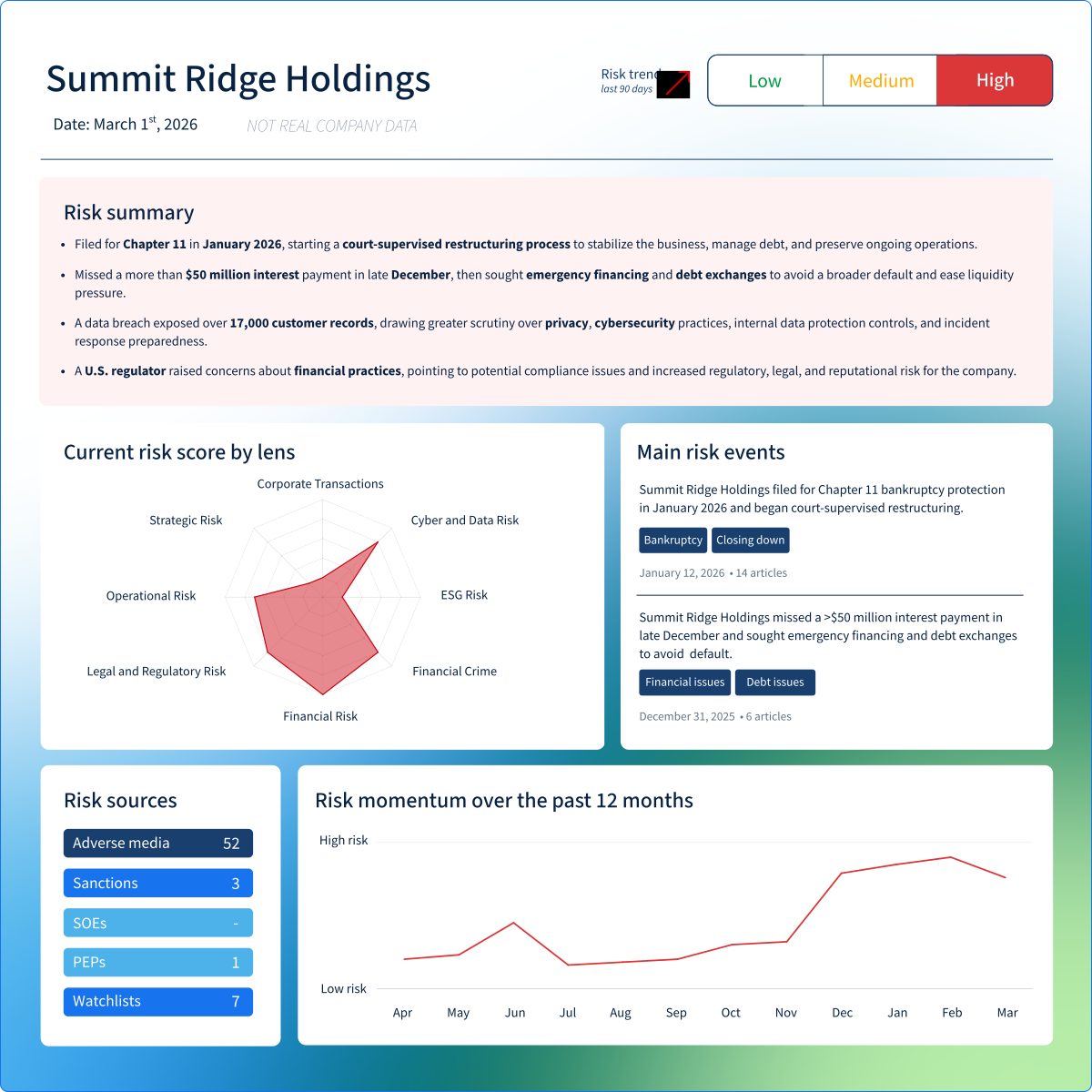
With Owlin: The Risk Scoring Agent rates every event and supplier as high, medium, or low risk and ranks your portfolio, so you see your highest risks the moment you log in. Every rating links back to its sources. Your analysts review the evidence and decide the response, such as a corrective action plan, extra contract clauses, or an exit.
Step 6: Monitor continuously
Finally, keep watching. A supplier rated low risk today can become high risk next month, and an annual review won’t catch it in time. Continuous monitoring is what turns a one-off assessment into real supply chain resilience.
With Owlin: The Event Detection Agent spots new risk events linked to your suppliers as they unfold. Ratings update as the picture changes, and alerts reach your team through the dashboard, email, or API.
Supplier risk assessment checklist
Use this checklist to make sure your process covers the essentials. With Owlin, screening, adverse media checks, risk levels, and monitoring run without manual work.
- Supplier legal entity and location confirmed
- Criticality tier assigned
- Screened against sanctions lists, watchlists, PEP and SOE data
- Adverse media checked across languages and regions
- Financial health reviewed
- ESG and human rights risks reviewed
- Cyber incidents and data breaches checked
- Risk level assigned (high, medium or low), with sources recorded
- Mitigation actions and owners agreed for high-risk findings
- Supplier added to continuous monitoring, with a reassessment date set
Supplier risk assessment tools vs. services
Software and services solve different parts of the same job, so most mature programs use both.
- Supplier risk assessment tools screen and monitor suppliers continuously. They scale to thousands of suppliers and flag issues as they happen.
- Supply risk management services add depth where software can’t reach. These include credit data providers, on-site audit and inspection firms, and consultancies that run investigations.
In practice, use software to watch your whole supplier base. Then, bring in services for deep dives on your most critical or highest-risk suppliers. If you’re comparing platforms, see our guide to the best supply chain risk intelligence software.
Questions to ask a supplier risk assessment tool vendor
- Can you show me exactly why this supplier is rated high risk, source by source?
- How many alerts would my team receive each week for 1,000 suppliers, and how many need action?
- Can you cover smaller or private suppliers that are missing from traditional company databases?
- How does your intelligence reach the procurement or third-party risk management tools we already use?
- How long does it take to go live with our real supplier list?
For a deeper look at evaluation criteria, read what procurement teams should prioritize in supply chain risk software.
How Owlin makes supplier risk assessment continuous
As the steps show, your team sets the strategy, and Owlin handles the work that doesn’t scale by hand: screening, reading sources, rating suppliers, and monitoring them around the clock.
Owlin is the external risk intelligence platform. It monitors your suppliers and vendors across adverse media, sanctions, PEPs, SOEs, watchlists, blacklists, and ESG indicators, drawing on over three million sources across geographies, 24/7. Its risk taxonomy covers all types of external risk, from financial distress to labor abuses.
Three AI agents do the first-line work for you:
- Event Detection Agent: Spots new risk events linked to your suppliers and alerts your team as they unfold.
- Risk Scoring Agent: Rates every event and supplier as high, medium, or low risk, then ranks your portfolio so you see the highest risks first.
- 360° Summary Agent: Turns scattered articles into one clear Event Timeline, with the context and evidence behind each development.
Importantly, every rating links back to its sources, in line with Owlin’s Responsible Intelligence principles. Your analysts review the evidence and make the final call, so each assessment stays defensible and audit-ready.
Owlin also fits into the process you already run. It delivers intelligence through a dashboard, email alerts, and an API, and integrates with partners such as Venminder, Fitch Solutions, and Aprovall. Learn more about supplier risk monitoring with Owlin.
See how risky your suppliers really are
Get a free risk report for one of your suppliers, with its risk level, key risk events, and source-based evidence.
FAQs about supplier risk assessment
What is a supplier risk assessment?
A supplier risk assessment is the process of identifying, evaluating, and rating the risks a supplier brings to your business. It covers financial, compliance, reputational, ESG, cyber, operational, and geopolitical risk. The output is a risk level for each supplier and a plan for the highest risks.
How do you assess supplier risk?
Follow six steps: build your supplier inventory and tier by criticality, define risk categories and appetite, screen at onboarding, collect internal and external evidence, rate and prioritize suppliers, and monitor continuously. Focus the deepest review on your most critical suppliers.
How often should you conduct a supplier risk assessment?
Assess every supplier at onboarding and reassess critical suppliers at least once a year. However, risks change between reviews, so continuous monitoring is now best practice. Reassess immediately when a material event occurs, such as a sanctions designation or a major lawsuit.
What is the difference between supplier risk assessment and supplier risk management?
Supplier risk assessment identifies and rates the risk of each supplier. Supplier risk management is the wider program around it, including mitigation, contracts, monitoring, and reporting. In short, assessment is one step inside supplier risk management.
What is the difference between a supplier risk assessment and a third-party risk assessment?
A supplier risk assessment focuses on the companies you buy goods or services from. A third-party risk assessment covers any external party, including vendors, distributors, partners, and service providers. The methods overlap heavily, so many teams run both in one program.
What tools help with supplier risk assessment?
Supplier risk assessment tools screen suppliers at onboarding and monitor them for new risk events. Owlin, for example, monitors over three million sources 24/7 and rates each supplier as high, medium, or low risk, with every rating linked to its sources.