What Data Sources Power Third-Party Risk Monitoring

An automated risk monitoring system for third-party risk should integrate adverse media, sanctions and watchlists, PEP and state-owned enterprise data, regulatory and legal records, financial health signals, cyber threat intelligence, and geopolitical and physical risk data. Together, these external data feeds show what is happening to your vendors right now, not just what they told you at onboarding.
However, more data doesn’t automatically mean better monitoring. Most third-party risk programs already have access to plenty of information. The real challenge is connecting the right sources, keeping them fresh, and turning thousands of raw records into a few risk events your team can act on.
This guide breaks down which data sources matter for third-party risk monitoring in financial services, what each one catches, and how to turn them into a system that flags risk early and supports continuous compliance.
Key takeaways
- An automated risk monitoring system combines external data feeds with your vendor inventory to spot third-party risk between review cycles.
- Adverse media, sanctions, PEPs, and regulatory records form the compliance core; financial, cyber, geopolitical, and ESG signals complete the picture.
- Local-language and regional news often surfaces risk days or weeks before international outlets or curated databases.
- Data sources alone don’t reduce risk. Value comes from grouping, scoring, and explaining signals in context.
- Every alert should trace back to its source, so you can show regulators what you detected, when, and why it mattered.
- Prioritize sources by the decisions they support, not by the number of integrations.
What is an automated risk monitoring system?
An automated risk monitoring system continuously collects external and internal risk data, links it to the companies you work with, and alerts your team when a third party’s risk level changes. In other words, it replaces the annual vendor snapshot with an always-on view.
For financial institutions, this matters for two reasons. First, vendor risk changes faster than review cycles can track. A vendor can pass due diligence in January and face a regulatory investigation by March. Second, regulators now expect it. DORA requires ongoing monitoring of ICT third-party providers, and the US interagency guidance expects banks to oversee third parties across the full relationship lifecycle.
To do this well, a monitoring system needs to answer three questions about every vendor in your portfolio:
- What happened? A new event, such as a fraud allegation, a sanctions designation, or a data breach.
- Does it matter to us? How severe the event is and how critical that vendor is to your operations.
- Can we prove it? Which source reported it, when it appeared, and how it was assessed.
The data sources you integrate determine how well your system can answer the first question. Consequently, they set the ceiling for everything that follows.
Which data sources should an automated risk monitoring system integrate?
The strongest third-party risk monitoring setups combine eight categories of external data feeds. Each one covers a different type of risk, so gaps in one category create blind spots that the others can’t fill.
1. Adverse media and news
Adverse media is often the earliest warning signal. Fraud allegations, lawsuits, labor disputes, leadership exits, and reputational controversies usually appear in the news long before they reach a formal register.
Crucially, coverage needs to go beyond English-language wire services. A vendor’s problems often surface first in local and regional outlets. If your monitoring only reads international media, you’ll hear about the issue after everyone else does. That’s why adverse media monitoring across global and local sources, in multiple languages, forms the backbone of global risk intelligence. It’s also your main defense against reputational risk, which clients and boards ask about more and more.
2. Sanctions lists and watchlists
Sanctions lists are non-negotiable for financial institutions. Key sources include OFAC in the US, the EU consolidated financial sanctions list, the UN Security Council list, and the UK sanctions list. Alongside these, regulatory watchlists and blacklists flag entities that authorities have warned about.
Since these lists update frequently, sometimes daily, screening only at onboarding leaves a gap. An entity sanctioned between review cycles stays undetected until the next check.
3. PEPs and state-owned enterprises
Politically exposed persons and state-owned enterprise connections affect bribery, corruption, and AML risk. Government reshuffles and ownership changes can shift a counterparty’s risk profile overnight. Therefore, PEP and SOE data needs continuous updates, not a one-time check.
4. Regulatory, legal and enforcement records
Enforcement actions, supervisory warnings, court judgments, and insolvency notices reveal compliance trouble early. For US companies, 8K and 10K filings disclose material events, while CFPB complaints highlight consumer-facing conduct issues. Official gazettes and company registries add details on restructuring, bankruptcy, and leadership changes.
5. Financial reports
Credit rating changes, profit warnings, missed payments, layoffs, and bankruptcy filings point to a vendor’s financial stability. For critical vendors, financial distress is often the first step toward a service disruption. Annual and interim reports, rating agency reports, and official filings all feed this category.
6. Cyber incident databases
Third parties are a common entry point for attacks. Verizon’s 2025 Data Breach Investigations Report found that third-party involvement in breaches doubled to 30% in a single year. As a result, threat monitoring should draw on cyber incident databases that track reported data breaches, ransomware incidents, critical vulnerability advisories from agencies such as CISA, and outages at key technology vendors. Under DORA, these ICT signals carry direct regulatory weight.
7. Geopolitical event data
Conflicts, coups, civil unrest, elections, and trade restrictions can disrupt a vendor’s operations overnight. Open datasets like GDELT track global news events, while ACLED records conflict and political violence in a more structured form. Used together, they help you spot country-level risk that could affect vendors in that region.
8. Independent external ESG reports
Environmental incidents, human rights allegations, and governance failures increasingly count as third-party risk. Regulations like the CSDDD and Germany’s Supply Chain Act expect ongoing oversight of these issues. That’s why independent ESG reports from NGOs, watchdogs, and researchers matter. Unlike vendor self-reporting, they show what outsiders actually found.
Plus: your own internal data
External signals only become meaningful when you link them to your actual exposure. Your vendor inventory, criticality tiers, contracts, and past incidents tell the system which signals deserve attention. For example, a data breach at a critical payments processor matters far more than the same headline about a low-risk office supplier.
Third-party risk data sources at a glance
Use this table to check which external data feeds your current setup covers, and where the gaps are.
| Data source | What it catches | Example sources | How fast it changes |
|---|---|---|---|
| Adverse media | Fraud, lawsuits, misconduct, reputational damage | Global and local news, regional outlets | Hourly |
| Sanctions and watchlists | Newly designated or restricted entities | OFAC, EU, UN and UK sanctions lists; regulatory watchlists | Daily |
| PEPs and SOEs | Political exposure and state ownership | Government sources, official appointments | Weekly to monthly |
| Regulatory and legal records | Enforcement, litigation, insolvency | Regulator notices, court records, 8K/10K filings, CFPB complaints | Daily |
| Financial reports | Financial distress, credit deterioration | Rating agencies, filings, market data | Daily |
| Cyber incident databases | Breaches, ransomware, critical vulnerabilities | CISA advisories, national CSIRTs, breach reporting | Hourly |
| Geopolitical event data | Conflict, unrest, trade restrictions | GDELT, ACLED, government advisories | Hourly to daily |
| Independent external ESG reports | Environmental incidents, human rights, natural hazards | NGO reports, independent ESG research | Daily |
If you’re relying on one or two of these, you’re likely catching compliance issues but missing operational, cyber and reputational risk.
Why data source integration alone isn’t enough
Connecting more data feeds doesn’t automatically improve monitoring. In fact, it often makes things worse. Each new feed adds alerts, and analysts end up reading the same story from ten different outlets. The real value comes from what happens between the raw data and the alert.
An effective automated risk monitoring system moves every signal through five stages:
- Collect. Pull in news, lists, filings, and advisories continuously, through APIs and streaming feeds.
- Filter for relevance. Remove records that mention a vendor’s name only in passing or refer to a different company.
- Group into events. Merge coverage of the same development into one risk event, so one story equals one item to review.
- Score and explain. Rate each event by severity and type of risk, and show the sources behind the score.
- Alert and act. Notify the right people when a vendor’s risk level changes, and push the event into your GRC or TPRM workflow.
This is where most programs struggle. Doing these steps manually doesn’t scale beyond a few dozen vendors. That’s why risk teams increasingly rely on AI-powered risk intelligence to handle the filtering, grouping, and scoring for them. As a result, analysts spend their time on decisions rather than on sorting noise.
What global risk intelligence requires
For institutions with vendors across many countries, data source integration needs a few extra safeguards. Without them, even a broad set of feeds leaves blind spots.
- Multilingual coverage. Read local-language reporting, not just English translations picked up days later.
- Real-time risk data. Track how fresh each feed is. A sanctions list that hasn’t updated in a week is a silent gap.
- Source traceability. Keep the source, publication time, and detection time behind every alert, so you can show an examiner exactly what you saw and when.
- Explainable scoring. Make every risk score traceable to the events that drove it. A score your team can’t explain is a score your regulator won’t accept.
- Data rights and privacy. Check licensing, redistribution rights, and GDPR obligations before you integrate a feed.
- Human oversight. Keep analysts in control of high-impact decisions. Automation should prioritize the work, not replace judgment.
Notably, a missing signal is not proof that no risk exists. If a feed goes down, your system should flag the outage rather than report a clean result.
How to prioritize data sources for third-party risk
Start with the decisions your monitoring needs to support, not with the longest possible list of integrations. A focused set of high-quality sources beats hundreds of unmanaged feeds.
For most financial institutions, a practical sequence looks like this:
- Cover the compliance core. Adverse media, sanctions, watchlists, and PEPs, since regulators expect these for every relationship.
- Add regulatory and financial signals. Enforcement actions, filings, and financial distress indicators for critical vendors.
- Layer in cyber and operational risk. Cyber incident databases and breach reporting, especially for ICT providers under DORA.
- Expand to geopolitical and ESG risk. Prioritize based on where your vendors operate and which regulations apply to you.
At each stage, ask one question: will this source help us act earlier on a vendor that matters? If the answer is no, it’s probably adding noise rather than insight.
How Owlin brings external risk data together
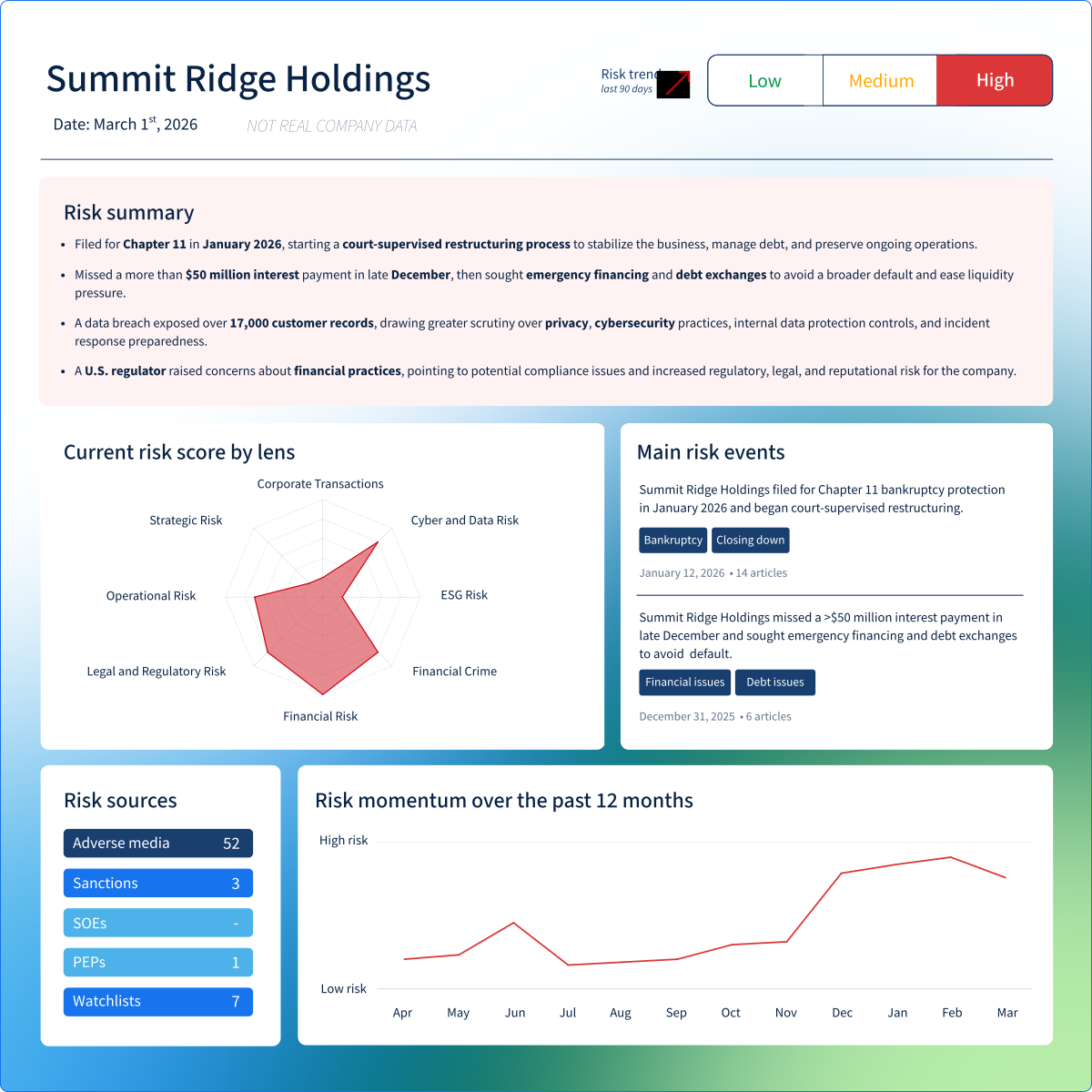
Owlin is the external risk intelligence platform that does the collecting, filtering, and scoring for you. Instead of stitching together separate feeds, your team gets one view of third-party risk across your whole vendor portfolio.
Here’s how it works:
- Broad, multilingual coverage. Owlin monitors 3 million+ global and local sources in multiple languages, across 240+ countries and territories.
- All signal types in one place. Adverse media, sanctions, PEPs, state-owned enterprises, watchlists and blacklists appear together on each company profile.
- Events, not article floods. The Event Detection Agent groups related articles and records into one risk event, so your analysts review one story instead of dozens of fragments.
- Explainable risk levels. The Risk Scoring Agent rates each company as high, medium, or low risk, and every score links back to the events and sources behind it.
- Built into your workflow. Owlin sends tailored email alerts when risk changes and feeds risk events into your TPRM or GRC platform via API, including through partners such as Venminder, Fitch Solutions and Aprovall.
Major financial institutions across the US and Europe, including banks, payment service providers and private equity firms, rely on Owlin to spot third-party risk early. Chartis Research has also recognized Owlin as a Category Leader in adverse media monitoring.
Want to see how it works on your own portfolio?
Request a demo, and we’ll show you how Owlin monitors your vendors across every risk signal.
FAQs about data sources for third-party risk monitoring
What data sources should a global automated risk monitoring system integrate with?
A global automated risk monitoring system should integrate adverse media, sanctions lists and watchlists, PEP and SOE data, regulatory and legal records, financial reports, cyber incident databases, geopolitical data and independent external ESG reports. It should also connect these external feeds to your internal vendor inventory and criticality tiers.
Which data source is most important for third-party risk monitoring?
Adverse media is usually the earliest warning signal, because issues appear in the news before they reach formal registers. However, sanctions and watchlist data remain mandatory for financial institutions. The strongest programs combine both rather than choosing one.
Why is local-language news important for global risk intelligence?
Risk events often surface first in local and regional outlets. If your monitoring only covers English-language international media, you may detect issues days or weeks late, especially for vendors in emerging markets.
How often should third-party risk data update?
As close to real time as possible. Adverse media and cyber threat data change hourly, while sanctions lists can update daily. Periodic or annual checks leave long windows where material risk goes undetected.
How does an automated risk monitoring system reduce false positives?
It filters out irrelevant mentions, merges coverage of the same development into one event, and scores events by severity. As a result, analysts only review risk that has actually changed.
Does automated risk monitoring help with DORA compliance?
Yes. DORA requires EU financial entities to monitor ICT third-party providers on an ongoing basis. Automated monitoring of cyber incidents, adverse media and regulatory signals, with a traceable audit trail, supports that obligation.
Sources
- Verizon. (2025). 2025 Data Breach Investigations Report. Verizon Business.
- European Parliament and Council. (2022). Regulation (EU) 2022/2554 on digital operational resilience for the financial sector (DORA). Official Journal of the European Union.
- CISA Cybersecurity Advisories.
- The GDELT Project.
- ACLED (Armed Conflict Location & Event Data).
- Owlin. (2026). The Complete Guide to Early Warning Gaps in TPRM.