Why Do Third-Party Risk Teams Miss Early Warning Signs?

Third-party risk teams miss early warning signs because most monitoring tools check vendors on a schedule, while vendor risk changes every day. On top of that, tools rely on closed databases, vendor self-reporting, and siloed alerts, so the first public signs of trouble rarely reach procurement in time.
The stakes keep rising. Verizon’s 2025 Data Breach Investigations Report found that third-party involvement in breaches doubled from 15% to 30% in a single year. Meanwhile, SecurityScorecard research shows that 98% of organizations have a relationship with at least one third party that suffered a breach.
For procurement and supply chain teams, that gap has a direct cost. A vendor can pass onboarding in January, face a regulatory investigation in April, and miss deliveries by June. If your next review sits in December, you find out last.
This guide explains why third-party risk teams struggle with monitoring tools, what causes early warning signs to slip through, and how continuous, outside-in risk intelligence closes those blind spots.
Key takeaways
- Periodic reviews create blind spots: risk moves daily, but most vendor reassessments happen once a year.
- Monitoring tools often depend on closed, English-heavy databases, so local and regional signals arrive late or never.
- Alert overload buries real signals. Analysts spend hours reading the same story from ten sources instead of acting.
- Siloed tools for adverse media, sanctions, and PEPs hide risk that only shows up when signals are combined.
- Vendor-reported data shows a vendor’s best face. Outside-in intelligence shows what the world reports about them.
- Continuous monitoring that groups signals into scored, explainable events helps procurement act weeks earlier.
What is third-party risk management monitoring?
Third-party risk management monitoring is the ongoing tracking of risk signals about the vendors, suppliers, and partners your business depends on. It runs between formal assessments and flags when a vendor’s risk profile changes.
In other words, assessment tells you what a vendor looked like on the day you checked. Monitoring tells you what it looks like today.
Those signals usually fall into five families:
- Financial distress: layoffs, missed filings, insolvency proceedings and credit downgrades.
- Legal and regulatory: lawsuits, enforcement actions, fines and license conditions.
- Sanctions, PEPs and state ownership: new sanctions designations, politically exposed persons and changes in state-owned enterprise links.
- Operational and cyber: data breaches, outages, plant closures and leadership exits.
- ESG and reputational: labor violations, environmental incidents, fraud and corruption allegations.
Most regulated enterprises already collect this information at onboarding. The challenge is keeping it current for hundreds or thousands of vendors at once.
Why do third-party risk teams struggle with monitoring tools?
Third-party risk teams struggle with monitoring tools because most tools were built for point-in-time due diligence, not continuous risk detection. As a result, they create five recurring problems.
1. They follow the calendar, not the news
Most TPRM programs reassess critical vendors once a year and lower-tier vendors even less often. That cadence works for questionnaires and contract reviews. However, an incident does not wait for your review date.
Think of it this way: a questionnaire is a scheduled pull. A lawsuit, a breach, or a sanctions designation is an unscheduled push. Unless your tool watches the outside world every day, it only sees what happened on review day.
2. Their source coverage is too narrow
Many monitoring tools draw on licensed, curated databases that refresh on a fixed schedule. These work well for structured data such as sanctions lists and court filings.
Still, early warning signs often appear first in local news, regional outlets, NGO reports and non-English media. For example, a labor investigation at a vendor’s factory in Vietnam may run in a Vietnamese daily weeks before it reaches an English wire service. If your tool doesn’t carry that source, the signal never reaches procurement.
3. They produce more alerts than teams can read
Wider coverage without smart filtering creates a different problem: noise. One development can produce dozens of articles, each landing as a separate alert. Analysts then spend their week reading the same story again and again instead of acting on it.
Eventually, teams start to tune alerts down or ignore them. That is exactly when a real early warning slips through.
4. They split signals across separate tools
Many enterprises run one tool for adverse media, another for sanctions, and a third for PEP screening. Each produces its own alerts, formats, and scores.
Consequently, nobody sees the full picture. A vendor can look clean in every silo while a minor news story, a regulatory notice, and a new ownership link quietly add up to a serious concern.
5. They sit outside procurement workflows
Even a good signal loses value if it lands in the wrong inbox. Risk insights often live in a separate dashboard that procurement and supply chain teams rarely open. By the time someone forwards the alert, the contract renewal or purchase order has already gone through.
What causes third-party risk management to miss early warning signs?
Third-party risk management misses early warning signs because of how programs are designed, not because teams lack effort. Four root causes show up again and again.
Programs are built for audits, not for detection
Many TPRM programs grew out of audit requirements. So they optimize for evidence: questionnaires completed, certificates filed, assessments logged. That proves due diligence happened. Yet it does little to spot a vendor’s deteriorating finances between review cycles.
Vendor-reported data drives decisions
Self-assessment questionnaires and trust center pages come from the vendor itself. Naturally, vendors show their best face. When teams treat that input as verified evidence, they miss everything the vendor chose not to mention, or doesn’t know yet.
Tiering leaves the long tail unwatched
To cope with volume, teams often monitor only their top-tier vendors closely. That makes sense on paper. In practice, though, disruption often starts with a smaller, less visible vendor. SecurityScorecard reports that less than half of organizations monitor even 50% of their extended supply chain for cyber threats.
Manual processes can’t keep up with scale
Spreadsheets, email follow-ups, and manual alert triage worked when portfolios held a few dozen vendors. Today, regulated enterprises manage hundreds or thousands of counterparties. As a result, reassessments pile up, alert queues grow, and signals sit unread.
It helps to remember how long problems can stay hidden. IBM’s Cost of a Data Breach report puts the average time to identify and contain a breach at 258 days. During that window, fragments of the story often surface publicly long before the vendor discloses anything.
Where do third-party risk monitoring blind spots form?
Blind spots form wherever a risk signal appears publicly before your monitoring setup is built to see it. The table below shows the most common risk detection gaps for procurement and supply chain teams.
| Early warning sign | Where it surfaces first | What periodic review sees | What continuous monitoring sees |
|---|---|---|---|
| Financial distress | Local business news, layoff reports, missed filings | A clean financial statement from last year | Layoffs and filing delays as they happen |
| Regulatory or enforcement action | Regulator notices, court records, 8-K filings | Nothing until the next questionnaire | The notice within hours or days |
| New sanctions designation | Updated sanctions lists | Status at onboarding only | Changes between review cycles |
| PEP or state ownership change | Government reshuffles, ownership news | A static ownership snapshot | The new link when it is reported |
| Labor or environmental violation | Regional and non-English media, NGO reports | A signed code of conduct | The local report, often weeks earlier |
| Gradual risk build-up | Several small signals across sources | Isolated items, if any | One combined, scored risk event |
The pattern is clear: periodic review looks backward, while continuous monitoring looks outward. Procurement needs both, but only one of them catches early warning signs.
How can procurement and supply chain teams close monitoring blind spots?
Procurement and supply chain teams close monitoring blind spots by adding a continuous, outside-in intelligence layer on top of their existing assessments. Here is what that looks like in practice.
Keep assessments, but add continuous monitoring between them
You don’t need to scrap questionnaires or onboarding checks. Instead, add a layer that watches every vendor every day and flags changes as they appear.
That way, a review is triggered by an event, not by the calendar. Owlin’s Monitoring runs around the clock across your full vendor portfolio, not only your top tier.
Look outside-in, not only inside-out
Outside-in risk intelligence starts with what the world reports about a vendor, independent of what the vendor says about itself. Adverse media, regulatory actions, sanctions updates, and ownership changes often appear long before a vendor discloses an issue.
Owlin scans more than 3 million global and local sources in multiple languages, covering 240+ countries and territories. So a story in a regional outlet can reach your team the same day it is published.
Turn alerts into events your team can act on
More sources should not mean more noise. Owlin’s Event Detection Agent groups related articles and signals into a single risk event, removes duplicates, and filters out irrelevant mentions. In short, Owlin does the reading, so your team reviews one clear story per development instead of dozens of fragments.
See every signal type in one view
Adverse media, sanctions, PEPs, state-owned enterprises, watchlists and blacklists belong on one vendor profile. When they sit together, gradual risk build-up becomes visible. Owlin brings these signals into a single view, so procurement no longer has to cross-reference separate tools.
Prioritize with explainable risk scores
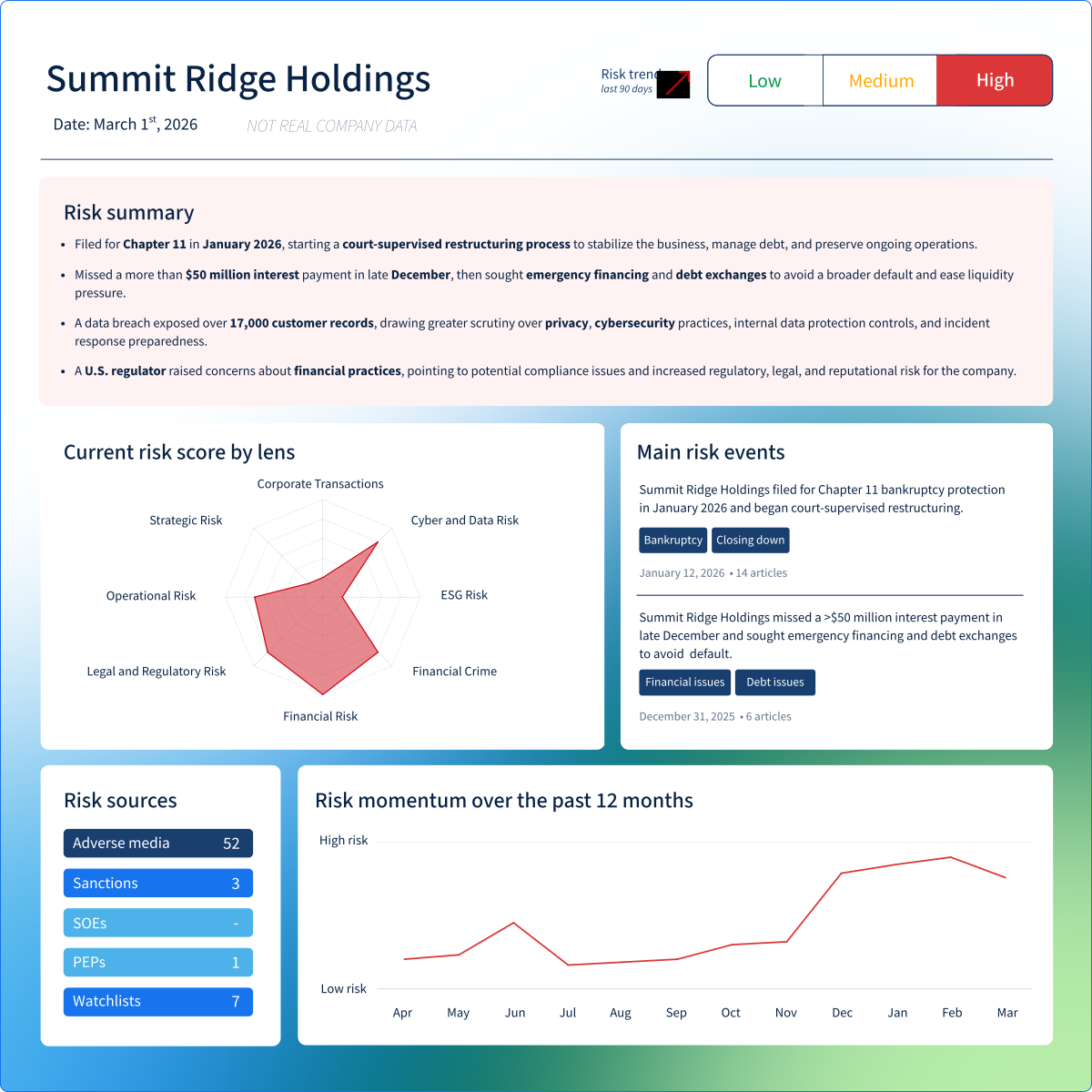
A sanctions hit on a critical vendor matters more than a minor news mention about a low-spend supplier. Owlin’s Risk Scoring Agent rates each vendor as high, medium, or low risk, and every score traces back to the underlying events and sources. As a result, buyers and risk owners can see why a vendor was flagged and defend that decision to auditors.
Push signals into the tools procurement already uses
Risk intelligence only helps if it reaches the person who owns the vendor relationship. Owlin delivers signals through email alerts and an API that feeds procurement, TPRM, and GRC platforms. Owlin also works with partners such as Venminder, Fitch Solutions and Aprovall. That way, an early warning lands in the workflow where sourcing and renewal decisions actually happen.
For a deeper look at the regulatory side, including DORA, CSDDD, and the German Supply Chain Act, read our complete guide to early warning gaps in TPRM.
How do you know if your third-party risk monitoring tools have blind spots?
Your monitoring tools likely have blind spots if you can’t answer these five questions with confidence:
- Time to detection: When a vendor makes the news, how long until your team knows? Hours are good. Weeks is a gap.
- Source coverage: Does your tool cover local, regional, and non-English sources, or mainly English-language wires?
- Signal-to-noise: How many alerts last month led to an actual decision? If the answer is “very few,” your team is sorting, not acting.
- Coverage depth: Are all vendors monitored continuously, or only the top tier?
- Workflow fit: Do alerts reach the buyer or vendor owner directly, or do they wait in a separate dashboard?
Not sure where your vendors stand today? Owlin’s free Risk Report shows the risk level, key risk events, and source-based evidence for a company you choose.
Closing the gap between signal and action
Third-party risk teams don’t miss early warning signs because they lack effort. They miss them because their tools check vendors on a schedule, read from narrow sources, flood teams with alerts, and keep signals in silos.
Fortunately, the fix doesn’t require replacing your TPRM program. It requires a continuous, outside-in layer that watches the world for you, groups signals into explainable events, and pushes them into procurement workflows.
That is exactly what Owlin does. Recognized by Chartis Research as a Category Leader in adverse media monitoring, Owlin helps banks, payment service providers, private equity firms, and other financial institutions across the US and Europe spot vendor risk early and act before it becomes their problem.
See your vendor blind spots in one demo
We’ll show you what continuous monitoring surfaces in your own vendor portfolio.
FAQs about third-party risk monitoring blind spots
Why do third-party risk teams struggle with monitoring tools?
Most monitoring tools were built for point-in-time due diligence. They reassess vendors on a schedule, rely on closed databases, produce too many duplicate alerts, and split signal types across separate tools. As a result, teams spend time sorting alerts instead of acting on real risk.
What causes third-party risk management to miss early warning signs?
Four root causes stand out: audit-first program design, reliance on vendor-reported data, monitoring only top-tier vendors, and manual processes that can’t scale. Together, they leave long windows where public risk signals go unseen.
What are early warning signs in supplier risk management?
Common early warning signs include layoffs, missed filings, lawsuits, enforcement actions, new sanctions designations, changes in PEP or state ownership links, data breaches, and labor or environmental violations. Many appear first in local or non-English media.
What is continuous monitoring in third-party risk management?
Continuous monitoring tracks external risk signals about vendors every day, between formal assessments. It flags changes as they happen, so a vendor review starts when an event occurs rather than on a fixed date.
How often should procurement teams monitor vendor risk?
Continuously. Annual or semi-annual reviews still matter for contracts and controls. However, risk events happen between them, so an automated monitoring layer should watch every vendor in the portfolio every day.
What should you look for in third-party risk monitoring tools?
Look for broad source coverage, including local and non-English media; grouping of related alerts into single events; all signal types in one view; explainable risk scores that trace back to sources; and integration with your procurement, TPRM, or GRC tools.
How does Owlin help close risk detection gaps?
Owlin monitors more than 3 million global and local sources, groups related signals into scored risk events, and explains every score with source evidence. It then delivers those signals through email alerts and an API, so early warnings reach procurement and risk teams where they already work.
Sources
- Verizon. (2025). 2025 Data Breach Investigations Report.
- SecurityScorecard. (2024). 98% of organizations have relationships with at least one breached third party.
- SecurityScorecard. Third-party risk management research.
- IBM. (2024). Cost of a Data Breach Report 2024.
- cloro. (2026). Third Party Risk Monitoring: The News Layer TPRM Misses.
- Diligent. (2025). Third-party risk management guide.
- Owlin. (2026). The Complete Guide to Early Warning Gaps in TPRM.