Alternatives to Annual Vendor Questionnaires

The best alternative to annual vendor questionnaires is continuous third-party risk monitoring: an always-on view of external signals such as adverse media, financial distress, sanctions, and regulatory action that flags vendor risk as it happens. Questionnaires still have a place, but they work best as a targeted follow-up when a signal appears, not as the main way you learn about a vendor once a year.
For third-party risk managers at banks and financial institutions, this shift matters. A vendor can pass its annual review in January and face a lawsuit, a data breach, or a liquidity crisis by March. With a yearly cycle, you may not find out until the next questionnaire lands, which creates exactly the kind of early warning gaps in TPRM that regulators and boards worry about. In this guide, we explain why the annual model falls short and walk through practical alternatives that give your team timely, actionable visibility.
Key takeaways
- Annual vendor questionnaires capture a single point in time, which leaves long blind spots between reviews.
- Continuous third-party risk monitoring tracks external signals every day, so your team hears about vendor risk when it happens.
- Event-triggered reassessments replace the calendar with real signals and cut questionnaire fatigue for vendors and analysts alike.
- Regulators increasingly expect ongoing monitoring and continuous oversight across the full vendor lifecycle.
- The strongest programs combine self-reported data, independent evidence, and real-time external intelligence.
Why annual vendor questionnaires fall short
Vendor questionnaires became the backbone of vendor risk management at financial institutions for good reasons. They are structured, auditable, and easy to standardize. However, they come with built-in limits that modern risk teams can no longer ignore.
They are a snapshot, not a stream. A questionnaire tells you what a vendor looked like on the day it filled in the form. Risk, on the other hand, changes daily. Leadership exits, enforcement actions, cyber incidents, and credit downgrades rarely line up with your review calendar.
They rely on self-reported answers. Vendors answer questionnaires themselves, and naturally they present themselves in the best light. As a result, a vendor risk assessment questionnaire rarely surfaces the issues a vendor would rather not mention, such as pending litigation or negative press.
They create fatigue on both sides. Vendors receive dozens of near-identical questionnaires every year. Meanwhile, your analysts spend weeks chasing responses and reviewing answers that often change very little year to year. That effort leaves less time for the vendors that actually need attention.
They miss the wider risk picture. Most questionnaires focus on security controls and policies. Yet many of the events that hurt financial institutions come from other directions: financial distress, financial crime allegations, ESG controversies, legal and regulatory action, or reputational damage.
What regulators expect: from periodic review to continuous oversight
Regulators have steadily moved away from “check once a year” thinking. In the US, the 2023 Interagency Guidance on Third-Party Relationships from the OCC, Federal Reserve, and FDIC describes ongoing monitoring as a core stage of the third-party risk management lifecycle. In Europe, the Digital Operational Resilience Act (DORA) asks financial entities to monitor ICT third-party risk on an ongoing basis.
In other words, regulators expect continuous oversight that matches the risk and criticality of each relationship. An annual questionnaire alone makes that hard to demonstrate. Therefore, many financial institutions now add continuous vendor risk monitoring to their programs so they can show examiners what they knew, when they knew it, and what they did next.
Seven practical alternatives to annual vendor questionnaires
You don’t need to scrap questionnaires overnight. Instead, the goal is to stop relying on them as your only source of truth. Below are seven practical alternatives, most of which work best together.
1. Continuous third-party risk monitoring of external signals
Continuous third-party risk monitoring tracks public and licensed sources such as news, regulatory announcements, court records, and sanctions lists for every vendor in your portfolio. Instead of waiting for a yearly update, your team receives alerts when something relevant happens. That is the core of continuous vendor monitoring: the vendor picture updates as the world changes, not when the calendar says so.
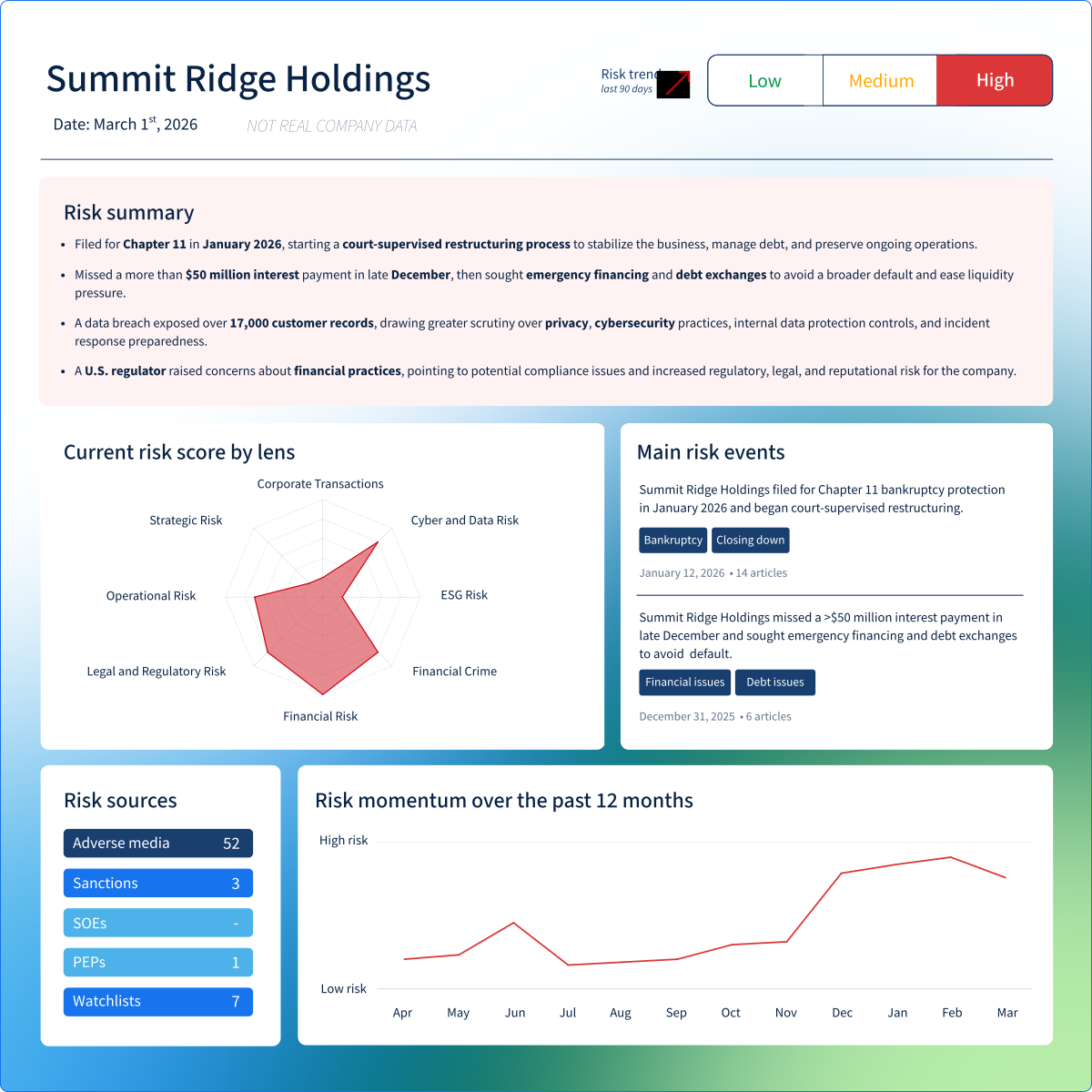
This approach covers the full range of external risk types, including financial, financial crime, corporate transactions, legal and regulatory, ESG, operational, strategic, cyber and data, and reputational risk. Because it relies on independent sources, it also surfaces the issues a vendor might leave out of its own answers.
The main challenge is noise. Raw news feeds generate far more alerts than any team can review. That is why AI-powered monitoring matters: it filters out irrelevant mentions, scores each event, and summarizes what happened, so analysts focus on decisions rather than reading.
2. Event-triggered reassessments
Next, replace the fixed calendar with triggers. When monitoring flags a meaningful event, such as a data breach, a change of ownership, or a regulatory fine, your team launches a targeted reassessment for that vendor only.
This turns the vendor questionnaire into a precise tool. Rather than sending 150 generic questions to every vendor, you ask five sharp questions about the specific issue that just appeared. Vendors respond faster, and your analysts spend time where the risk actually sits.
3. Risk-tiered review cycles
Not every vendor deserves the same level of scrutiny. A critical cloud provider and an office supplies vendor carry very different risks. Consequently, many financial institutions now set review depth and frequency by vendor criticality and inherent risk.
Continuous monitoring makes tiering more dynamic. When a low-tier vendor suddenly shows high-risk signals, it can move up a tier immediately rather than waiting for the next scheduled review.
4. Financial health monitoring
Financial distress often shows up in external signals long before a vendor admits it. Credit downgrades, missed payments, layoffs, restructuring news, and insolvency filings all point to rising counterparty risk.
Continuous counterparty risk monitoring helps you prepare contingency plans before a critical vendor fails. For example, an early warning about a vendor’s restructuring gives you time to review exit strategies, rather than scrambling after an outage.
5. Ongoing sanctions, watchlist, and regulatory screening
Sanctions lists, enforcement actions, and regulatory notices change constantly. A vendor that screened clean during supplier due diligence can appear on a list months later. Ongoing screening closes that gap and supports both TPRM and AML obligations, including perpetual KYC and KYB on corporate counterparties.
6. Evidence-based assessments instead of bespoke questionnaires
Where you still need control-level assurance, lean on independent evidence. ISO 27001 certifications, SOC 2 reports, penetration test summaries, and standardized frameworks such as the SIG questionnaire reduce the need for custom vendor security questionnaires and lengthy vendor due diligence questionnaires. They also give you third-party validation rather than self-reported claims.
Pair this evidence with continuous monitoring. Certifications show how a vendor designed its controls; external signals show whether something has gone wrong since.
7. Monitoring known fourth and fifth parties
Your vendors depend on their own vendors. When a key subcontractor fails, the impact flows straight to you. Extending monitoring to known fourth and fifth parties helps you spot concentration risk and supply chain disruption that a direct questionnaire would never reveal.
Annual questionnaires vs. continuous monitoring at a glance
| Annual vendor questionnaires | Continuous third-party risk monitoring | |
|---|---|---|
| Frequency | Once a year (or less) | Every day, 24/7 |
| Data source | Self-reported by the vendor | Independent external sources |
| Risk coverage | Mostly security and policy controls | Financial, financial crime, legal and regulatory, ESG, operational, strategic, cyber and data, and reputational risk |
| Time to detect an incident | Up to 12 months | As soon as it is reported |
| Analyst effort | High: chasing and reviewing responses | Focused: reviewing scored, summarized alerts |
| Vendor burden | High | Low: short, targeted questions only when an event occurs |
| Regulatory fit | Shows periodic review | Supports ongoing monitoring and continuous oversight |
How to move beyond the annual questionnaire
Shifting your third-party risk assessment model doesn’t require a big-bang change. Most teams follow a few simple steps:
- Start with critical vendors. Add continuous monitoring to the vendors that would hurt most if something went wrong.
- Define your triggers. Agree which events should prompt a reassessment, escalation, or exit review.
- Shorten your questionnaires. Keep the questions that evidence and monitoring can’t answer, and drop the rest.
- Connect signals to your workflow. Feed alerts into your existing TPRM or GRC platform, so your team works from one place.
- Expand coverage over time. Once the process runs smoothly, extend monitoring across your full vendor portfolio.
How Owlin supports continuous third-party risk monitoring
Owlin is the external risk intelligence platform for third-party risk monitoring, helping risk teams move from periodic reviews to continuous oversight. It monitors your entire vendor portfolio between reviews, across global news, sanctions, PEPs, and watchlists, with no limit on the number of third parties. In fact, 92% of Owlin clients monitor beyond their critical vendors. Major financial institutions across the US and Europe, including banks, payment service providers, and private equity firms, rely on Owlin, and Chartis Research has named Owlin a Category Leader in Adverse Media Monitoring Solutions in 2024, 2025, and 2026.
Owlin turns millions of sources into relevant, scored risk events. It filters out irrelevant reporting and groups related coverage into a single event, so analysts review what matters instead of reading the same story ten times. Each vendor receives a clear high, medium, or low risk level across financial, financial crime, corporate transactions, legal and regulatory, ESG, operational, strategic, and cyber and data risk, as well as reputational risk. Moreover, every score traces back to its events, reasoning, and original sources, so your team can explain each decision to auditors. The result: 4–8 weeks earlier warning and 84% less time spent per alert.
Owlin handles the monitoring and initial analysis, while your team stays in control of what to investigate, escalate, or act on. You also choose how insights reach you: through the Owlin Dashboard, Intelligent Alerts in email, Slack or Microsoft Teams, or integrations via API, MCP or JSON that feed risk signals into your TPRM, GRC and procurement platforms. In short, your team knows what is happening with every vendor, not just once a year.
See continuous third-party risk monitoring in action
Find out how Owlin flags vendor risk the moment it happens, with less noise and clear explanations.
Frequently asked questions
What is the best alternative to annual vendor questionnaires?
Continuous third-party risk monitoring is the most effective alternative. It tracks external signals such as adverse media, financial distress, sanctions, and regulatory action every day, so your team learns about vendor risk as it happens rather than once a year.
Should financial institutions stop using vendor questionnaires completely?
No. Questionnaires remain useful for documenting controls and gathering information only the vendor can provide. However, they work best as a targeted follow-up when monitoring flags an issue, combined with independent evidence such as ISO 27001 certifications and independent audit reports.
What is continuous oversight in third-party risk management?
Continuous oversight means monitoring vendor relationships throughout their lifecycle rather than only at onboarding and annual review. Regulators, including US banking agencies under the 2023 Interagency Guidance and EU authorities under DORA, expect this kind of ongoing monitoring, proportionate to each vendor’s risk and criticality.
How does continuous monitoring reduce vendor questionnaire fatigue?
Continuous monitoring answers many risk questions from external data, so you need fewer and shorter questionnaires. Instead of sending long annual forms to every vendor, you send short, specific questions only when a real event occurs.
What risks can continuous third-party risk monitoring detect?
It can detect financial distress, financial crime allegations, mergers and acquisitions, legal and regulatory action, ESG controversies, operational disruptions, strategic changes, cyber incidents and data breaches, and reputational issues affecting your vendors and known fourth and fifth parties.