Continuous Vendor Monitoring: A Practical Playbook for Financial Institutions

Continuous vendor monitoring is the ongoing, automated tracking of external risk signals on your vendors between scheduled reviews. Instead of learning about a problem at the next annual assessment, your team is alerted when something changes, and can decide what to do while it still matters.
Most risk teams already agree that continuous risk monitoring beats a review calendar. The harder part is making it work day to day: deciding what to watch, which events should trigger a reassessment, and who acts on an alert. This playbook covers those three questions.
Key takeaways
- Scope monitoring by vendor criticality, but cover your whole portfolio, not only tier 1.
- Watch every risk lens, not just cyber or sanctions. Most early warnings show up first in the news.
- Agree on reassessment triggers in advance, so a high-risk event leads to action, not a debate.
- Route alerts to named owners with clear response times, and document every decision.
Step 1: Decide which vendors to monitor, and how closely
Start from your existing vendor risk tiering. Critical vendors, those supporting important business services or holding customer data, need the closest watch and the fastest escalation. But don’t stop there. Risk often surfaces in the long tail of smaller vendors that never get a full review.
A practical setup:
| Vendor tier | Monitoring | Who reviews alerts |
|---|---|---|
| Critical | All risk lenses, all severities | Vendor owner and TPRM team, same day |
| High | All risk lenses, medium and high severity | TPRM team, within a few working days |
| Standard | All risk lenses, high severity only | TPRM team, as part of the regular cycle |
Step 2: Define what to watch across every risk lens
A vendor rarely fails without warning. The signals are usually public before they show up in a questionnaire: a lawsuit, a regulator’s statement, a data breach, a wave of layoffs. Monitoring only one risk type, such as cyber ratings or sanctions lists, leaves the rest of the picture dark.
Owlin groups external risk into eight lenses. Use them as a checklist for vendor risk monitoring:
| Risk lens | Signals to watch |
|---|---|
| Financial Risk | Insolvency, missed payments, credit downgrades, going-concern warnings, sudden layoffs |
| Legal and Regulatory Risk | Lawsuits, fines, regulatory investigations, license issues |
| ESG Risk | Environmental incidents, labor and human rights issues, governance failures |
| Operational Risk | Outages, production stops, supply disruptions, key-person departures |
| Strategic Risk | Major strategy shifts, loss of key customers, market exits |
| Cyber and Data Risk | Data breaches, ransomware attacks, exposed customer data |
| Financial Crime Risk | Fraud, bribery, money laundering allegations, sanctions exposure |
| Corporate Transactions Risk | Mergers, acquisitions, ownership changes, divestments |
Coverage matters as much as the checklist. A vendor’s first warning sign often appears in local news or a regional regulator’s notice, so your sources need to span the geographies your vendors operate in. Adverse media monitoring is usually where that coverage comes from.
Step 3: Set reassessment triggers for vendor monitoring alerts
An alert is only useful if your team knows what it means for the vendor relationship. Set the rules in advance, and get them signed off by the risk owner, so nobody has to debate them under pressure.
| Risk level of the event | Default action | Example |
|---|---|---|
| High | Immediate review, escalate to vendor owner, consider an ad hoc reassessment | Regulator opens an investigation into a critical vendor |
| Medium | Review within the agreed time, add to the vendor file, watch for follow-up events | A vendor discloses a data breach that didn’t affect your data |
| Low | Log it and review at the next scheduled assessment | A vendor announces a minor leadership change |
Two rules make this work in practice. First, repeated medium events on the same vendor should count as a high trigger. Second, every trigger should lead to a recorded decision, even if the decision is to take no action. For more on moving from annual questionnaires to event-driven reviews, see Alternatives to Annual Vendor Questionnaires.
Step 4: Route vendor monitoring alerts to the right people
Monitoring fails when alerts land in a shared inbox nobody owns. Build a simple escalation path:
- Detect: monitoring flags a new event on a vendor and rates its risk level.
- Triage: the TPRM team checks the evidence and confirms the event is relevant.
- Escalate: high-risk events go to the vendor owner and, for critical vendors, the risk committee.
- Act: the owner decides: no action, request more information, reassess, or start an exit plan.
- Record: the decision and its reasoning go into the vendor file.
Deliver alerts where your team already works: email, Slack or Microsoft Teams, or straight into your TPRM or GRC platform, so nobody has to check yet another dashboard.
Step 5: Document it for auditors and regulators
Regulators increasingly expect ongoing oversight of third parties, not just checks at onboarding. In the US, the Interagency Guidance on Third-Party Relationships describes ongoing monitoring as part of the third-party risk management lifecycle, and in the EU, DORA sets requirements for managing ICT third-party risk. You can read the full texts in OCC Bulletin 2023-17 and Regulation (EU) 2022/2554.
Your monitoring records are your evidence. For each alert, keep the event, its source, the risk level, who reviewed it, the decision, and the date. That record shows you monitored continuously and acted on what you found.
Common mistakes to avoid
- Monitoring only tier 1 vendors. Smaller vendors can still cause big problems.
- Watching one risk type. A clean cyber rating says nothing about a pending lawsuit.
- Too many alerts. If every news mention becomes an alert, your team will start ignoring them. Filter out irrelevant noise and rate what’s left. Our post on why third-party risk teams miss early warning signs covers how to cut the noise.
- No owner. An alert without a named owner and deadline usually goes nowhere.
How Owlin supports continuous vendor monitoring
Owlin is the external risk intelligence platform that provides third-party risk monitoring for your vendors 24/7 across all eight risk lenses. The Event Detection Agent flags new risk events across multiple geographies, the Risk Scoring Agent rates each one high, medium, or low and shows the evidence behind it, and the 360° Summary Agent turns each vendor’s events into a clear timeline. Every step follows Owlin’s Responsible Intelligence principles, so your team can see why a score was given and make the final call.
Signals reach your team through the dashboard, through Intelligent Alerts by email, Slack, or Microsoft Teams, or through integrations with the TPRM and GRC platforms you already use. Comparing tools? See 6 Best TPRM Software for Continuous Monitoring.
See what continuous monitoring finds on one of your vendors
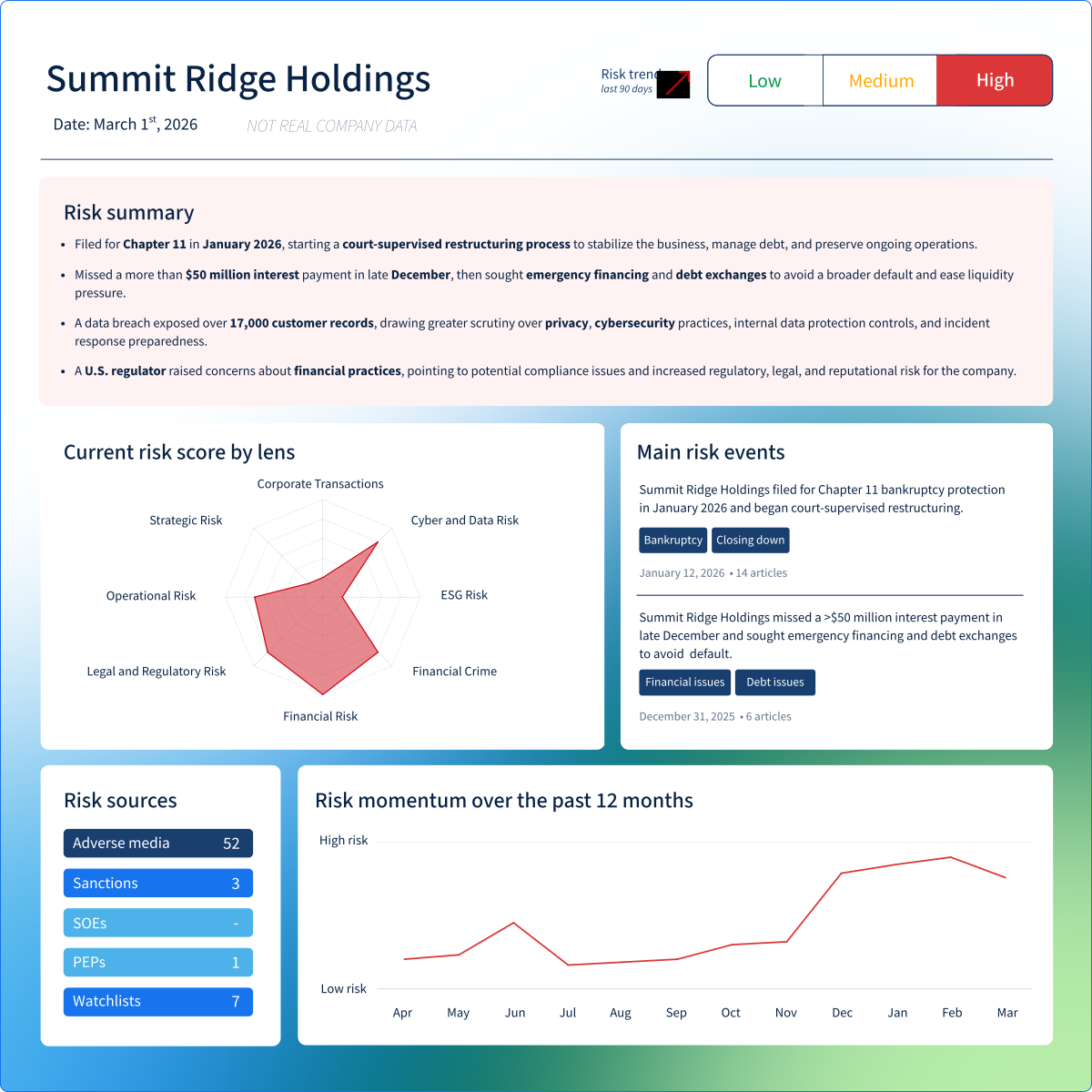
Get a free risk report on one of your vendors. You’ll see its risk score, a short summary, the main risk events Owlin found, how they spread across the eight risk lenses, and how the vendor’s risk has changed over time.
FAQs about continuous vendor monitoring
Continuous vendor monitoring is the ongoing, automated tracking of external risk signals on your vendors between scheduled reviews. It alerts your team when a relevant event happens, such as a lawsuit, data breach, or sanctions listing.
A vendor risk assessment is a point-in-time review, usually at onboarding and then once a year. Continuous monitoring covers the time in between and can trigger an earlier reassessment when a high-risk event occurs.
Monitor every risk lens: financial, legal and regulatory, ESG, operational, strategic, cyber and data, financial crime, and corporate transactions. Most early warnings appear first in the news and public records.
Agree on triggers in advance. High-risk events, such as a regulatory investigation or a major data breach at a critical vendor, should trigger an immediate review. Repeated medium-risk events on the same vendor should be treated as high risk.
Monitor all of them, but adjust how closely. Critical vendors get every alert and same-day review, while standard vendors can be limited to high-risk alerts.
Filter out irrelevant news, rate each event by risk level, and send only the alerts that match each vendor’s tier. Explainable risk scores help teams trust and act on what they receive.
Regulators increasingly expect ongoing third-party oversight, for example under the US Interagency Guidance on Third-Party Relationships and the EU’s DORA. Continuous monitoring, with documented decisions, is a practical way to show that oversight.